Skip to content
  • Blog Home
  • Cyber Map
  • About Us – Contact
  • Disclaimer
  • Terms and Rules
  • Privacy Policy
Cyber Web Spider Blog – News

Cyber Web Spider Blog – News

Globe Threat Map provides a real-time, interactive 3D visualization of global cyber threats. Monitor DDoS attacks, malware, and hacking attempts with geo-located arcs on a rotating globe. Stay informed with live logs and archive stats.

  • Home
  • Cyber Map
  • Cyber Security News
  • Security Week News
  • The Hacker News
  • How To?
  • Toggle search form

Cisco Desk, IP, and Video Phone Vulnerabilities Let Remote Attackers Trigger DoS And XSS Attacks

Posted on October 17, 2025October 17, 2025 By CWS

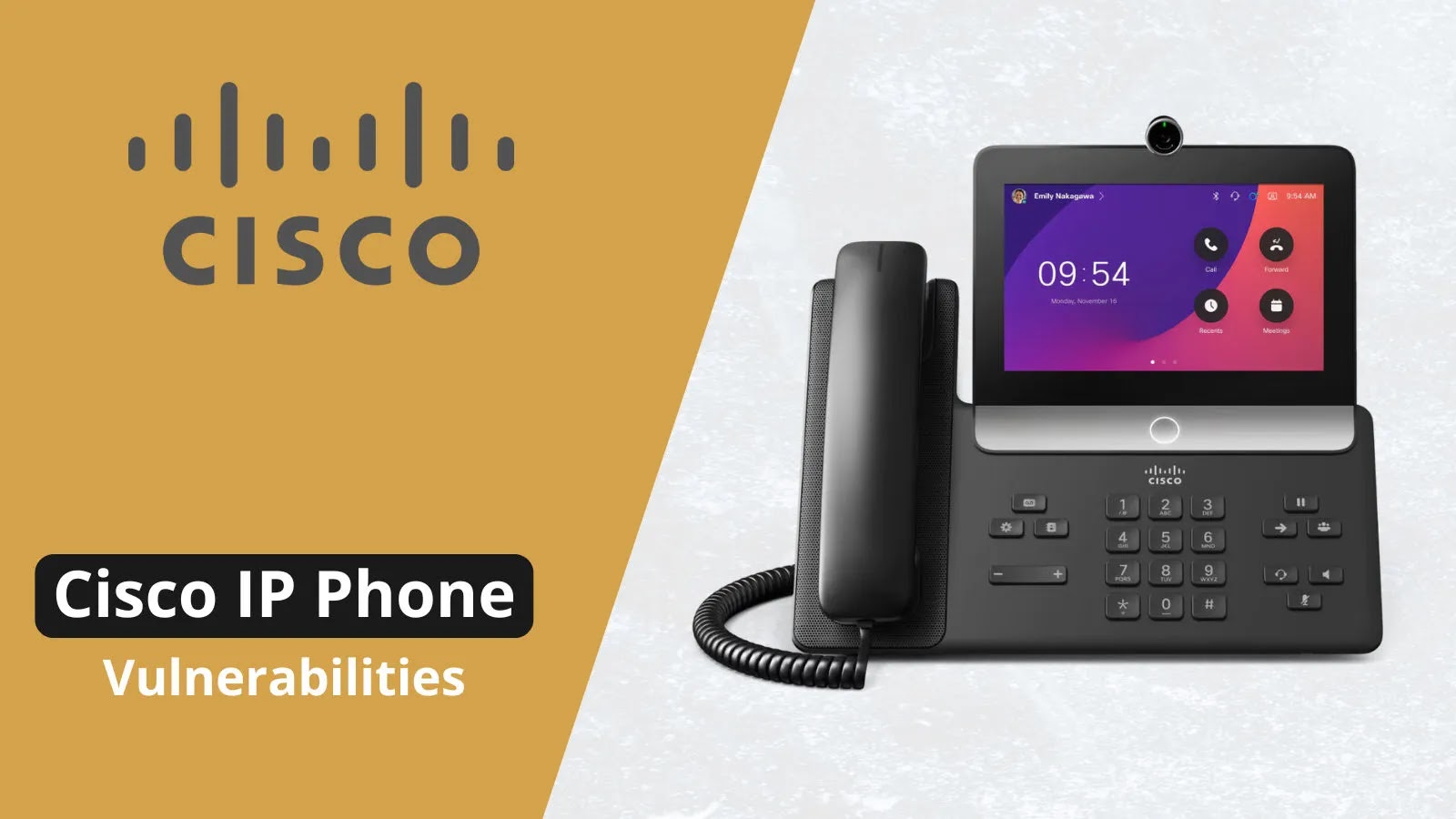
Cisco has issued a safety advisory warning of a number of vulnerabilities in its Desk Telephone 9800 Collection, IP Telephone 7800 and 8800 Collection, and Video Telephone 8875 fashions working Cisco Session Initiation Protocol (SIP) Software program.

Printed on October 15, 2025, the advisory particulars dangers that would allow unauthenticated distant attackers to set off denial-of-service (DoS) circumstances or cross-site scripting (XSS) assaults through the units’ net person interface.

These flaws have an effect on telephones registered to Cisco Unified Communications Supervisor (CUCM) with Net Entry enabled, a characteristic disabled by default to attenuate publicity.

DoS Vulnerability Poses Excessive Threat To Gadget Stability

The first concern is CVE-2025-20350, a high-severity buffer overflow flaw rated at a CVSS 3.1 rating of seven.5. This vulnerability arises when affected units course of crafted HTTP packets, probably inflicting the cellphone to reload and disrupt operations.

Attackers want no privileges and might exploit it over the community with low complexity, resulting in the non permanent unavailability of communication providers.

Cisco hyperlinks this to a number of bug IDs, together with CSCwn51601, emphasizing its impression on enterprise telephony environments. A secondary situation, CVE-2025-20351, introduces a medium-severity XSS vulnerability with a CVSS rating of 6.1.

As a consequence of insufficient enter validation within the net UI, attackers can inject malicious scripts by tricking customers into clicking crafted hyperlinks.

Profitable exploitation may steal session knowledge or manipulate the interface, although it requires person interplay. Related bugs embody CSCwn51683, highlighting persistent weaknesses in net dealing with.

These vulnerabilities goal particular Cisco SIP Software program releases throughout the talked about cellphone sequence, excluding these on Multiplatform Firmware, reads the advisory.

Exploitation hinges on Net Entry being lively and CUCM registration, circumstances not met in normal setups. No public exploits or malicious makes use of have been reported, however organizations with enabled net options face elevated dangers in unified communications networks.

Mitigations

Cisco offers no direct workarounds past disabling Net Entry by way of CUCM administration or the Bulk Administration Instrument, which directors can confirm by checking the cellphone’s IP in a browser.

Fastened releases embody SIP Software program 3.3(1) for Desk Telephone 9800 and Video Telephone 8875, 14.3(1)SR2 for IP Telephone 7800/8800, and 11.0(6)SR7 for IP Telephone 8821.

Customers ought to improve promptly to avert potential disruptions, as these patches absolutely handle the failings with out impacting core performance.

Observe us on Google Information, LinkedIn, and X for each day cybersecurity updates. Contact us to characteristic your tales.


Cyber Security News Tags:Attackers, Attacks, Cisco, Desk, DoS, Phone, Remote, Trigger, Video, Vulnerabilities, XSS

Post navigation

Previous Post: Researchers Uncover WatchGuard VPN Bug That Could Let Attackers Take Over Devices
Next Post: ‘Highest Ever’ Severity Score Assigned by Microsoft to ASP.NET Core Vulnerability

Related Posts

Cybersecurity Industry Gains $1.7 Billion to Develop Cutting-Edge Protection Technologies Cyber Security News
8 New Malicious Firefox Extensions Steal OAuth Tokens, Passwords, and Spy on Users Cyber Security News
Microsoft Azure API Management Flaw Enables Cross-Tenant Account Creation, Bypassing Admin Restrictions Cyber Security News
Why Cross-Training in Networking and Cybersecurity Matters Cyber Security News
KimJongRAT Attacking Windows Users via Weaponized .hta Files to Steal Logins Cyber Security News
Germany Urges Apple, Google to Block Chinese AI App DeepSeek Over Privacy Rules Cyber Security News

Categories

  • Cyber Security News
  • How To?
  • Security Week News
  • The Hacker News

Recent Posts

  • New FvncBot Android Banking Attacking Users to Log Keystrokes and Inject Malicious Payloads
  • Researchers Uncover 30+ Flaws in AI Coding Tools Enabling Data Theft and RCE Attacks
  • Critical React2Shell Flaw Added to CISA KEV After Confirmed Active Exploitation
  • Researchers Hack Google’s Gemini CLI Through Prompt Injections in GitHub Actions
  • 2.15M Web Services Running Next.js Exposed Over Internet, Active Exploitation Underway – Patch Now

Pages

  • About Us – Contact
  • Disclaimer
  • Privacy Policy
  • Terms and Rules

Archives

  • December 2025
  • November 2025
  • October 2025
  • September 2025
  • August 2025
  • July 2025
  • June 2025
  • May 2025

Recent Posts

  • New FvncBot Android Banking Attacking Users to Log Keystrokes and Inject Malicious Payloads
  • Researchers Uncover 30+ Flaws in AI Coding Tools Enabling Data Theft and RCE Attacks
  • Critical React2Shell Flaw Added to CISA KEV After Confirmed Active Exploitation
  • Researchers Hack Google’s Gemini CLI Through Prompt Injections in GitHub Actions
  • 2.15M Web Services Running Next.js Exposed Over Internet, Active Exploitation Underway – Patch Now

Pages

  • About Us – Contact
  • Disclaimer
  • Privacy Policy
  • Terms and Rules

Categories

  • Cyber Security News
  • How To?
  • Security Week News
  • The Hacker News

Copyright © 2025 Cyber Web Spider Blog – News.

Powered by PressBook Masonry Dark