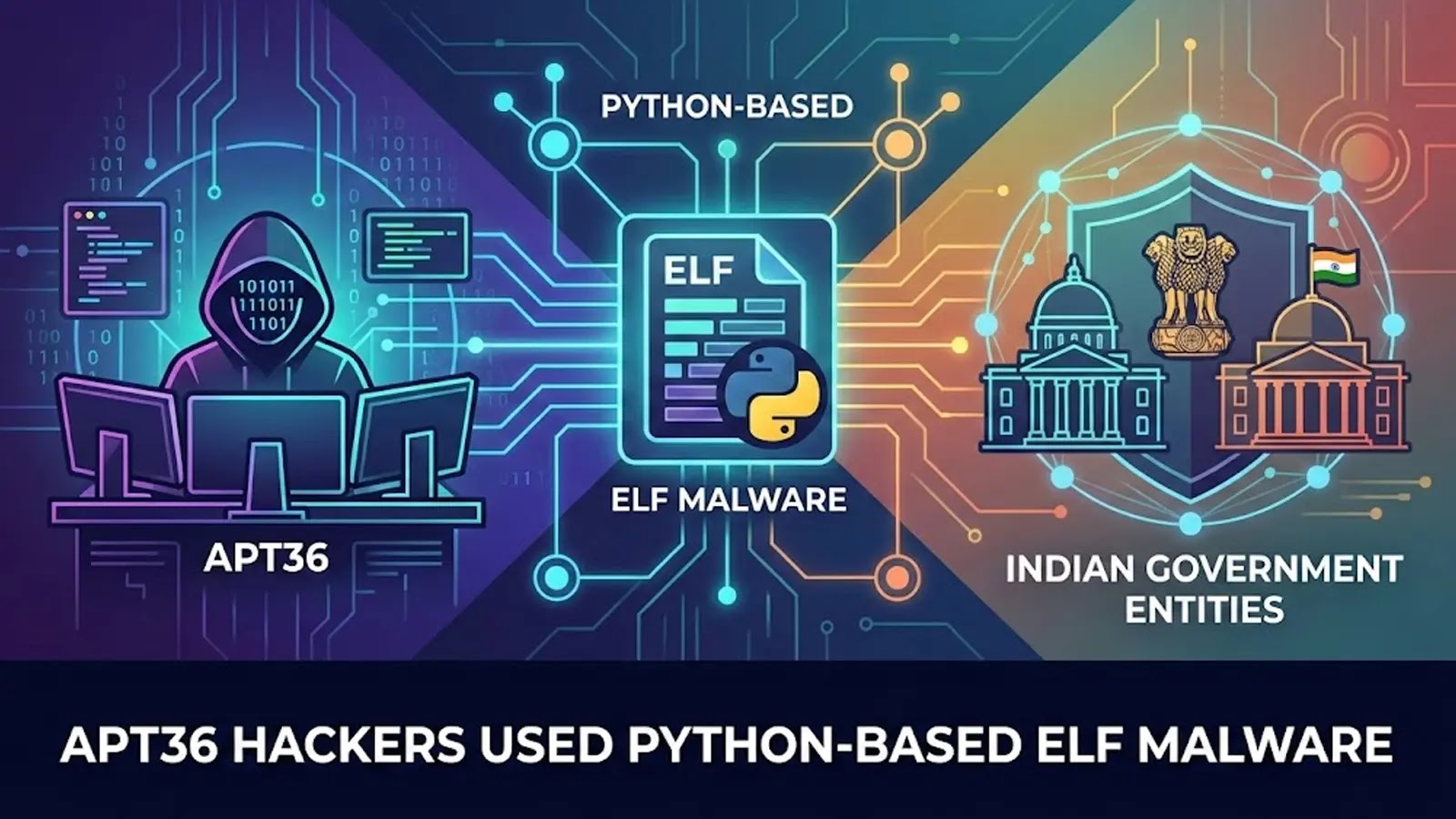
Pakistan-based menace actor APT36, also called Clear Tribe, has launched a complicated cyber-espionage marketing campaign in opposition to Indian authorities establishments utilizing a newly developed Python-based ELF malware.
The assault marks a big escalation within the group’s capabilities, demonstrating their rising technical maturity and adaptableness to Linux-based working techniques.
The marketing campaign facilities on spear-phishing emails containing weaponized Linux shortcut recordsdata designed to deceive authorities staff.
When recipients extract and open these recordsdata, the malware silently downloads and executes malicious parts within the background whereas displaying seemingly innocent content material to the consumer.
This dual-layer method permits the attackers to take care of stealth whereas establishing persistent entry to crucial infrastructure. APT36’s shift towards Linux focusing on represents a strategic evolution of their operational doctrine.
The group has traditionally centered on Home windows-based assaults, however this new marketing campaign reveals their dedication to focusing on the BOSS working system, which is extensively deployed throughout Indian authorities companies.
By adapting their instruments to take advantage of a number of platforms, the menace actors considerably develop their assault floor and operational effectiveness.
Cyfirma safety analysts recognized the malware after discovering the weaponized .desktop recordsdata being distributed by way of focused phishing campaigns.
Analysis_Proc_Report_Gem.desktop (Supply – Cyfirma)
The researchers famous that the an infection chain begins with a misleading archive file containing the malicious shortcut, which triggers a multi-stage payload supply course of.
As soon as executed, the shortcut downloads a decoy PDF doc to distract the consumer whereas concurrently fetching and putting in the precise ELF malware payload from attacker-controlled servers.
Malware’s an infection mechanism
The malware’s an infection mechanism depends on .desktop recordsdata as middleman supply vectors, permitting the menace actors to hide their malicious intent whereas sustaining flexibility in payload deployment.
Not like instantly transmitting ELF binaries, which safety techniques can extra simply detect, .desktop recordsdata seem reliable to Linux customers whereas working embedded instructions.
Supply code of the bash file (Supply – Cyfirma)
This method permits dynamic payload retrieval and considerably reduces forensic proof.
Malicious 64-bit ELF (Supply – Cyfirma)
Evaluation of the extracted malware reveals a feature-rich distant entry instrument able to executing arbitrary shell instructions, establishing command-and-control communication, capturing screenshots, and exfiltrating information.
Shell Instructions (Supply – Cyfirma)
The malware makes use of systemd user-level providers to determine persistence, guaranteeing it continues working throughout system reboots and consumer periods.
Researchers found that the menace actor strategically makes use of the .desktop file format mixed with shell script execution to bypass conventional safety controls and preserve undetected presence.
The marketing campaign infrastructure makes use of just lately registered domains and compromised servers situated in a number of nations.
The malicious area lionsdenim[.]xyz, registered simply 22 days prior, mixed with IP tackle 185.235.137.90 in Frankfurt, facilitates payload supply.
Indian authorities companies ought to implement rapid mitigation measures, together with enhanced e-mail safety, endpoint detection and response options, and strict utility authorization insurance policies to counter this persistent menace.
Observe us on Google Information, LinkedIn, and X to Get Extra Prompt Updates, Set CSN as a Most well-liked Supply in Google.