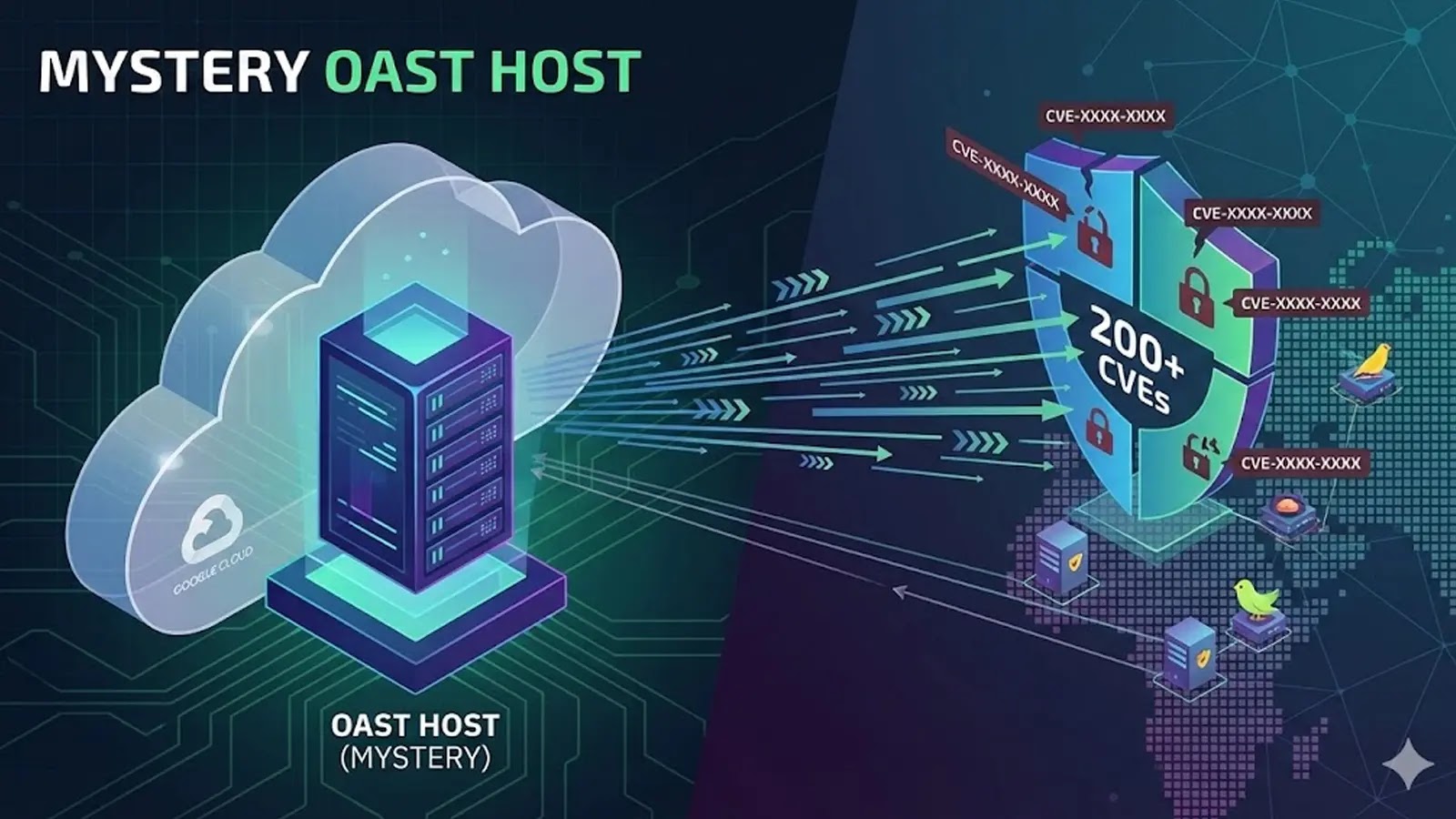
A brand new risk has emerged within the cybersecurity panorama as safety specialists uncover a non-public Out-of-Band Software Safety Testing (OAST) service working on Google Cloud infrastructure.
This thriller operation stands out from typical exploit scanning actions as a result of it makes use of customized infrastructure somewhat than counting on public companies. The attackers have been operating a centered marketing campaign that targets particular areas with over 200 totally different vulnerabilities.
Between October and November 2025, researchers noticed roughly 1,400 exploit makes an attempt spanning greater than 200 CVEs linked to this operation.
In contrast to most attackers who use public OAST companies like oast.enjoyable or work together.sh, this risk actor operates their very own personal OAST area at detectors-testing.com.
This uncommon setup caught consideration when callbacks began showing to subdomains of i-sh.detectors-testing.com, a website not related to any recognized OAST supplier or in style scanning framework.
VulnCheck safety researchers recognized this operation after noticing uncommon patterns of their Canary Intelligence visitors.
The marketing campaign combines normal Nuclei scanning templates with customized payloads to develop their attain. What makes this operation significantly fascinating is that each one noticed exercise focused programs deployed in Brazil, suggesting a transparent regional focus.
Whereas the identical attacker IP addresses have been flagged in Serbia and Turkey by AbuseIPDB stories, VulnCheck’s dataset confirmed exercise concentrated completely on Brazilian targets.
The infrastructure behind this operation consists of a number of Google Cloud IP addresses, with six addresses used as exploit scanners and one because the OAST host.
Utilizing Google Cloud offers sensible benefits for attackers since defenders not often block main US cloud suppliers, and visitors to Google networks simply blends with regular background communication.
The operation has been operating since at the very least November 2024, indicating a long-term sustained effort somewhat than fast opportunistic scans.
Proof from an open listing on port 9000 revealed a modified Java class file known as TouchFile.class, initially documented in Fastjson 1.2.47 exploitation examples.
The attackers prolonged the essential model to simply accept customized instructions and HTTP requests by parameters, displaying they actively modify publicly out there exploit instruments somewhat than utilizing them unchanged.
The decompiled code exhibits that if no parameters are offered, it runs a default command to the touch /tmp/success3125, however when cmd or http parameters are current, it executes these instructions or makes outbound HTTP requests as an alternative.
Technical Breakdown of the Exploit Mechanism
The attackers use a mixture of present and outdated Nuclei templates to probe for vulnerabilities. One instance is the outdated grafana-file-read.yaml template, which was faraway from the official nuclei-templates repository in early October 2025.
Discovering this older template in energetic use suggests the attackers both use third-party Nuclei-based scanners like dddd or just haven’t up to date their scanning instruments.
This mixture of outdated and new templates helps them solid a wider web throughout totally different vulnerability sorts.
Open listing on port 9000 hosts a Java class file (Supply – VulnCheck)
The exploit payloads comply with an ordinary sample the place profitable exploitation triggers the compromised host to make HTTP requests again to the attacker-controlled OAST subdomains.
As an example, in an try in opposition to CVE-2025-4428 affecting Ivanti Endpoint Supervisor Cell, the payload would power the sufferer system to contact d4bqsd6e47mo47d93lpgq55d3j111y6em.i-sh.detectors-testing.com.
This callback mechanism permits attackers to confirm which programs are weak while not having direct entry, making detection tougher for defenders.
The OAST host at 34.136.22.26 constantly presents Interactsh companies throughout ports 80, 443, and 389, confirming its function as a devoted command and management endpoint for accumulating exploit verification callbacks from compromised programs worldwide.
Observe us on Google Information, LinkedIn, and X to Get Extra Instantaneous Updates, Set CSN as a Most well-liked Supply in Google.