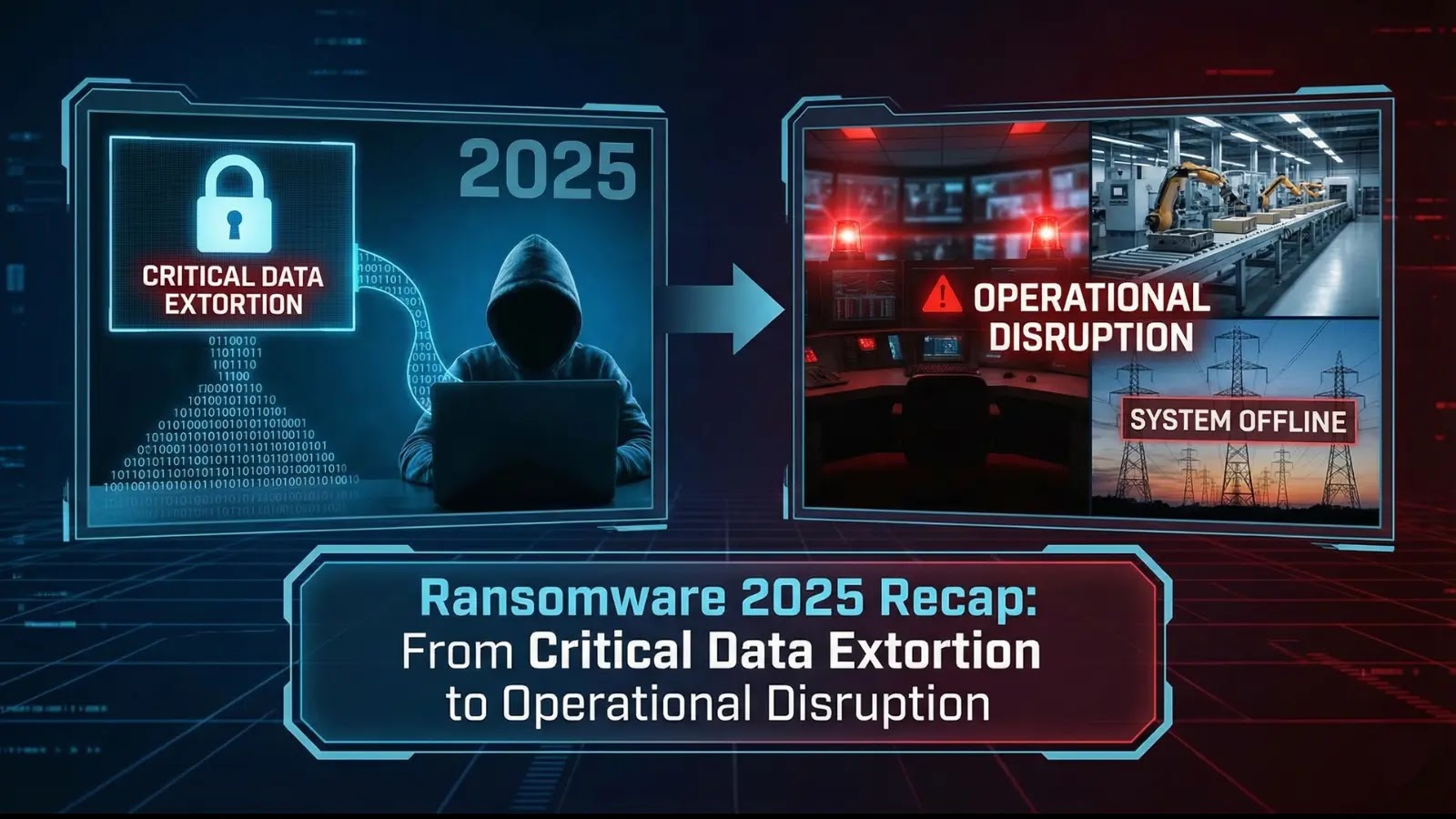
The ransomware panorama in 2025 has reached new heights, evolving from a cybersecurity challenge right into a strategic menace to nationwide safety and world financial stability.
This yr noticed a 34%-50% surge in assaults in contrast with 2024, with 4,701 confirmed incidents globally between January and September alone, underscoring ransomware as one of the persistent and devastating cyber threats in trendy historical past.
Nevertheless, beneath the floor of those alarming statistics lies a paradox: whereas assault volumes have soared, ransom fee charges have plummeted to historic lows of 23-25%, forcing menace actors to reimagine their enterprise fashions and extortion techniques essentially.
Ransomware assault panorama (picture: cybersecuritynews.com)
The yr 2025 has been characterised by a dramatic fragmentation of the ransomware ecosystem following legislation enforcement disruptions of main operations corresponding to LockBit and ALPHV/BlackCat, leading to 45 newly noticed teams and pushing the full variety of energetic extortion operations to a record-breaking 85 distinct menace actors.
This decentralization has coincided with refined evolutions in assault methodologies, together with the widespread adoption of double and triple extortion techniques, AI-enhanced phishing campaigns, and focused exploitation of cloud infrastructure and operational expertise methods.
Most regarding has been the deliberate concentrating on of essential infrastructure sectors, with manufacturing, healthcare, power, transportation, and finance accounting for 50% of all assaults, demonstrating how ransomware has transcended its prison origins to change into a weapon able to destabilizing whole industries and threatening public security.
The 2025 Ransomware Menace Panorama
Unprecedented Assault Quantity and World Attain
The ransomware financial system in 2025 skilled a watershed second, marked by unprecedented assault frequency and collapsing monetary returns for cybercriminals. Between January and September 2025, researchers documented 4,701 confirmed ransomware incidents worldwide, representing a 34% improve over the identical interval in 2024.
By October, the cumulative whole reached 6,330 circumstances uncovered on darkish net leak websites, a staggering 47% improve from the 4,293 circumstances recorded throughout the equal timeframe in 2024. This surge resulted in organizations experiencing a median of 1,984 cyberattacks per week in Q2 2025, with ransomware accounting for a major share of those assaults.
Month-to-month traits revealed sustained escalation all year long. Ransomware assaults climbed to 623 incidents in October 2025 alone, up greater than 30% from September and representing the second-highest month-to-month whole on document, exceeded solely by February 2025’s peak.
This marked the sixth consecutive month-to-month improve in ransomware exercise, underscoring the persistent and accelerating nature of the menace. The worldwide cadence of assaults reached such depth that by Q3 2025, a company someplace on this planet fell sufferer to ransomware roughly each 19 seconds on common.
Geographic concentrating on remained closely concentrated in economically developed nations. The US continued to bear the brunt of worldwide ransomware exercise, accounting for roughly 1,000 incidents, roughly 21% of all assaults in 2025.
Ransomware Assault Quantity (picture: cybersecuritynews.com)
Following the US, Canada skilled 361 assaults, the second-most of any nation, adopted by Germany, the UK, and Italy.
Of specific concern was the emergence of Australia as a top-five goal, with the nation experiencing a 67% improve in total assault numbers as its wealthy sources and excessive per-capita GDP made it an more and more engaging goal for menace actors.
The Cost Price Collapse: A Disaster for Cybercriminals
Whereas assault volumes soared, the ransomware enterprise mannequin confronted an existential disaster as sufferer organizations more and more refused to pay extortion calls for. In Q3 2025, solely 23% of ransomware victims paid a ransom, with the speed dropping to a mere 19% for knowledge theft incidents that concerned no encryption.
By This autumn 2024, incident response agency Coveware reported that the proportion of victims who paid ransoms fell to an all-time low of 25%, that means three out of each 4 organizations have been capable of restore operations and handle incidents with out funding criminals.
This dramatic decline in fee charges resulted from the convergence of three highly effective forces: improved backup and restoration capabilities that lowered organizations’ dependence on paying for decryption keys, rising consciousness that paying ransoms typically fails to stop knowledge leaks or assure file restoration, and more and more sturdy cybersecurity postures that allow sooner detection and response.
The development represented essentially the most important existential menace to the ransomware enterprise mannequin, because the crime depends essentially on a easy return-on-investment calculation. When conversion charges plummet, your complete financial mannequin begins to fail, forcing attackers to work exponentially more durable for every greenback obtained.
The monetary impression was stark. Regardless of extra assaults, whole ransomware revenues fell by greater than one-third yr over yr, with world funds declining from an estimated $1.1 billion in 2023 to roughly $813.6 million in 2024.
Common ransom funds in Q3 2025 plummeted to $376,941, down 66% from Q2 2025, whereas median funds fell 65% to $140,000. This mirrored the intersecting dynamics of declining fee propensity and a elementary market correction within the ransomware ecosystem.
Nevertheless, for organizations that complied with extortion calls for, the monetary toll was unprecedented. The common ransom fee surged by 500% from roughly $400,000 in 2023 to $2.0 million in 2024, pushed by the growing prevalence of multi-million-dollar extortion occasions concentrating on giant enterprises.
In 2024, 63% of ransom calls for exceeded $1 million, indicating a pronounced shift amongst attackers towards high-value “large sport” targets. A single record-breaking fee of $75 million was made in 2024, considerably elevating the common and illustrating the excessive stakes concerned in trendy ransomware assaults.
The ransomware ecosystem in 2025 underwent a profound structural transformation characterised by unprecedented fragmentation and decentralization. The variety of energetic knowledge leak websites soared to a record-breaking 81 in Q3 2025, as smaller ransomware teams crammed the gaps left by bigger operations disrupted by legislation enforcement.
All through 2025, 45 newly noticed ransomware teams emerged, with 14 new teams starting to publish victims in Q3 alone. By September 2025, researchers attributed incidents to 66 completely different energetic teams, marking a five-year excessive within the variety of distinct menace actors working concurrently.
This fragmentation adopted the closure or dormancy of a number of main Ransomware-as-a-Service (RaaS) manufacturers throughout 2025, together with RansomHub (which ceased operations in April), together with operational disruptions affecting 8Base, BianLian, and Cactus. The market share of the highest ten most energetic teams declined precipitously: in Q1 2025, they accounted for 71% of all knowledge leak website postings, however their share fell to 63% in Q2 and simply 56% by Q3.
This ongoing fragmentation eroded ransomware operators’ reliability, as victims historically relied on attackers’ reputations to provide decryption keys after fee. Massive RaaS manufacturers maintained business incentives to protect credibility, however smaller, short-lived teams lacked such constraints, additional contributing to declining fee charges.
New teams rising in 2025 demonstrated refined capabilities from inception. Notable entrants included Arkana Safety, which rose to prominence after a significant U.S. ISP breach; AiLock, suspected of being AI-assisted and intentionally advertising itself as such; Kairos/Kairos V2, focusing solely on knowledge theft and extortion; and Weyhro, which employed distinctive interconnected laundering patterns.
The Ransomware-as-a-Service mannequin continued to proliferate regardless of legislation enforcement strain, reducing limitations to entry and enabling a wider vary of criminals to take part in refined operations.
Underneath this enterprise mannequin, builders lease ransomware instruments to associates for a share of earnings, sometimes 20-30%, making superior assault capabilities accessible to actors who lack technical improvement abilities. This franchise mannequin fueled the surge in incidents and accelerated the diversification of the menace panorama.
Dominant Ransomware Teams and Their Evolution
Qilin: The New Market Chief
Qilin emerged as essentially the most dominant ransomware operation in 2025, claiming 701 victims by October, already surpassing RansomHub’s 547 victims throughout all of 2024. The Russia-based group, which first appeared in 2022 below the title “Agenda,” solely started gaining critical traction in 2023 with 45 assault claims.
Its sufferer depend rose to 179 in 2024 earlier than quadrupling in 2025. By October 2025, Qilin had been essentially the most energetic ransomware group for six consecutive months, with 210 victims in October alone, thrice as many as second-place Akira.
Qilin operates as a extremely refined Ransomware-as-a-Service platform, using Rust-based and C-language ransomware payloads supported by superior options together with Secure Mode execution, automated negotiation instruments, and community propagation capabilities.
The group employs double extortion, encrypting victims’ recordsdata, demanding ransom for decryption, and exfiltrating delicate knowledge, threatening to launch it even when the ransom is paid.
A part of Qilin’s meteoric rise was attributed to an inflow of associates from defunct rival teams, significantly following RansomHub’s sudden cessation of operations in April 2025. This coincided with a 280% bounce in Qilin’s assault claims, from 185 on the finish of April to 701 by October.
The group’s concentrating on remained strategically targeted on high-impact sectors. Producers accounted for 143 confirmed assaults, service-based firms 108, finance corporations 69, retailers 50, and building firms 34.
Qilin demonstrated specific success exploiting unpatched Fortinet vulnerabilities, together with CVE-2024-21762 and CVE-2024-55591, which enabled the group to breach FortiGate firewalls between Might and June 2025.
The group’s operational maturity was additional evidenced by its introduction of authorized strain techniques, threatening victims with regulatory reporting and stakeholder notification to maximise extortion leverage.
Notable Qilin assaults in 2025 included the devastating breach of UK-based pathology companies supplier Synnovis in June, which demanded a $50 million ransom and resulted within the theft of 400GB of affected person knowledge affecting greater than 900,000 people.
The assault prompted important disruption to NHS hospitals throughout southeast London, forcing the cancellation of over 800 deliberate operations and 700 outpatient appointments, and was later confirmed as a contributory consider a affected person’s loss of life. In France, Qilin’s assault on the Area Hauts-de-France affected 80% of the area’s excessive faculties with system disruptions, with the group claiming to have stolen 1.1 TB of information.
Cl0p: Recognized for Exploiting 0-days
Cl0p (additionally written as CL0P) returned to prominence as essentially the most prolific ransomware actor in Q1 2025, exploiting new zero-day vulnerabilities in Cleo-managed file switch merchandise to assert 392 publicly named victims, greater than 300 of which resulted from the Cleo marketing campaign alone.
The group, related to the bigger TA505 menace group and energetic since 2019, has distinguished itself by relying strategically on mass knowledge exfiltration and extortion reasonably than encryption, focusing as an alternative on leveraging zero-day vulnerabilities in broadly used third-party platforms to compromise service suppliers and subsequently entry shopper knowledge.
Cl0p’s operational evolution showcased a shift from conventional ransomware techniques to pure knowledge extortion. The group specialised in exploiting SQL injection and authentication bypass vulnerabilities in file switch software program functions, conducting zero-day assaults en masse.
Following earlier high-impact campaigns concentrating on GoAnywhere MFT in early 2023 and MOVEit Switch in mid-2023, Cl0p’s 2025 exercise centered on exploiting vulnerabilities CVE-2024-50623 and CVE-2024-55956 in Cleo’s Concord, VLTrader, and LexiCom merchandise starting in December 2024.
In October 2025, Cl0p launched one other main provide chain assault by exploiting a essential vulnerability (CVE-2025-61882) in Oracle E-Enterprise Suite variations 12.2.3–12.2.14 to attain distant code execution by way of server-side request forgery (SSRF).
The group compelled focused functions to fetch and execute malicious XSL payloads, utilizing this as an entry level for knowledge theft with out deploying conventional ransomware encryption. This assault demonstrated Cl0p’s continued deal with high-value enterprise platforms and its capacity to weaponize newly found vulnerabilities quickly.
Cl0p’s assault methodology prioritized stealth and pace. The group sometimes gained entry by means of zero-day exploits, moved laterally utilizing instruments like Mimikatz, PsExec, and Cobalt Strike, disabled Home windows Defender and backup processes, exfiltrated knowledge utilizing customized instruments just like the Teleport exfiltration instrument, and solely selectively encrypted recordsdata when tactical worth justified the extra step.
Since 2021, Cl0p largely shifted its operational mannequin towards knowledge extortion solely, avoiding encryption in latest campaigns to stay singularly targeted on mass knowledge exfiltration with out establishing persistence or deploying ransomware.
The group’s aggressive extortion techniques prolonged past conventional ransom calls for to incorporate distributed denial-of-service (DDoS) assaults and stakeholder harassment, contacting affected staff, clients, companions, and media to strain breached firms into paying.
Cl0p’s success in supply-chain assaults enabled it to entry 1000’s of victims concurrently; the MOVEit Switch vulnerability alone affected greater than 3,000 U.S. entities and eight,000 organizations globally in 2023. Since its emergence in 2019, Cl0p has extorted over $500 million in ransom funds and immediately affected 1000’s of organizations and tens of tens of millions of people worldwide.
LockBit: The Resilient Phoenix
LockBit demonstrated exceptional resilience in 2025, resurfacing after being disrupted by Operation Cronos in early 2024 and reemerging with LockBit 5.0 (additionally referred to as “ChuongDong”) in September 2025. Till its takedown, LockBit was essentially the most dominant RaaS operation globally, chargeable for 20-30% of all knowledge leak website sufferer postings.
Following legislation enforcement motion that compromised the administration panel and led to arrests and knowledge seizures, competing ransomware packages like RansomHub and Qilin tried to soak up LockBit associates. Nevertheless, LockBit’s administrator, LockBitSupp, evaded seize and maintained public defiance, posting in Might 2025 on the RAMP discussion board: “We at all times stand up after being hacked”.
By August 2025, LockBitSupp reappeared claiming the group was “getting again to work,” a press release that proved correct when Test Level Analysis confirmed the revived operation focused not less than a dozen organizations all through September 2025.
Half of those victims have been contaminated with the brand new LockBit 5.0 variant, whereas the remaining have been focused with LockBit 3.0 (also called LockBit Black). The assaults spanned Western Europe, the Americas, and Asia, affecting each Home windows and Linux methods—clear proof that LockBit’s infrastructure and affiliate community have been as soon as once more absolutely operational.
LockBit 5.0 launched a number of technical enhancements designed to enhance effectivity, safety, and stealth. Key updates included multi-platform help with new builds for Home windows, Linux, and ESXi; stronger evasion mechanisms, incorporating enhanced anti-analysis options to hinder forensic investigation; sooner encryption by means of optimized routines that lowered response instances for defenders; and new identifiers, utilizing randomized 16-character file extensions to evade detection.
The ransomware additionally preserved core functionalities to take care of operational consistency whereas introducing important enhancements aimed toward complicating evaluation and delaying improvement of detection signatures.
To rejoin the operation, associates have been required to deposit roughly $500 in Bitcoin for entry to manage panels and encryptors—a mannequin aimed toward sustaining exclusivity and vetting contributors. Up to date ransom notes recognized themselves as LockBit 5.0 and included customized negotiation hyperlinks, granting victims a 30-day deadline earlier than stolen knowledge can be printed.
The group’s Ransomware-as-a-Service mannequin efficiently reactivated its affiliate base, with assaults noticed on each Home windows methods (roughly 80% of targets) and ESXi/Linux environments (roughly 20%).
Regardless of reputational injury from the legislation enforcement operation and the general public launch of inside affiliate and sufferer knowledge, LockBit’s resurgence for its sixth anniversary demonstrated the group’s willpower to take care of its market place.
Nevertheless, the group confronted continued strain: in Might 2025, LockBit’s infrastructure was breached once more and defaced, leading to a knowledge dump exposing Bitcoin pockets addresses, public encryption keys, inside chat logs with victims, affiliate particulars, and different delicate info.
Play: Fast Growth and Persistent Menace
The Play ransomware group emerged as one of the energetic and harmful menace actors in 2024 and 2025. First showing in mid-2022, Play (also called Playcrypt or Balloonfly) accelerated its operations dramatically, attacking roughly 900 organizations by Might 2025—a threefold improve from the roughly 300 organizations compromised when CISA and the FBI issued their earlier advisory in December 2023.
The group was among the many most energetic ransomware operators in 2024 and maintained that standing into 2025. Play operates as a closed ransomware group designed to “assure the secrecy of” operations, conducting assaults in North America, South America, and Europe throughout a number of sectors, together with healthcare suppliers, manufacturing, IT companies, and significant infrastructure entities.
The group employs double extortion techniques, stealing delicate knowledge earlier than encrypting recordsdata and demanding ransoms each for decryption keys and to stop publication of exfiltrated info. Victims are despatched ransom calls for requiring them to contact the group by way of e-mail addresses ending in @gmx.de or @net.de, with ransoms paid in cryptocurrency to pockets addresses offered by Play actors.
The group’s preliminary entry strategies embrace abusing credentials for legitimate accounts, exploiting vulnerabilities in public-facing functions (significantly FortiOS vulnerabilities CVE-2018-13379, CVE-2020-12812, and Microsoft Change vulnerabilities CVE-2022-41040, CVE-2022-41082), and leveraging Distant Desktop Protocol (RDP) and Digital Non-public Networks (VPNs).
In a major escalation, Play menace actors exploited CVE-2025-29824, a privilege escalation flaw in Microsoft Home windows’ Frequent Log File System (CLFS) driver, as a zero-day earlier than Microsoft patched the vulnerability.
Play’s technical sophistication is evidenced by its use of specialised instruments and evasion techniques. The group employs AdFind for operating Lively Listing queries, Grixba (a customized info stealer) to enumerate community info and scan for anti-virus software program, GMER, IOBit, and PowerTool for eradicating log recordsdata and disabling safety software program, PowerShell scripts to disable Microsoft Defender, PsExec for lateral motion and file execution, and Mimikatz for acquiring area administrator credentials.
Play recompiles its ransomware binary for every assault, leading to distinctive hashes for every deployment and complicating anti-malware detection. Notable Play victims included Microsoft Cuba, the Metropolis of Oakland, the Swiss authorities, and Dallas County, with some assaults having worldwide repercussions impacting a whole lot of 1000’s of consumers concurrently.
The group distributes ransomware payloads throughout methods by way of Group Coverage Objects executed as scheduled duties, enabling systematic encryption of recordsdata throughout networks whereas evading detection by most endpoint safety options.
Play provides full secrecy to firms that pay ransom charges, whereas people who refuse fee instantly have all knowledge printed on-line and exploit particulars posted to the group’s Tor weblog.
Akira: The Quick-Rising Mid-Market Menace
Akira emerged as a fast-rising menace supporting assaults on each Home windows and Linux environments, more and more concentrating on mid-sized companies by means of a rising Ransomware-as-a-Service mannequin. The ransomware variant, first recognized in Q1 2023, employs ChaCha2008 encryption and infiltrates methods by way of phishing emails and VPN vulnerabilities.
Akira remained constantly among the many most energetic teams all through 2025, claiming the second-most victims in October with 70 assaults, and exhibiting a 9.7% improve in exercise in June in comparison with earlier months.
The group makes use of refined techniques, together with LOLBins (Dwelling Off the Land Binaries) and credential dumping, to evade detection and acquire privileges, whereas using intermittent encryption to keep away from safety options and deleting shadow copies to hinder restoration.
Akira’s assault chain sometimes entails preliminary entry by means of compromised credentials or phishing, reconnaissance utilizing instruments like Sharphound and ADFind, credential theft by way of Mimikatz and Rubeus to conduct AS-REP Roasting and Kerberoasting assaults, lateral motion utilizing SMB transfers and RDP, knowledge exfiltration earlier than encryption, and last ransomware deployment with calls for starting from reasonable to substantial quantities relying on the goal’s profile.
All through 2025, Akira demonstrated adaptability and persistence throughout various sectors. The group focused essential infrastructure, together with healthcare suppliers, manufacturing amenities, skilled companies corporations, and expertise firms.
In July 2025, Akira was attributed to a ransomware assault on Russian alcohol retailer WineLab, forcing the corporate to close down retail operations and on-line companies and severely disrupting IT infrastructure and buyer companies. The group’s associates acquired as much as 80% of ransom proceeds, incentivizing aggressive recruitment and sustained assault volumes.
RansomHub: The Meteoric Rise and Sudden Fall
RansomHub achieved exceptional prominence earlier than its sudden cessation in April 2025, changing into essentially the most prolific ransomware variant amongst public reviews on leak websites from January by means of March 2025.
Unit 42 tracked the group distributing RansomHub as Spoiled Scorpius, and Bitsight estimated the operation carried out 534 assaults in 2024 with over 15,000 Telegram mentions, 315 Pastebin mentions, and 148 Reddit mentions. The group was suspected of recruiting former associates of ALPHV/BlackCat following that operation’s exit rip-off after the Change Healthcare assault.
RansomHub operators leveraged social engineering assaults, significantly phishing, password spraying, and exploitation of CVEs, for preliminary entry. As soon as inside sufferer environments, associates deployed Mimikatz to extract login credentials in bulk, then escalated privileges and moved laterally utilizing Distant Desktop Protocol (RDP), AnyDesk, Metasploit, PsExec, N-able, and Cobalt Strike, amongst different command-and-control frameworks.
In November 2024, a brand new assault chain attributed to RansomHub emerged involving phishing emails with malicious attachments, utilizing obfuscated NODESTEALER Python scripts to ship encrypted XWORM recordsdata that loaded extra encrypted shellcode into reminiscence.
Notable RansomHub assaults included a February 21, 2024, assault on Change Healthcare simply weeks after the corporate was beforehand focused by ALPHV/BlackCat, with associates claiming to have stolen 4 terabytes of delicate knowledge and demanding fee inside 12 days or threatening to promote the information to the best bidder.
In one other incident in This autumn 2024, RansomHub associates have been noticed deploying disk wiping methods and utilizing BitLocker pre-boot authentication to encrypt goal drives and disable restoration and boot capabilities.
Nevertheless, RansomHub’s operations abruptly halted in April 2025 below circumstances that stay unclear. On April 1, 2025, safety researchers noticed that RansomHub’s shopper communication portal, which is often used to barter ransomware calls for with victims, had gone offline. Hypothesis urged a dispute could have arisen between RansomHub’s core members and its associates, with some researchers believing sure members defected to Qilin.
In Might 2025, the DragonForce menace actor claimed to have taken management of RansomHub and introduced plans to launch a white-label branding service permitting associates to disguise DragonForce ransomware as completely different strains for an extra price, with DragonForce taking a 20% share of profitable payouts.
BlackSuit: The Royal Rebrand
BlackSuit emerged in Might 2023 as a rebrand of the Royal ransomware household, believed to include Russian and Japanese European hackers working as a personal group with no public associates. By the point of the rebrand, Unit 42 researchers had noticed not less than 93 victims globally with an upward development in profitable compromises shared on the group’s leak website, suggesting an total ramping up of operations.
BlackSuit payloads comprise many technical similarities to Royal ransomware, together with related encryption mechanisms, command-line parameters, and the preservation of the double extortion playbook.
The group employs refined techniques, together with vishing (voice phishing) to steal VPN credentials for preliminary entry, performing DCSync assaults on area controllers for high-privilege credentials, deploying AnyDesk and customized RATs for persistence, wiping forensic traces with CCleaner, and utilizing Ansible to deploy BlackSuit ransomware throughout ESXi hosts encrypting a whole lot of digital machines and inflicting main operational disruption.
BlackSuit’s multi-threaded method and aggressive file system scanning permit it to encrypt knowledge extraordinarily shortly, with researchers observing the ransomware initiating encryption inside seconds of execution and finishing file-locking throughout company networks in simply minutes.
BlackSuit’s ransom calls for sometimes ranged from $1 million to $10 million in Bitcoin, with the best recorded demand reaching $60 million. In whole, the group reportedly demanded over $500 million from victims inside two years of exercise.
Excessive-profile assaults included an April 2024 assault on Octapharma Plasma that disrupted operations at over 160 blood plasma donation facilities throughout the US, and a June 2024 assault on CDK World a software program supplier for roughly 15,000 North American automotive dealerships—inflicting widespread operational disruptions and estimated losses of $1 billion.
The group operates a darkish net leak website the place they publish victims’ names and stolen knowledge to extort fee, leveraging the specter of reputational injury and regulatory violations. BlackSuit’s concentrating on spans a number of sectors, together with healthcare, schooling, IT, authorities, retail, and manufacturing, although the group doesn’t seem to deal with any specific trade.
In July 2025, worldwide legislation enforcement from the US and 9 accomplice international locations seized a part of BlackSuit’s darkish net infrastructure as a part of ongoing efforts to disrupt ransomware operations.
Scattered Spider: The Id Hijacking Specialists
Scattered Spider (also called UNC3944, Star Fraud, Octo Tempest, Scatter Swine, and Muddled Libra) represents one of the refined and harmful menace actors to emerge in recent times, with members believed to be youngsters and younger adults primarily based primarily in the US and the UK.
The group, related to the bigger hacking collective generally known as “The Neighborhood” or “The Com,” has developed from fundamental credential phishing to full-scale ransomware operations, establishing strategic alliances with main ransomware operators, together with ALPHV, RansomHub, and DragonForce, to achieve entry to infrastructure, deployment instruments, and ransom negotiation platforms.
A joint advisory from main world cybersecurity companies, together with Australia’s ASD and ACSC, the FBI, CISA, and the UK’s NCSC—launched in July 2025 revealed a pointy escalation in Scattered Spider’s actions, with enhanced use of ransomware, social engineering, and credential theft.
The group now deploys DragonForce ransomware, marking a shift from pure extortion by way of knowledge theft to full encryption of enterprise methods, significantly concentrating on VMware ESXi servers and demanding fee by way of TOR, Tox, e-mail, or encrypted apps.
Scattered Spider focuses on exploiting human belief by means of superior social engineering methods, together with SIM swapping, push bombing (MFA fatigue assaults), and vishing—often posing as assist desk or IT employees to assemble credentials.
In latest campaigns, menace actors impersonated staff throughout a number of calls to IT service desks to reset passwords and redirect MFA prompts to attacker-controlled units, resulting in full account takeovers inside Single Signal-On (SSO) environments. Their phishing domains mimic actual companies (e.g., targetsname-okta.com, targetsname-helpdesk.com) so as to add legitimacy to impersonation techniques.
The group’s malware arsenal consists of AveMaria/WarZone RAT for distant system entry, Raccoon Stealer and VIDAR for harvesting browser credentials and cookies, RattyRAT (a stealthy Java-based distant entry trojan), and DragonForce Ransomware for post-exfiltration encryption.
Scattered Spider closely depends on dwelling off the land (LOTL) techniques and legit instruments repurposed for malicious ends, together with Ngrok, Tailscale, and ScreenConnect to tunnel site visitors and evade perimeter detection.
The group additionally infiltrates inside communications platforms, together with Microsoft Groups, Change On-line, and Slack, typically becoming a member of incident response calls in actual time to observe and adapt to countermeasures.
In 2025, Scattered Spider introduced plans to launch its personal Ransomware-as-a-Service providing referred to as “ShinySp1d3r RaaS,” claiming it will be “the most effective RaaS to ever reside” and placing organizations liable to each knowledge theft and encryption. The group’s 70% concentrating on deal with expertise, finance, and retail commerce sectors makes these industries particularly weak to credential theft and ransomware assaults.
Analysis revealed that 81% of Scattered Spider’s domains impersonate expertise distributors, concentrating on high-value credentials like these of system directors and executives. In July 2025, 4 people within the UK aged between 17 and 20 have been arrested in reference to Scattered Spider ransomware assaults that disrupted operations at main retailers Marks & Spencer, Co-op, and Harrods.
Key ransomware Teams
Rising Menace Teams
Past the dominant gamers, 2025 witnessed the fast emergence of a number of notable new ransomware operations. Sinobi achieved a exceptional third-place exhibiting with 69 victims claimed by October 2025, representing fast ascendance for a gaggle that first emerged solely in July 2025.
DragonForce surged in 2025, breaking sufferer data by means of aggressive recruiting and promoting on dark-web boards, providing associates as much as 80% of ransom proceeds plus ransomware builders for Home windows, Linux, ESXi, and NAS platforms.
The group reused LockBit and Conti code, swapped payloads to evade defenses, and employed Carry-Your-Personal-Susceptible-Driver (BYOVD) methods to disable safety instruments. DragonForce assaults spiked 212.5% in June 2025 in comparison with earlier months, and the group introduced a ransomware cartel claiming management of RansomHub together with a white-label branding service.
Medusa emerged as a rising menace particularly concentrating on public establishments together with faculty methods and regional governments, utilizing knowledge leaks and extortion techniques that closely impression public companies and infrastructure.
The group operates as a RaaS variant that grew considerably since 2023, claiming a whole lot of victims and changing into a top-ten ransomware actor. Medusa sometimes pays Preliminary Entry Brokers (IABs) to supply credentials and delicate knowledge enabling entry, although the group additionally conducts phishing campaigns and exploits public-facing vulnerabilities independently.
In October 2025, Medusa was noticed chaining an unauthenticated deserialization distant code execution vulnerability in GoAnywhere MFT (CVE-2025-10035) to achieve preliminary entry, then sustaining persistence by abusing RMM tooling (SimpleHelp and MeshAgent) and creating .jsp net shells in MFT directories.
The Gents gained consideration by means of updates to their Home windows, Linux, and ESXi lockers introduced by menace actor Zeta88 in October 2025, including automated self-restart and run-on-boot capabilities, silent mode for Home windows that encrypts with out renaming recordsdata whereas preserving timestamps, and self-spread capabilities throughout networks/domains utilizing WMI/WMIC, SCHTASKS, SC (Service Management), and PowerShell Remoting.
INC Ransom emerged as essentially the most energetic ransomware pressure concentrating on healthcare suppliers in 2025, claiming 39 assaults with 15 confirmed, whereas additionally demonstrating important concentrating on of healthcare companies.
Assault Vectors and An infection Methodologies
Phishing and Social Engineering: The Dominant Entry Level
Phishing and social engineering remained essentially the most prevalent preliminary entry vectors for ransomware assaults in 2025, with research indicating these techniques accounted for roughly 46-67% of profitable breaches. In accordance with Verizon’s Information Breach Report, 74% of all breaches started with a social engineering assault, underscoring the essential position of human manipulation in trendy cyber operations.
The Cybersecurity and Infrastructure Safety Company (CISA) defines social engineering as assaults the place adversaries use human interplay and social abilities to acquire or compromise details about organizations or pc methods.
Ransomware operators in 2025 more and more employed refined phishing methods enhanced by synthetic intelligence. CrowdStrike’s 2025 ransomware report revealed that 87% of safety professionals believed AI makes phishing lures extra convincing, with deepfakes rising as a significant driver of future ransomware assaults.
Assault Vectors and An infection
GenAI-enabled attackers to automate key duties and write code to streamline operations, with ThreatLabz uncovering proof of how one infamous menace group used ChatGPT to help the execution of assaults. These AI-powered capabilities allowed for the technology of extremely convincing phishing emails tailor-made to particular recipients, automation of vulnerability scanning and exploitation, and customization of ransom notes primarily based on sufferer profiles.
The concentrating on grew to become extra customized and strategic. Ransomware menace actors largely shifted away from conventional large-scale spam campaigns towards extra tailor-made assaults that impersonated IT employees to focus on staff with privileged entry.
This evolution was exemplified by former Black Basta associates who resurfaced in 2025, utilizing methods that integrated Microsoft Groups phishing, Python scripting, and social engineering messages posing as IT help, prompting victims to provoke distant entry instruments corresponding to Fast Help or AnyDesk. Following entry institution, Python scripts retrieved by means of cURL requests established command-and-control communications.
Phishing emails often contained malicious attachments with Workplace paperwork using malicious macros, with anti-phishing options and worker coaching recognized as essential defenses in opposition to this assault vector. The sophistication prolonged past e-mail to incorporate vishing (voice phishing) campaigns, with BlackSuit operators using vishing to steal VPN credentials for preliminary entry.
The Vanilla Tempest marketing campaign demonstrated how menace actors mixed a number of vectors, distributing pretend Microsoft Groups installers hosted on look-alike domains with fraudulently signed certificates, delivering the Oyster backdoor, and in the end Rhysida ransomware earlier than Microsoft disrupted the operation in early October by revoking greater than 200 certificates.
Exploitation of Unpatched Vulnerabilities
Exploitation of identified CVEs as preliminary ingress strategies elevated dramatically throughout 2025, with ransomware actors aggressively weaponizing essential vulnerabilities in broadly deployed software program and community infrastructure.
Among the many most closely focused vulnerabilities have been CVE-2025-61882 in Oracle E-Enterprise Suite (exploited by Cl0p for distant code execution by way of SSRF), CVE-2025-10035 in GoAnywhere MFT (chained by Medusa for unauthenticated deserialization RCE), CVE-2024-50623 and CVE-2024-55956 in Cleo’s Concord, VLTrader, and LexiCom file switch merchandise (mass-exploited by Cl0p), and CVE-2025-29824 in Home windows Frequent Log File System (used as zero-day by Play ransomware).
Fortinet vulnerabilities acquired specific consideration, with the Qilin ransomware group launching assaults that exploited CVE-2024-21762 and CVE-2024-55591 on FortiGate firewalls between Might and June 2025. Play ransomware traditionally exploited FortiOS vulnerabilities CVE-2020-12812 and CVE-2018-13379, together with Microsoft Change vulnerabilities CVE-2022-41040 and CVE-2022-41082.
These exploitation patterns demonstrated ransomware operators’ sophistication in quickly incorporating newly disclosed vulnerabilities into their assault arsenals, typically attaining weaponization inside days and even hours of public disclosure.
The concentrating on of zero-day vulnerabilities represented an escalating menace all through 2025. Cl0p distinguished itself by repeatedly exploiting zero-day vulnerabilities in managed file switch platforms, following earlier campaigns in opposition to Accellion’s File Switch Equipment (2020-2021), Fortra’s GoAnywhere MFT (2023), and MOVEit Switch (2023).
These supply-chain-style assaults proved “ruthlessly environment friendly,” enabling Cl0p to focus on a whole lot of victims concurrently by scanning the web for weak servers and absolutely automating exploitation, as demonstrated when the group exploited roughly 2,500 uncovered MOVEit servers in a compressed timeframe.
The persistent exploitation of unpatched methods mirrored broader challenges in vulnerability administration. Patching these vulnerabilities remained essential to creating it harder for ransomware teams to achieve preliminary footholds inside organizational networks.
Nevertheless, the window of alternative for defenders continued shrinking as attackers accelerated their exploitation timelines, with some teams deploying assaults inside hours of vulnerability disclosures or, within the case of zero-days, earlier than patches have been even out there.
Compromised Credentials and Entry Dealer Providers
Compromised credentials emerged because the second most typical perceived assault vector, concerned in roughly 23-25% of ransomware incidents in 2025.
Teams corresponding to Black Basta, RansomHub, and DragonForce more and more relied on compromised or weakly secured credentials as main intrusion vectors, using automated brute-forcing frameworks and credential-stuffing methods to systematically goal community perimeter units, together with VPNs, firewalls, and distant desktop companies.
Black Basta’s leaked chat logs revealed intensive use of an automatic brute-force framework known as “BRUTED” to focus on broadly used enterprise edge units corresponding to Palo Alto Networks GlobalProtect, Cisco AnyConnect, and Fortinet SSL VPN.
The rise of Preliminary Entry Brokers (IABs) essentially remodeled the ransomware ecosystem by commoditizing the preliminary breach part. IABs utilized credential stuffing, phishing, and different methods to assemble datasets earlier than promoting them on cybercrime marketplaces.
Medusa ransomware sometimes pays IABs to supply consumer credentials and delicate knowledge, enabling entry, accelerating assaults by permitting the group to deal with encryption, exfiltration, and ransom negotiation reasonably than gaining preliminary community entry. This division of labor professionalized ransomware operations and lowered technical limitations to entry.
Credential theft instruments proliferated all through 2025. Scattered Spider’s arsenal included Raccoon Stealer and VIDAR for harvesting browser credentials and cookies, whereas many teams deployed Mimikatz for dumping credentials from reminiscence after gaining preliminary entry.
The Warlock ransomware operation put in outdated variations of the open-source Velociraptor instrument on a number of servers to determine stealthy persistence and distant management, utilizing it alongside pre-existing vulnerabilities and Group Coverage Object modifications to disable defenses earlier than deploying a number of ransomware variants.
The exploitation of Distant Desktop Protocol (RDP) and Digital Non-public Community (VPN) companies represented one other essential credential-based assault vector. RansomHub operators in January 2025 made a number of authentication makes an attempt to retrieve legitimate credentials, with believable entry by means of Distant Desktop net servers, adopted by RDP connections to pivot to different community units.
LockBit operators often gained preliminary entry by exploiting weak RDP servers or utilizing compromised credentials bought from associates, with extra vectors together with phishing emails with malicious attachments or hyperlinks and brute-forcing weak RDP or VPN passwords.
Distant Entry Software Abuse and Dwelling-Off-The-Land Strategies
A defining attribute of 2025 ransomware operations was the widespread abuse of reliable Distant Monitoring and Administration (RMM) instruments and distant entry software program.
Ransomware operators more and more hijacked or silently put in reliable instruments corresponding to AnyDesk, RustDesk, Splashtop, TightVNC, TeamViewer, Tactical RMM, and Pulseway after credential compromise to achieve persistent, stealthy entry.
These trusted channels facilitated file switch, interactive management, antivirus neutralization, and ransomware supply whereas evading detection by safety methods designed to determine malicious binaries.
Assault paths sometimes concerned credential theft or brute pressure, modifying present instrument configurations or utilizing silent set up flags, escalating privileges to SYSTEM degree, disabling defenses, and propagating instruments throughout networks to help lateral motion and last encryption.
Scattered Spider established persistence by registering new MFA tokens and deploying RMM instruments together with TeamViewer, Tactical RMM, AnyDesk, and Pulseway, whereas additionally manipulating SSO id suppliers. The group’s hybrid use of reliable and malicious software program created critical detection challenges for defenders.
Dwelling-off-the-land (LOTL) techniques grew to become more and more prevalent as ransomware associates sought to mix into reliable operations and evade behavioral detection. The ELENOR-corp ransomware operation mirrored rising sophistication by mixing commodity malware with customized tooling, using modular payload staging, layered obfuscation, and stealthy knowledge exfiltration whereas demonstrating endurance in fastidiously establishing infrastructure earlier than detonating last payloads.
Future ransomware campaigns have been assessed as more likely to proceed adopting modular architectures and LOTL methods to mix into reliable operations, with teams growing deal with stealthy credential harvesting and exfiltration previous to encryption.
Play ransomware associates made intensive use of living-off-the-land and publicly out there instruments of their assault chains, using built-in Home windows utilities like systeminfo and nltest for enumeration, PowerShell for varied execution duties, and legit system administration instruments for lateral motion.
The FOG ransomware operation demonstrated related approaches with incorporation of political themes and impersonation techniques suggesting future variants would intensify social engineering whereas increasing by means of trusted companies or compromised third events.
Cloud and Digital Infrastructure Focusing on
Ransomware actors in 2025 considerably expanded concentrating on of cloud environments and virtualized infrastructure, adapting techniques to impression extra knowledge throughout sufferer networks. Cybercriminals corresponding to Bling Libra (distributors of ShinyHunters ransomware) and Muddled Libra gained entry to cloud environments by exploiting misconfigurations and discovering uncovered credentials.
Scattered Spider specialised in concentrating on Snowflake databases, launching 1000’s of queries in fast succession to exfiltrate huge datasets, whereas additionally creating new Amazon EC2 cases, activating AWS Programs Supervisor, and deploying customized ETL instruments to centralize exfiltrated knowledge.
The proliferation of ransomware payloads able to operating on a number of platforms grew to become customary observe. Ransomware teams more and more developed or modified malware to focus on not simply Home windows but additionally Linux, hypervisors (significantly VMware ESXi), and even macOS.
This cross-platform method, noticed because the norm amongst ransomware menace teams, dramatically expanded assault surfaces and complex defensive methods. LockBit 5.0 launched multi-platform help with new builds for Home windows, Linux, and ESXi methods, whereas Play developed separate Home windows and ESXi variants with distinctive hashes for every deployment.
ESXi hypervisors acquired specific consideration as a result of their central position in enterprise virtualization. Teams together with Scattered Spider, RansomHub, and BlackSuit intentionally focused ESXi environments—methods that energy firms’ servers and digital operations however typically function below the radar of conventional safety instruments.
BlackSuit integrated a -killvm operate particularly to close down VMware ESXi digital machines and encrypt them, extending assaults to personal cloud servers and enabling encryption of a whole lot of VMs concurrently. The Three AM ransomware group used cellphone calls to spoof focused organizations’ IT division numbers, deceiving staff into permitting distant entry to computer systems that facilitated ESXi concentrating on.
This shift towards cloud and digital infrastructure represented a strategic evolution recognizing that virtualized environments typically concentrated huge quantities of essential knowledge and companies whereas sustaining weaker safety postures than conventional endpoints. The concentrating on of hypervisor layers allowed attackers to bypass safety instruments deployed on the visitor working system degree, attaining most impression with minimal detection.
Ransomware Assault
Information Exfiltration and Leak Websites: Psychological Warfare
The proliferation of devoted knowledge leak websites (DLS) remodeled ransomware right into a type of psychological warfare, leveraging reputational injury and regulatory violation threats to strain victims into fee.
The variety of energetic knowledge leak websites soared to a record-breaking 81 in Q3 2025, with ransomware teams’ distinctive concentrating on preferences and methods making assaults more and more unpredictable and more durable to defend in opposition to.
These websites served twin functions: demonstrating proof of compromise by publishing pattern knowledge from victims who refused to barter, and creating urgency by means of countdown timers indicating when full datasets can be launched publicly.
Qilin reportedly claimed to have stolen greater than 11.1 terabytes of information total throughout its operations, with roughly 8 terabytes from its assault on Israel’s Shamir Medical Middle alone, for which the group demanded a $700,000 ransom in change for knowledge deletion.
Cl0p operated devoted leak websites the place victims have been listed in the event that they refused ransom calls for, with the group even creating clearweb websites to leak knowledge stolen throughout MOVEit Switch assaults, together with websites for PwC, Aon, EY, Kirkland, and TD Ameritrade the place knowledge was posted in spanned ZIP archives.
INC Ransom claimed to have stolen over 20.1 terabytes of information in assaults on healthcare companies, primarily from incidents concentrating on Singular Genomics and Deerfield Administration.
The psychological impression of potential knowledge publicity proved particularly highly effective in sectors dealing with extremely delicate info. Healthcare suppliers confronted catastrophic eventualities the place affected person knowledge leakage might expose protected well being info, medical data, diagnoses, and therapy particulars—info with profound privateness implications and important regulatory penalties.
Within the June 2024 Synnovis assault, Qilin printed “proof packs” of confidential info on their darknet website exhibiting delicate affected person particulars together with names, dates of beginning, NHS numbers, and blood check descriptions to strain the pathology supplier into paying a $50 million ransom.
The effectiveness of leak website strain diverse by sector and regulatory surroundings. Organizations in jurisdictions with strict knowledge safety laws like GDPR confronted monumental legal responsibility from knowledge publicity, creating sturdy incentives to stop publication even when decryption may very well be achieved by means of different means.
Nevertheless, as 2025 progressed, a number of high-profile knowledge exfiltration campaigns proved “largely unfruitful for attackers regardless of broadly reported impression on sufferer organizations,” as entities more and more understood that paying to suppress stolen knowledge proliferation supplied minimal sensible utility.
Sectoral Focusing on and Operational Disruption
Important Infrastructure Underneath Siege
Ransomware assaults in opposition to essential infrastructure sectors reached alarming ranges in 2025, with 2,332 incidents concentrating on important industries between January and September, representing 50% of all ransomware assaults globally and marking a 34% year-over-year improve.
This focus underscored how adversaries systematically exploited weaknesses in infrastructure very important to nationwide resilience, financial stability, and public security. The manufacturing sector skilled the sharpest progress with assaults surging 61% in comparison with the earlier yr, whereas healthcare, power, transportation, and monetary companies additionally confronted relentless concentrating on.
The strategic deal with essential infrastructure mirrored deliberate menace actor prioritization primarily based on most disruption potential and fee probability. These sectors maintain delicate knowledge like mental property and monetary data, function outdated methods or keep restricted safety budgets, and embrace many smaller companies with weaker cybersecurity measures making them each simple and worthwhile targets.
Important infrastructure organizations additionally face monumental strain to revive operations shortly as a result of public security implications, creating urgency that ransomware actors exploit to extract greater ransom funds.
Sectors and fee timeline
In October 2025, roughly 31 incidents probably impacted essential infrastructure, with 26 incidents carrying attainable provide chain implications. The month additionally marked the rise of commercial extortion, exemplified by the Asahi Breweries incident, the place ransomware prompted direct operational disruption past mere knowledge encryption.
General, October 2025 underscored a brand new part of technical sophistication and industrial concentrating on, as ransomware developed from knowledge encryption to strategic enterprise disruption, leveraging downtime, reputational injury, and monetary strain as main extortion instruments.
Future ransomware campaigns have been assessed as more likely to deal with synchronized disruptions throughout IT and operational expertise (OT) methods, exploiting manufacturing scheduling, logistics, and order administration dependencies. The subsequent wave of commercial ransomware might incorporate automation-aware payloads able to halting provide chains at scale to amplify negotiation strain.
Trendy ransomware strains now goal industrial management methods (ICS) and SCADA methods immediately, specializing in elements like programmable logic controllers (PLCs) and human-machine interfaces (HMIs) to close down OT methods completely.
Ransomware operations needs to be understood not solely as financially motivated assaults but additionally as tactical devices able to disrupting sufferer operations whereas inflicting monetary and reputational injury. In essential industries, such disruptions can have national-level penalties, undermining important operations and eroding public belief.
Healthcare: Most Affect, Most Struggling
The healthcare sector endured significantly devastating ransomware assaults in 2025, with 293 assaults on healthcare suppliers and 130 assaults on healthcare companies recorded within the first 9 months alone.
Whereas assaults on healthcare suppliers remained comparatively steady in comparison with 2024, incidents concentrating on healthcare companies rose by 30%, reflecting a strategic shift as cybercriminals exploited the interconnected nature of healthcare ecosystems.
Healthcare companies together with pharmaceutical producers, medical billing suppliers, and healthcare expertise firms typically serve a number of suppliers, giving hackers entry to bigger numbers of organizations by means of single central targets and growing the scope of ensuing knowledge breaches.
The healthcare sector’s vulnerability stemmed from a number of components: excessive sensitivity of medical knowledge making it helpful for extortion, essential dependence on operational continuity the place delays can immediately impression affected person care, typically outdated IT infrastructure with restricted safety sources, and excessive probability of fee as a result of regulatory pressures and affected person security issues.
Healthcare suppliers hit by ransomware in 2024 confirmed a regarding 53% fee charge considerably greater than many different sectors—with median ransom funds of $1.5 million and averages hovering to $4.4 million. Attackers proved significantly profitable at neutralizing main defenses in healthcare, attaining a 66% success charge in compromising or destroying backups and successfully forcing victims’ fingers.
Essentially the most prolific ransomware strains concentrating on healthcare suppliers in 2025 included INC (39 assaults with 15 confirmed), Qilin (34 assaults with 14 confirmed), SafePay (21 assaults), RansomHub (13 assaults with 6 confirmed), and Medusa (13 assaults with 8 confirmed). For healthcare companies, Qilin led with 19 assaults (4 confirmed), adopted by KillSec (12 assaults, 2 confirmed), Akira (10 assaults, 2 confirmed), INC (9 assaults), and SafePay (7 assaults).
When measured by quantity of information stolen reasonably than incident depend, Interlock was chargeable for the biggest variety of compromised data amongst healthcare suppliers with 2,735,407 data breached—primarily from an assault on DaVita—whereas Qilin claimed to have stolen the biggest quantity of information total at greater than 11.1 terabytes.
The operational impression prolonged far past particular person incidents. The primary quarter of 2025 noticed 158 ransomware assaults on the well being sector, marking a slight improve from 154 in This autumn 2024 and persevering with an upward development from 109 incidents in Q3 2024. These assaults accounted for roughly 6.5% of the two,429 whole ransomware assaults reported throughout all sectors throughout the identical interval.
Cross-border ransomware assaults concentrating on well being care suppliers and mission-critical third-party companies prompted important disruption and delay to healthcare supply, leading to dangers to affected person and neighborhood security as lack of entry to on-premises and cloud-based info, medical applied sciences, and operational methods compelled organizations to close down inside networks and disconnect from the web.
Adversaries tailored their techniques particularly for healthcare targets. The proportion of healthcare suppliers hit by extortion-only assaults—the place knowledge wasn’t encrypted however ransoms have been nonetheless demanded—tripled to 12% of assaults in 2025 from simply 4% in 2022-2023, representing the best charge reported in surveys and sure reflecting the excessive sensitivity of medical knowledge, together with affected person data.
This evolution demonstrated how menace actors acknowledged that the mere menace of exposing protected well being info may very well be as efficient as operational disruption by means of encryption.
Main Ransomware Incidents of 2025
The ransomware assault on Change Healthcare in February 2024 stood as essentially the most important and consequential cyberattack in opposition to the U.S. healthcare system in historical past, with ramifications extending all through 2025.
Change Healthcare, a subsidiary of UnitedHealth Group and one of many largest healthcare fee processing firms in the US—processing roughly 15 billion healthcare transactions yearly and dealing with one in each three affected person data—fell sufferer to the ALPHV/BlackCat ransomware group.
The assault started on February 12, 2024, when attackers gained preliminary entry by means of a essential utility missing multi-factor authentication—a surprising safety oversight given the delicate nature of information Change Healthcare dealt with and its central position in U.S. healthcare infrastructure.
The vulnerability allowed compromise of credentials on an utility allowing distant system entry, and attackers spent 9 days transferring laterally by means of the community, exfiltrating knowledge, and getting ready for ransomware deployment earlier than launching the assault on February 21. The corporate was compelled to disconnect over 100 methods to stop additional impression, successfully grinding operations to a halt.
The forensic investigation confirmed menace actors had entry to Change Healthcare’s methods from February 17 by means of February 20, 2024, throughout which they claimed to have stolen 6 terabytes of information, together with medical data, affected person Social Safety numbers, info on energetic army personnel, names, contact info, dates of beginning, and intensive protected well being info.
The prolonged dwell time urged potential weaknesses in menace detection and response capabilities. Entry was in the end confirmed to have been gained by means of a weak Citrix distant entry service missing multi-factor authentication.
UnitedHealth Group, by way of subsidiary Optum, paid a $22 million ransom to make sure the deletion of stolen knowledge. Nevertheless, the BlackCat ransomware group carried out an exit rip-off, pocketing the ransom fee with out compensating the affiliate who carried out the assault.
The aggrieved affiliate subsequently retained a replica of stolen knowledge and joined the RansomHub ransomware operation, which sought an extra ransom fee in mid-April 2024. RansomHub printed parts of stolen recordsdata that appeared to comprise personal and delicate affected person data as proof of its menace, though no second fee was made.
The breach in the end affected an estimated 192.7 million people greater than virtually 2.5 instances the dimensions of the earlier largest healthcare knowledge breach (the 78.8 million-record breach at Anthem Inc. in 2015) and representing practically one-third of the US inhabitants.
This made it not solely the biggest healthcare knowledge breach however one of many largest knowledge breaches ever reported throughout any sector. The assault resulted in outages lasting a number of weeks and severely hampered claims processing, inflicting huge disruption to suppliers’ income cycles.
Survey knowledge from the American Medical Affiliation revealed that 80% of doctor practices misplaced income from unpaid claims, 60% confronted challenges verifying affected person eligibility, 75% encountered limitations with declare submission, 79% couldn’t obtain digital remittance recommendation, and 85% skilled disruptions in claims funds.
The monetary impression was substantial for smaller practices and rural hospitals, with some dealing with closure danger as a result of extended disruption. UnitedHealth Group estimated the breach might value in extra of $1.5 billion, together with direct prices of responding to the assault and restoring methods plus potential authorized liabilities, regulatory fines, and reputational injury.
The incident prompted renewed deal with baseline cybersecurity necessities in healthcare, with OCR proposing updates to the HIPAA Safety Rule requiring obligatory multifactor authentication—immediately addressing the vulnerability that enabled the Change Healthcare breach.
Synnovis: Ransomware’s Human Toll
The June 3, 2024, ransomware assault on Synnovis—a pathology partnership between Man’s and St Thomas’ NHS Basis Belief, King’s Faculty Hospital NHS Basis Belief, and SYNLAB offering diagnostic and testing companies throughout southeast London—demonstrated the devastating real-world penalties of healthcare ransomware.
The Qilin ransomware group executed the assault, inflicting main operational impression on procedures and companies at a number of main NHS hospital,s together with King’s Faculty Hospital, Man’s Hospital, St Thomas’ Hospital, Royal Brompton Hospital, and Evelina London Youngsters’s Hospital.
The assault resulted in important disruptions to non-emergency pathology appointments and blood transfusions, which have been both canceled, postponed, or redirected to different suppliers. Blood shortages emerged throughout London, and affected hospitals have been compelled to cancel over 800 deliberate operations and 700 outpatient appointments. The delays to over 11,000 outpatient and elective process appointments represented huge operational disruption extending for months following the preliminary breach.
Qilin hackers injected malware into Synnovis’s IT system, locking your complete pc community till ransom fee would restore management and take away the ransomware. The stolen knowledge included delicate affected person particulars corresponding to names, dates of beginning, NHS numbers, and descriptions of blood exams, together with enterprise account spreadsheets detailing monetary transactions between hospitals, GP companies, and Synnovis.
The attackers demanded roughly $50 million in ransom, which Synnovis and its NHS Belief companions refused to pay, reflecting a dedication to moral ideas and rejection of funding future cybercriminal actions threatening essential infrastructure, affected person privateness, and nationwide safety.
When the ransom was not paid, Qilin printed roughly 400GB of personal knowledge on their darknet website on June 20, 2024, prompting Synnovis to inform the Info Commissioner’s Workplace and safe a authorized injunction to stop additional use of the information.
The forensic assessment of stolen knowledge took over a yr to finish, requiring a big crew of forensic specialists and knowledge specialists to piece collectively unstructured, incomplete, and fragmented info utilizing extremely specialised platforms and bespoke processes. By November 2025, Synnovis started notifying affected organizations—probably together with any of Synnovis’s service customers throughout England—although affected person notifications have been dealt with by impacted NHS organizations reasonably than immediately by Synnovis.
Most devastatingly, King’s Faculty Hospital NHS Basis Belief confirmed in June 2025 {that a} detailed affected person security incident investigation recognized the cyberattack as a contributory issue resulting in an sudden affected person loss of life.
Whereas the investigation recognized a number of contributing components, one of many important parts was the lengthy look forward to blood check outcomes as a result of impression the cyberattack had on pathology companies. This represented one of many first confirmed cases of a ransomware assault immediately contributing to affected person mortality, underscoring the life-and-death stakes of healthcare cybersecurity.
The assault reportedly value Synnovis greater than £32 million ($43 million) as of January 2025, with greater than 900,000 sufferers thought to have had their knowledge stolen—although precise affirmation remained pending completion of the forensic assessment.
Synnovis Chief Govt Mark Greenback expressed profound unhappiness that the prison cyberattack was acknowledged as contributing to the affected person loss of life, extending condolences to the affected household. The incident highlighted why NHS organizations are focused so often, with attackers recognizing the essential nature of healthcare companies and the immense strain to revive operations shortly no matter safety posture.
MOVEit Switch: Provide Chain Disaster
The MOVEit Switch vulnerability exploitation by the Cl0p ransomware group in Might-June 2023 continued reverberating by means of 2025 as one of many largest and most consequential provide chain assaults in ransomware historical past.
On Might 27, 2023, Cl0p started exploiting CVE-2023-34362, a essential SQL injection zero-day vulnerability within the MOVEit file switch software program developed by Progress Software program, which was utilized by 1000’s of organizations throughout varied sectors, together with finance, healthcare, and schooling, to securely transmit giant volumes of delicate knowledge.
The exploitation allowed attackers to interrupt into public-facing servers utilizing SQL injection, gaining unauthorized entry to MOVEit databases. After breaching methods, hackers put in a customized net shell referred to as LEMURLOOT—disguised to resemble a reliable MOVEit file named human2.aspx—that acted as a secret backdoor enabling cybercriminals to discover saved recordsdata and steal huge quantities of information from Microsoft Azure Blob Storage cloud options with out detection.
The online shell utilized customized HTTP headers (X-siLock-Step1, X-siLock-Step2, and X-siLock-Step3) that acted as phases in executing payloads and managing responses, permitting Cl0p operators to chain instructions and automate knowledge exfiltration.
Certainly one of LEMURLOOT’s most damaging options was the power to create privileged accounts within the MOVEit Switch database utilizing randomly generated usernames however showing in methods below the innocuous label “Well being Test Service,” enabling persistent entry and elevated privileges.
Inside only a few days of first exploitation on Might 27, 2023, 1000’s of organizations have been compromised worldwide, with CISA estimating that greater than 3,000 U.S. entities and eight,000 organizations globally have been affected. Victims included monetary establishments, airways, universities, authorities companies, and healthcare suppliers, demonstrating how a single zero-day vulnerability in broadly deployed file switch methods might cascade throughout whole provide chains.
The last word impression proved staggering: not less than 66.4 million people had delicate knowledge stolen from greater than 2,500 corporations in what was described as a “world privateness catastrophe”. Cl0p had reportedly been testing the vulnerability and resultant entry to MOVEit databases since July 2021, demonstrating long-term reconnaissance and preparation.
Progress Software program was first knowledgeable of suspicious exercise on Might 28, 2023, and by Might 31 had recognized the beforehand unknown flaw, shortly notifying clients and patching the vulnerability. Opinions of MOVEit code yielded discovery of 5 extra zero-day vulnerabilities that have been promptly patched by July 6, 2023.
This assault represented a shift in ransomware operations, with Cl0p focusing purely on knowledge exfiltration reasonably than encryption, realizing that publicity on leak websites may very well be as damaging as downtime and infrequently more durable to get better from.
The group gave impacted firms till June 14, 2023, to pay ransoms, then started creating clearweb websites to leak stolen knowledge for organizations that refused fee, together with websites for PwC, Aon, EY, Kirkland, and TD Ameritrade the place leaked firm knowledge was posted in spanned ZIP archives. Cl0p claimed to have erased all knowledge stolen from authorities, metropolis, and police companies, stating that they had “no curiosity to show such info,” although this declare’s veracity remained unverifiable.
The MOVEit breach adopted Cl0p’s established sample of exploiting managed file switch platforms, with earlier campaigns concentrating on Accellion’s File Switch Equipment (2020-2021) and Fortra’s GoAnywhere MFT (early 2023).
These supply-chain model assaults proved “ruthlessly environment friendly,” permitting Cl0p to focus on a whole lot of victims concurrently by writing or buying exploits for frequent MFT merchandise, scanning the web for weak servers, and absolutely automating exploitation throughout all of them—as seen when Cl0p compromised roughly 2,500 uncovered MOVEit servers in a compressed timeframe.
The development of exploiting MFT software program highlighted a elementary shift in ransomware techniques towards data-theft and extortion by way of supply-chain exploits, with the mass assaults on Accellion, GoAnywhere, MOVEit, and subsequently Cleo in late 2024 exhibiting a repeating sample: discover a zero-day in broadly used file-transfer merchandise, assault en masse, steal delicate recordsdata in bulk, and extort every sufferer firm for ransom.
Excessive-Profile Assaults Throughout Sectors
Past these landmark incidents, 2025 witnessed quite a few important ransomware assaults demonstrating the breadth and persistence of the menace throughout all sectors. Ingram Micro, a number one world IT distributor processing roughly 15 billion transactions yearly, suffered a extreme assault in July 2025 attributed to the SafePay hacker group.
The breach disrupted operations worldwide, forcing the corporate to take essential methods offline and impacting capacity to course of orders and ship merchandise. SafePay claimed to have stolen 3.5 terabytes of delicate knowledge together with buyer info and inside paperwork, threatening launch except ransom was paid, with the assault inflicting an estimated $136 million in every day income losses.
Qantas skilled a significant knowledge leak in October 2025 when hackers from Scattered Lapsus$ Hunters—an alliance of Scattered Spider, ShinyHunters, and Lapsus$ members reportedly leaked private info of 5.7 million clients after a ransom deadline expired on October 11.
The group claimed to have stolen knowledge from 39 firms utilizing Salesforce-based methods, affecting over one billion data worldwide, with different victims together with Toyota, Disney, McDonald’s, and HBO Max. The exploitation of Salesforce integrations demonstrated how menace actors focused cloud-based enterprise platforms to attain huge multi-victim impression by means of single vulnerability chains.
In the UK, Marks & Spencer, Co-op, and Harrods all skilled disruptions from ransomware assaults in July 2025, with 4 people aged between 17 and 20 arrested in reference to the marketing campaign attributed to Scattered Spider. The assaults highlighted the group’s deal with high-profile retail targets and demonstrated how comparatively younger menace actors leveraging refined social engineering might impression main multinational companies.
The Hunters Worldwide ransomware group added Nikki-Common Co. Ltd, a significant chemical producer, to its sufferer checklist in January 2025, with the group confirming the assault and stating an investigation was ongoing. The group claimed to have exfiltrated 476,342 recordsdata totaling 761.8GB throughout the incident, although a ransom demand was not publicly posted.
Sunflower Medical Group, a Kansas-based healthcare supplier, suffered theft of over 3TB of information by the Rhysida group, which posted the group on its darknet leak website claiming to own over 400,000 driver’s licenses, insurance coverage playing cards, Social Safety numbers, and an SQL database. The group shared a pattern of allegedly stolen knowledge alongside a ransom demand of 10 BTC, equal to only below $10 million.
The Sault Ste. Marie Tribe of Chippewa in Michigan skilled a RansomHub assault that compelled a number of pc and cellphone methods out of operation for an indefinite interval throughout quite a few organizations together with casinos, well being facilities, and varied companies.
The menace actors claimed to have exfiltrated 119GB of confidential info from the tribe, with some information shops reporting the ransom demand stood at $5 million. Russian alcohol retailer WineLab was compelled to close down retail operations and on-line companies following an Akira ransomware assault that severely disrupted IT infrastructure and buyer companies.
These incidents collectively illustrated that no sector, group measurement, or geographic area remained resistant to ransomware threats in 2025. The assaults ranged from focused assaults on particular high-value entities to mass exploitation campaigns leveraging provide chain vulnerabilities, with monetary impacts spanning from tens of millions to billions of {dollars} and operational disruptions lasting from days to months.
Ransomware in 2025 presents a stark paradox that defines the present cybersecurity panorama. Assault volumes reached unprecedented heights with 4,701 confirmed incidents globally between January and September, a 34% improve over 2024, but ransom fee charges collapsed to historic lows of 23-25%, forcing a elementary market correction within the cybercriminal financial system.
This distinction highlights the evolution of defensive capabilities and the growing desperation of menace actors. These teams have fragmented into 85 distinct energetic factions, intensifying their deal with essential infrastructure. They’re additionally growing extra refined multi-extortion techniques that mix encryption, knowledge theft, DDoS assaults, and harassment of stakeholders.
The yr demonstrated unequivocally that ransomware has transcended its origins as a financially motivated cybercrime to emerge as a strategic menace to nationwide safety and world stability.
With 50% of assaults concentrating on essential infrastructure sectors, together with manufacturing, healthcare, power, transportation, and finance, ransomware operators wielded capabilities to destabilize important companies, disrupt provide chains, compromise affected person security, and undermine public belief in establishments.
The confirmed contribution of the Synnovis assault to a affected person’s loss of life, the $1.5 billion value of the Change Healthcare breach affecting 192.7 million people, and the 66.4 million victims of the MOVEit provide chain assault collectively illustrated that ransomware penalties now lengthen far past knowledge encryption and monetary extortion to embody threats to human life, financial safety, and societal resilience.
The operational sophistication displayed by dominant teams like Qilin (701 victims), Cl0p (392 Q1 victims from Cleo exploitation alone), LockBit (resurgent with model 5.0), Play (900 whole victims), and rising threats like Scattered Spider demonstrated that ransomware actors repeatedly tailored to defensive enhancements and legislation enforcement strain.
The proliferation of Ransomware-as-a-Service platforms, abuse of reliable distant entry instruments, exploitation of zero-day vulnerabilities in broadly deployed software program, concentrating on of cloud and virtualization infrastructure, and employment of AI-enhanced phishing collectively revealed an adversary ecosystem rising extra succesful and resilient regardless of important disruptions.
But the dramatic decline in fee charges from over 50% in earlier years to 23-25% in 2025 supplied hope that the ransomware enterprise mannequin faces existential challenges. Organizations more and more demonstrated that improved backup and restoration capabilities, sturdy incident response preparedness, and refusal to fund prison enterprises might break the financial incentives driving ransomware proliferation.
The collapse of whole ransomware revenues from $1.1 billion in 2023 to roughly $813.6 million in 2024, regardless of surging assault volumes, proved that defensive investments and coverage choices might materially impression adversary profitability.
Trying ahead, the ransomware menace will seemingly proceed evolving alongside a number of trajectories: additional fragmentation and specialization as smaller teams fill niches left by disrupted main operations, intensified concentrating on of operational expertise and cloud infrastructure enabling most disruption with strategic leverage, elevated employment of AI and automation for each assault enhancement and defensive evasion, and deeper integration with nation-state aims blurring strains between financially motivated cybercrime and strategic cyber operations.
Organizations should reply by treating cyber resilience as a core pillar of nationwide safety technique, prioritizing proactive preventive measures, sustaining steady, real-time monitoring, establishing sector-specific resilience requirements, investing in incident response and restoration capabilities, and fostering worldwide cooperation to dismantle cross-border infrastructure that allows these assaults.
The yr 2025 marked a watershed second within the ransomware panorama, when assaults reached unprecedented scale and class, but fee economics started to shift essentially in opposition to adversaries.
Whether or not this inflection level presages a gradual decline in ransomware viability or merely represents a brief correction earlier than menace actors adapt to new market realities will rely on sustained dedication from governments, industries, and world companions to strengthen defenses, deny criminals earnings, and guarantee ransomware can not proceed threatening the protection, stability, and safety of recent society.
Observe us on Google Information, LinkedIn, and X for every day cybersecurity updates. Contact us to characteristic your tales.