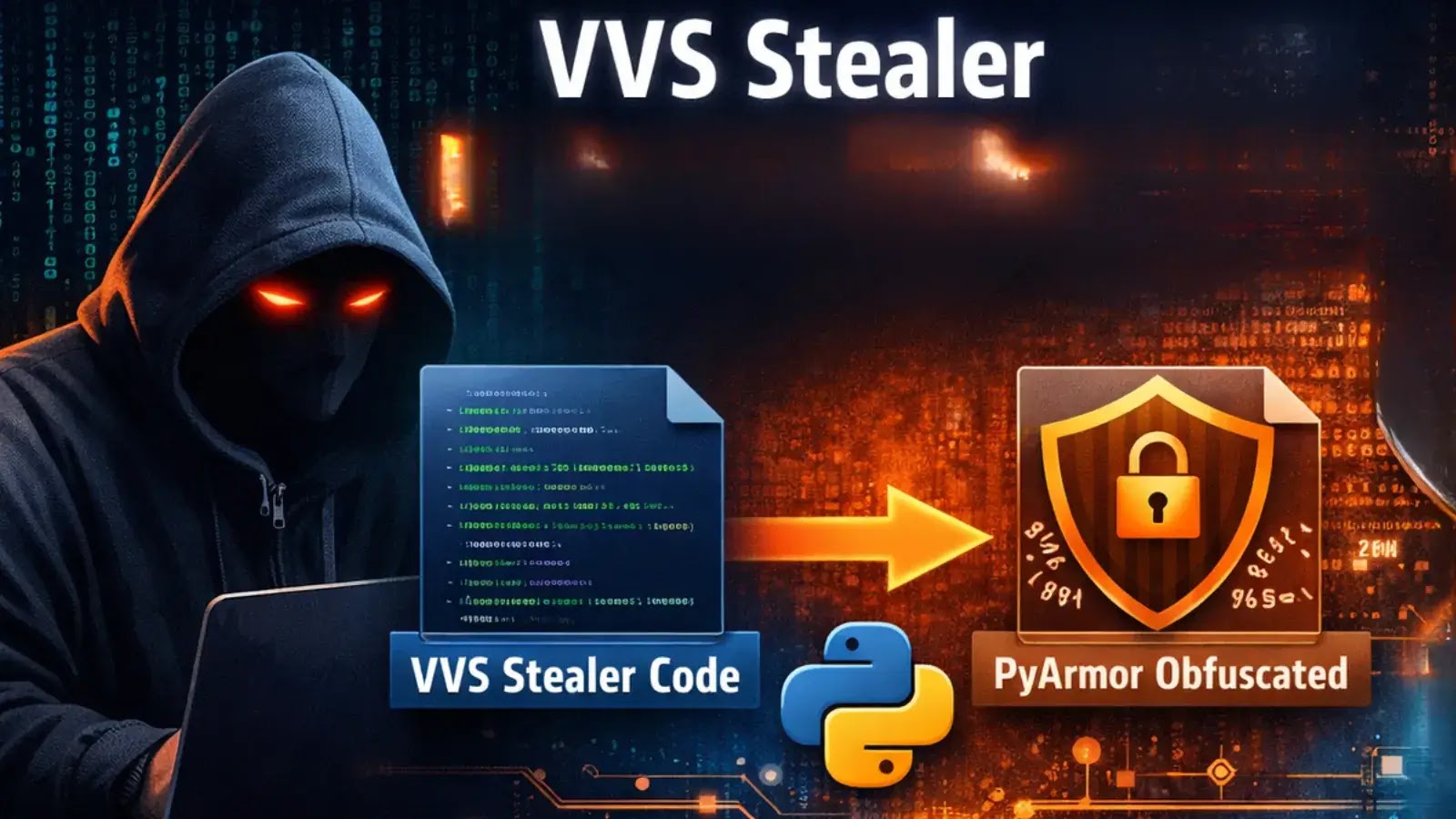
The cybersecurity panorama is witnessing an increase in subtle malware that leverages professional instruments to masks malicious intent. A major instance is VVS Stealer (additionally styled VVS $tealer).
This Python-based malware household has been actively marketed on Telegram since April 2025. This risk targets Discord customers explicitly to exfiltrate delicate credentials, tokens, and browser knowledge.
A key attribute of VVS Stealer is its use of PyArmor, a command-line software for obfuscating Python scripts.
Whereas builders use PyArmor to guard mental property, risk actors exploit it to cover malware code, successfully bypassing conventional safety controls similar to static evaluation and signature-based detection.
Advert in Telegram
This text examines the technical mechanisms of VVS Stealer and the deobfuscation course of required to investigate it.
The Position of PyArmor in Malware Evasion
Malware authors more and more want Python for its ease of use, however uncooked Python code is definitely readable by safety analysts, as reported by PaloAlto Networks.
workflow for analyzing the VVS stealer malware pattern
To counter this, VVS Stealer employs PyArmor (particularly model 9.1.4 Professional) to encrypt its payload.
PyArmor transforms the malware in a number of methods:
Bytecode Encryption: It converts customary Python code right into a specialised, encrypted format that customary decompilers can not learn.
BCC Mode: It converts Python capabilities into C capabilities, that are then compiled into machine directions. This successfully hides the logic in a separate ELF (Executable and Linkable Format) file, making reverse engineering considerably tougher.
AES Encryption: The malware makes use of Superior Encryption Normal (AES) with a 128-bit key in Counter (CTR) mode to encrypt strings and bytecode. This prevents analysts from merely studying textual content strings (like command-and-control URLs) to grasp the malware’s habits.
Analyzing VVS Stealer requires a multi-step course of to strip away these protecting layers.
Safety researchers should first extract the payload from its PyInstaller bundle to find the encrypted Python bytecode and the PyArmor runtime library.
get_encryption_key technique
By reverse-engineering the PyArmor encryption keys (typically discovered inside the runtime DLL) and restoring the Python bytecode headers, analysts can decompile the code again right into a human-readable format.
This course of reveals the malware’s core logic, exposing capabilities that had been beforehand hidden behind cryptographic limitations.
Malware Capabilities
As soon as deobfuscated, VVS Stealer reveals a collection of aggressive information-stealing options:
Discord Token Theft: The malware scans native recordsdata (.ldb and .log) for encrypted Discord tokens, decrypts them utilizing Home windows DPAPI (Knowledge Safety API), and queries Discord’s API to reap consumer particulars similar to fee strategies, pal lists, and telephone numbers.
Session Injection: It kills working Discord processes and injects malicious JavaScript (obfuscated through customary JS instruments) into the appliance. This permits the attacker to intercept lively periods, monitor community visitors, and seize password modifications or view backup code.
Browser Knowledge Extraction: VVS Stealer targets practically 20 completely different internet browsers (together with Chrome, Edge, and Opera) to steal cookies, historical past, and autofill passwords.
Persistence: The malware copies itself to the Home windows Startup folder, making certain it runs each time the sufferer boots their pc. It additionally shows a pretend “Deadly Error” message field to distract the consumer whereas it installs.
Injected JS configuration and exfiltration
VVS Stealer demonstrates how risk actors weaponize professional safety instruments like PyArmor to create stealthy, efficient malware.
A pretend message field instructing the sufferer to restart the pc
By complicating the reverse-engineering course of, they enhance the time it takes for safety distributors to develop detections.
Organisations should depend on superior behavioural evaluation and endpoint safety, moderately than relying solely on static signatures, to defend towards these obfuscated threats.
Observe us on Google Information, LinkedIn, and X for every day cybersecurity updates. Contact us to characteristic your tales.