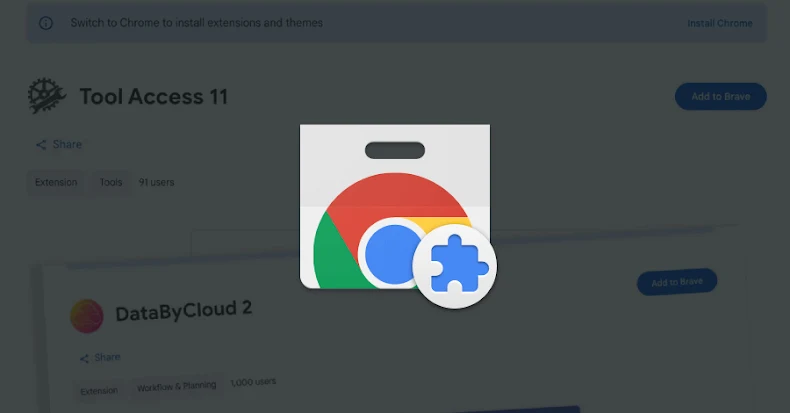
Cybersecurity researchers have found 5 new malicious Google Chrome internet browser extensions that masquerade as human sources (HR) and enterprise useful resource planning (ERP) platforms like Workday, NetSuite, and SuccessFactors to take management of sufferer accounts.
“The extensions work in live performance to steal authentication tokens, block incident response capabilities, and allow full account takeover by means of session hijacking,” Socket safety researcher Kush Pandya stated in a Thursday report.
The names of the extensions are listed beneath –
DataByCloud Entry (ID: oldhjammhkghhahhhdcifmmlefibciph, Revealed by: databycloud1104) – 251 Installs
Device Entry 11 (ID: ijapakghdgckgblfgjobhcfglebbkebf, Revealed by: databycloud1104) – 101 Installs
DataByCloud 1 (ID: mbjjeombjeklkbndcjgmfcdhfbjngcam, Revealed by: databycloud1104) – 1,000 Installs
DataByCloud 2 (ID: makdmacamkifdldldlelollkkjnoiedg, Revealed by: databycloud1104) – 1,000 Installs
Software program Entry (ID: bmodapcihjhklpogdpblefpepjolaoij, Revealed by: Software program Entry) – 27 Installs
All of them, except for Software program Entry, have been faraway from the Chrome Net Retailer as of writing. That stated, they’re nonetheless obtainable on third-party software program obtain websites similar to Softonic. The add-ons are marketed as productiveness instruments that provide entry to premium instruments for various platforms, together with Workday, NetSuite, and different platforms.. Two of the extensions, DataByCloud 1 and DataByCloud 2, have been first printed on August 18, 2021.
The marketing campaign, regardless of utilizing two totally different publishers, is assessed to be a coordinated operation primarily based on equivalent performance and infrastructure patterns. It particularly includes exfiltrating cookies to a distant server beneath the attackers’ management, manipulating the Doc Object Mannequin (DOM) tree to dam safety administration pages, and facilitating session hijacking by way of cookie injection.
As soon as put in, DataByCloud Entry requests permissions for cookies, administration, scripting, storage, and declarativeNetRequest throughout Workday, NetSuite, and SuccessFactors domains. It additionally collects authentication cookies for a specified area and transmits them to the “api.databycloud[.]com” area each 60 seconds.
“Device Entry 11 (v1.4) prevents entry to 44 administrative pages inside Workday by erasing web page content material and redirecting to malformed URLs,” Pandya defined. “This extension blocks authentication administration, safety proxy configuration, IP vary administration, and session management interfaces.”
That is achieved by DOM manipulation, with the extension sustaining an inventory of web page titles that is always monitored. Knowledge By Cloud 2 expands the blocking function to 56 pages, including essential features like password adjustments, account deactivation, 2FA machine administration, and safety audit log entry. It is designed to focus on each manufacturing environments and Workday’s sandbox testing atmosphere at “workdaysuv[.]com.”
In distinction, Knowledge By Cloud 1 replicates the cookie-stealing performance from DataByCloud Entry, whereas concurrently incorporating options to forestall code inspection utilizing internet browser developer instruments utilizing the open-source DisableDevtool library. Each extensions encrypt their command-and-control (C2) visitors.
Essentially the most subtle extension of the lot is Software program Entry, which mixes cookie theft with the flexibility to obtain stolen cookies from “api.software-access[.]com” and inject them into the browser to facilitate direct session hijacking. Moreover, it comes fitted with password enter subject safety to forestall customers from inspecting credential inputs.
“The perform parses cookies from the server payload, removes present cookies for the goal area, then iterates by means of the supplied cookie array and injects each utilizing chrome.cookies.set(),” Socket stated. “This installs the sufferer’s authentication state immediately into the risk actor’s browser session.”
A notable facet that ties collectively all 5 extensions is that they function an equivalent checklist comprising 23 security-related Chrome extensions, similar to EditThisCookie, Cookie-Editor, ModHeader, Redux DevTools, and SessionBox, which are designed to watch and flag their presence to the risk actor.
That is probably an try to assess whether or not the net browser has any instrument that may probably intervene with their cookie harvesting goals or reveal the extension’s conduct, Socket stated. What’s extra, the presence of an analogous extension ID checklist throughout all 5 extensions raises two potentialities: both it is the work of the identical risk actor who has printed them beneath totally different publishers or a typical toolkit.
Chrome customers who’ve put in any of the aforementioned add-ons are suggested to take away them from their browsers, carry out password resets, and evaluation for any indicators of unauthorized entry from unfamiliar IP addresses or gadgets.
“The mix of steady credential theft, administrative interface blocking, and session hijacking creates a state of affairs the place safety groups can detect unauthorized entry however can not remediate by means of regular channels,” Socket stated.