The Hacker InformationJan 27, 2026Attack Floor Administration / Cyber Threat
Cybersecurity groups more and more wish to transfer past threats and vulnerabilities in isolation. It isn’t solely about what might go flawed (vulnerabilities) or who may assault (threats), however the place they intersect in your precise surroundings to create actual, exploitable publicity.
Which exposures actually matter? Can attackers exploit them? Are our defenses efficient?
Steady Risk Publicity Administration (CTEM) can present a helpful method to the cybersecurity groups of their journey in direction of unified menace/vulnerability or publicity administration.
What CTEM Actually Means
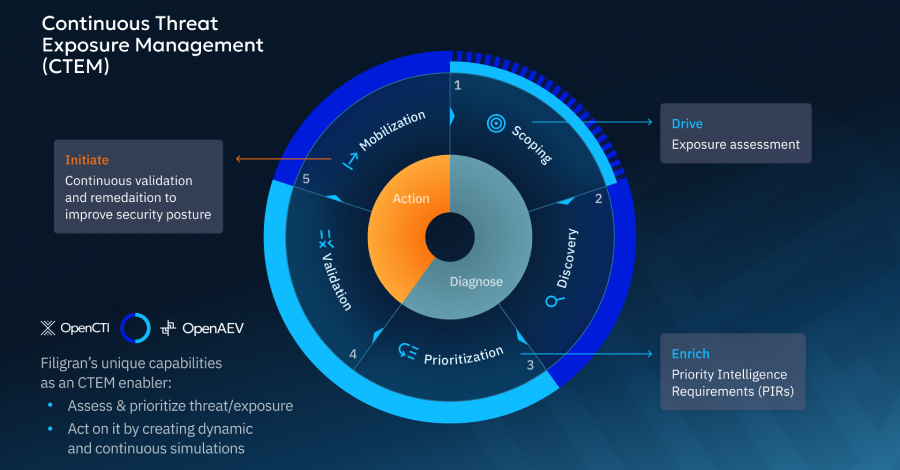
CTEM, as outlined by Gartner, emphasizes a ‘steady’ cycle of figuring out, prioritizing, and remediating exploitable exposures throughout your assault floor, which improves your general safety posture as an consequence. It isn’t a one-off scan and a outcome delivered by way of a instrument; it is an operational mannequin constructed on 5 steps:
Scoping – assess your threats and vulnerabilities and establish what’s most necessary: property, processes, and adversaries.
Discovery – Map exposures and assault paths throughout your surroundings to anticipate an adversary’s actions.
Prioritization – Give attention to what attackers can realistically exploit, and what you could repair.
Validation – Take a look at assumptions with secure, managed assault simulations.
Mobilization – Drive remediation and course of enhancements based mostly on proof
What’s the Actual Good thing about CTEM
CTEM shifts the main target to risk-based publicity administration, integrating plenty of sub-processes and instruments like vulnerability evaluation, vulnerability administration, assault floor administration, testing, and simulation. CTEM unifies publicity evaluation and publicity validation, with the last word goal for safety groups to have the ability to file and report potential affect to cyber danger discount. Know-how or instruments have by no means been a difficulty; in truth, now we have an issue of loads within the cybersecurity house. On the similar time, with extra instruments, now we have created extra siloes, and that is precisely what CTEM units out to problem – can we unify our view into threats/vulnerabilities/assault surfaces and take motion towards actually exploitable publicity to scale back general cyber danger?
Function of Risk Intelligence in CTEM
Hundreds of vulnerabilities are reported yearly (the quantity was greater than 40,000 in 2024), however lower than 10% are literally ever exploited. Risk Intelligence can considerably show you how to zero in on those that matter to your group by connecting vulnerabilities to adversary ways, strategies, and procedures (TTPs) noticed in lively campaigns. Risk intelligence is not a good-to-have however is a need-to-have. It could show you how to specify Precedence Intelligence Necessities (PIRs): the context, the menace panorama that issues most in your surroundings. This prioritized menace intelligence tells you which of them flaws are being weaponized, towards which targets, and underneath what situations, so you’ll be able to focus remediation on what’s exploitable in your surroundings, not what’s theoretically attainable.
The query it is best to ask your menace intelligence workforce is: Are you optimizing the worth from the menace knowledge you’re gathering right this moment? That is your first space of enchancment/ change.
Validation Pushed Threat Discount
Prioritized menace intelligence must be adopted by testing and validation to see how your safety controls maintain towards essentially the most possible exploitables and assault paths, and the way it might affect your group. An necessary issue right here is that your safety validation program should transcend expertise; it also needs to embody processes and folks. A wonderfully tuned EDR, SIEM, or WAF gives restricted safety in case your incident workflows are unclear, playbooks are outdated, or escalation paths break underneath strain. That is the place we anticipate to see a convergence of breach & assault simulation, tabletop workouts, automated pen-testing, and many others., in direction of Adversarial Publicity Validation (AEV).
Keep away from the Buzzwords
CTEM is not a product; it is a strategic method utilizing outcome-driven metrics for publicity administration. Implementation of it would not fall on a single safety workforce/perform both. It must be pushed from the highest, breaking siloes and bettering safety workflows throughout groups. Begin with the ‘Scoping’ stage to determine what to incorporate in your publicity administration program and the place to focus first:
What are our high enterprise dangers that cybersecurity can immediately affect?
Which surroundings (on-prem, cloud, IT/OT, subsidiaries…) and asset sorts (crown jewels, endpoints, id methods, knowledge shops…) are in scope?
Do you’ve an correct view of this stock?
Which menace actors and assault strategies are most related to our trade and tech stack?
How will we incorporate current menace intel and incident knowledge to refine the scope?
How will we outline ‘crucial publicity’ (based mostly on exploitability, enterprise affect, knowledge sensitivity, blast radius, and many others.)?
Can we validate instruments, individuals, processes, and instruments right this moment?
What’s our preliminary capability to remediate points inside this scope (individuals, tooling, SLAs)?
This isn’t an exhaustive record, however these questions assist outline a practical, danger‑aligned CTEM scope that may be executed and measured, as an alternative of an excessively broad however unmanageable effort.
Backside line:
CTEM works when it solutions the questions that matter, with proof:
What can damage us? How wouldn’t it occur? Can we cease it?
For extra sources on publicity administration, menace intelligence, and validation practices, go to Filigran.
Discovered this text fascinating? This text is a contributed piece from certainly one of our valued companions. Comply with us on Google Information, Twitter and LinkedIn to learn extra unique content material we put up.