Panorays has simply dropped the newest version of its annual CISO Survey for Third-Celebration Cyber Threat Administration, and it accommodates some main wakeup requires safety professionals.
The most important takeaway is that software program provide chain assaults are rising as soon as extra, as cybercriminals look to make the most of their complexity by concentrating on a rising laundry checklist of third-party parts.
The scenario isn’t helped by the mass adoption of AI, which not solely will increase the risk floor, but additionally supplies cybercriminals with extra superior instruments for finishing up their assaults.
Nonetheless, AI works each methods, and there are encouraging indicators for enterprise safety as extra safety leaders flip to such instruments to bolster their cyber protection.
In response to Panorays, 60% of the 200 U.S.-based CISOs surveyed mentioned they’ve witnessed a rise in third-party safety incidents this yr. Of these, 9% mentioned the bounce had been “important,” whereas 51% mentioned the variety of assaults had solely barely elevated.
However the greater concern for CISOs is the impression of these incidents.
Greater than three-quarters of respondents mentioned third-party software program dangers are one of the substantial cybersecurity considerations they face, with 23% going so far as to say it’s the primary threat to their group.
Simply 22% mentioned they rank third-party threat as a “minor” concern.
The findings display that CISOs have gotten conscious about their reliance on third-party software program distributors, and that’s simply as properly given how deeply embedded such instruments have develop into of their enterprise operations.
An earlier research by JumpCloud confirmed that the common enterprise makes use of anyplace from 100 to 300 software-as-a-service functions, and that’s actually simply the tip of the iceberg, for it doesn’t embody components like cloud infrastructure and the open-source parts utilized in proprietary functions.
Third-party software program has created a rising assault floor that few CISOs actually know the right way to deal with, primarily attributable to an alarming lack of visibility.
In response to Panorays, simply 15% of respondents claimed to have full perception into their whole software program provide chains.
The shortage of visibility into third-party software program provide chains stems from group’s continued reliance on outdated risk evaluation strategies.
The report discovered that the overwhelming majority of CISOs nonetheless use conventional vendor safety questionnaires as their main supply of risk intelligence, but 71% admit they’re unable to precisely assess third-party threat.
Sometimes, organizations will present distributors with a static checklist of questions in the course of the onboarding section, however whereas the insights gleaned may be helpful, they can not establish evolving threats.
It’s primarily an issue of scale – vendor ecosystems are rising exponentially, and so these handbook processes can now not sustain with the altering risk panorama.
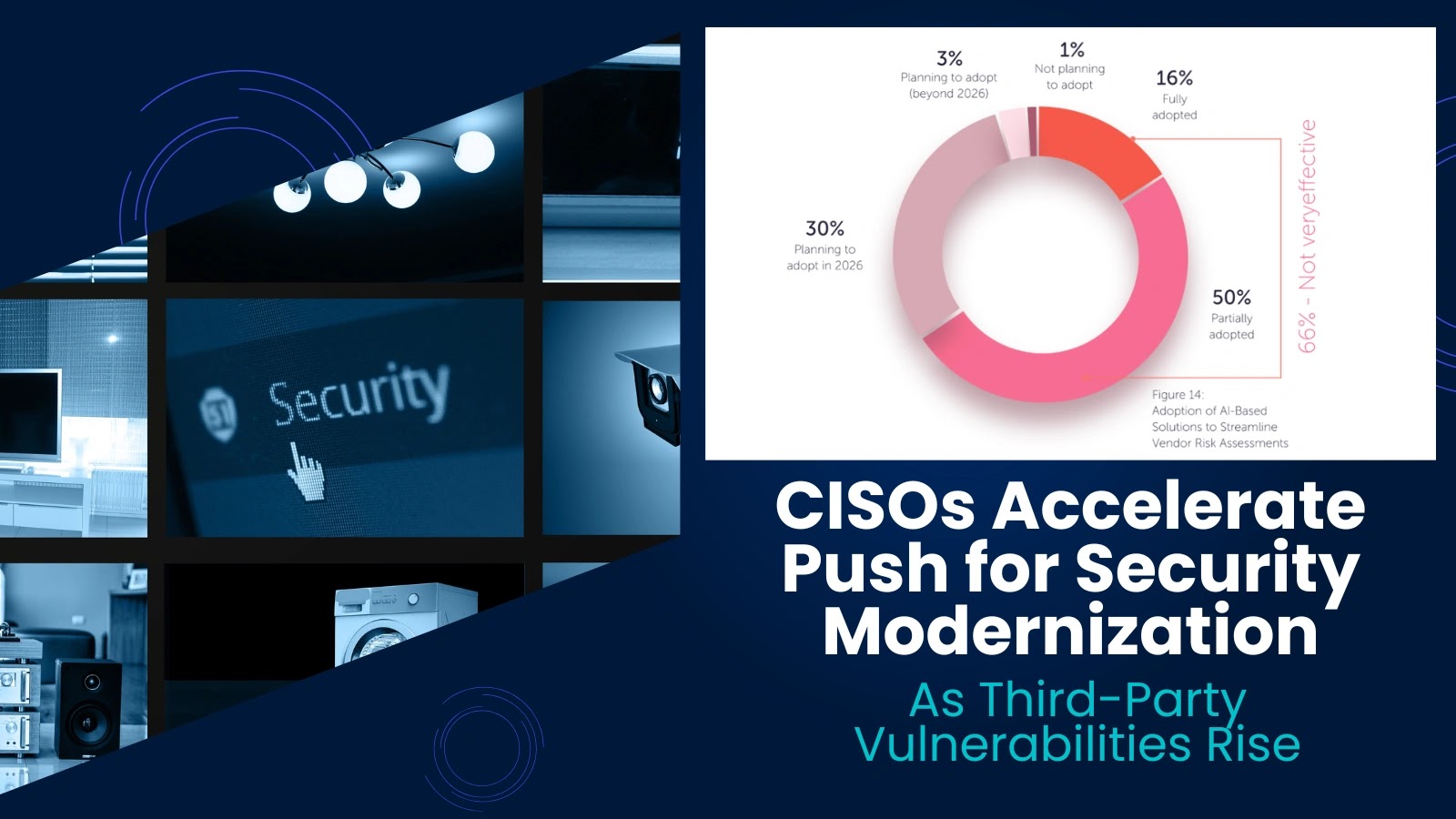
Fortuitously, the rising consciousness across the deficiencies of static questionnaires seems to have kick-started a modernization push, with two-thirds of CISOs responding by embracing newer, AI-powered instruments to try to improve vendor threat evaluation.
Amongst those that haven’t but adopted AI instruments, the bulk intend to take action quickly, with simply 1% of CISOs saying they haven’t any such plans.
The rising adoption of AI for cyber risk visibility underscores the altering nature of the CISO’s function. Fashionable CISOs are now not simply technical gatekeepers – as an alternative, they need to act like orchestrators of enterprise-wide threat administration.
They’re required to construct a tradition of cyber resilience, and that explains why so many are embracing AI-enabled safety platforms.
With AI, it’s potential to automate lots of the extra time-consuming points of risk evaluation, auto-filling responses primarily based on historic knowledge and liberating safety groups to deal with threat validation.
AI additionally improves accuracy as a result of it eliminates human fatigue, decreasing the variety of false positives and creating house for deeper oversight.
Visibility Isn’t Sufficient
AI clearly has transformative potential for risk visibility, however a lot work stays. Enhanced visibility doesn’t do a lot good if CISOs don’t even have a complete, tried-and-tested incident response plan in place to cope with the threats they floor.
Sadly, simply 21% of CISOs at the moment do have a plan to cope with breaches that stem from exterior software program suppliers, whereas the remainder lack any type of standardized framework on the right way to cope with them.
The excellent news is that fixing this seems to be on CISOs’ agendas, significantly at bigger organizations. The survey discovered that 36% of CISOs at enterprises with 10,000 or extra workers do have a correct incident response plan, in comparison with simply 16% of CISOs at smaller firms with lower than 5,000 workers.
Panorays founder and CEO Matan Or-El blamed the rise in third-party safety vulnerabilities on the “rampant adoption” of AI instruments, however mentioned he’s additionally optimistic that AI would be the answer to many of those woes.
“CISOs are more and more seeing the worth of AI-driven options to extend readability across the evolving risk panorama,” he defined.