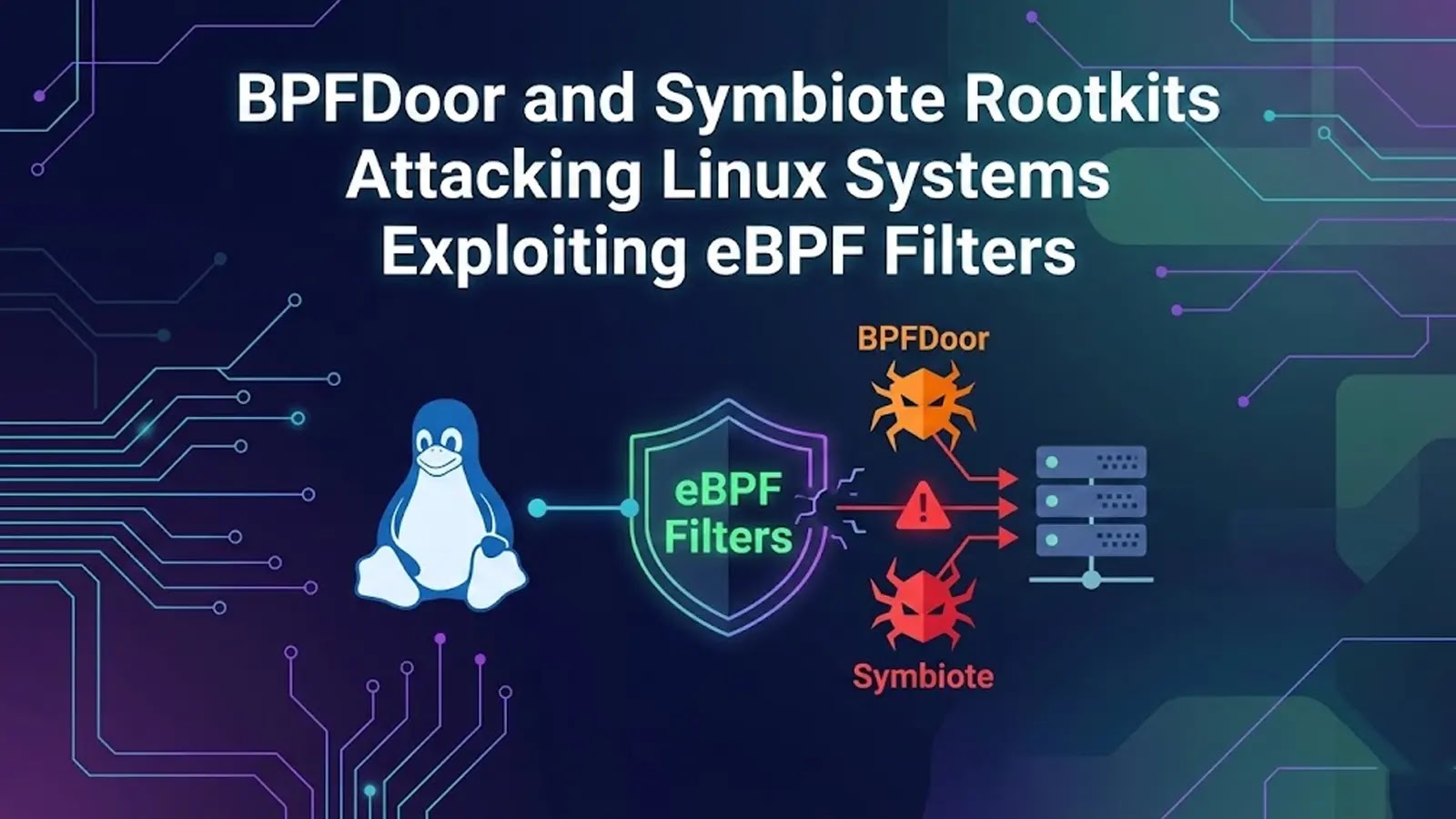
Two subtle Linux rootkits are posing more and more critical threats to community safety by exploiting eBPF expertise to cover their presence from conventional detection techniques.
BPFDoor and Symbiote, each originating from 2021, characterize a harmful class of malware that mixes superior kernel-level entry with highly effective evasion capabilities.
In 2025 alone, safety researchers detected 151 new samples of BPFDoor and three samples of Symbiote, demonstrating that these threats stay actively developed and deployed towards vital infrastructure.
These rootkits leverage eBPF (prolonged Berkeley Packet Filter), a Linux kernel expertise launched in 2015 that enables customers to load sandboxed applications straight into the kernel for inspecting and modifying community packets and system calls.
Whereas eBPF serves official functions in community monitoring and safety, malware authors have weaponized it to create practically undetectable backdoors that may intercept communications and preserve persistent entry with out triggering conventional safety alerts.
The emergence of those threats displays a strategic shift in malware improvement. In contrast to mass-distributed ransomware or frequent botnets, eBPF-based rootkits require specialised technical experience to develop and deploy.
Pattern of Symbiote (Supply – Fortinet)
This exclusivity makes them the popular selection for state-sponsored attackers in search of dependable, long-term entry to vital techniques.
Fortinet safety analysts recognized that each malware households proceed to evolve with more and more subtle filtering mechanisms designed to bypass trendy safety defenses.
The latest variants exhibit notable tactical enhancements. Symbiote’s newest model from July 2025 now accepts IPv4 and IPv6 packets throughout TCP, UDP, and SCTP protocols on non-standard ports together with 54778, 58870, 59666, 54879, 57987, 64322, 45677, and 63227.
This expanded port vary permits the malware to conduct command and management communications by means of port hopping, making it tough for community directors to dam malicious visitors with out creating false positives.
Evolution of Evasion Ways
Essentially the most regarding development lies in how these rootkits disguise their command and management communications. BPFDoor’s 2025 variants now help IPv6 visitors and cleverly filter DNS visitors on port 53 over each IPv4 and IPv6 protocols.
Ai immediate (Supply – Fortinet)
By masquerading as official DNS queries, the malware blends seamlessly into regular community exercise that safety groups usually contemplate innocent and routine.
The technical implementation makes use of eBPF bytecode that attaches on to community sockets, functioning as a kernel-level packet filter invisible to userspace instruments.
When analyzed utilizing specialised reverse engineering instruments like Radare2, the bytecode reveals rigorously constructed inspection routines that establish command packets by means of particular port numbers and protocol combos, then silently passes them to command servers whereas dropping all different visitors.
BPFDoor pattern (Supply – Fortinet)
Detection stays terribly difficult as a result of eBPF filters function on the kernel stage, beneath the visibility of ordinary safety monitoring instruments.
Fortinet safety mechanisms now detect these threats by means of signature-based antivirus engines and specialised IPS signatures that monitor reverse shell communications and botnet exercise.
Comply with us on Google Information, LinkedIn, and X to Get Extra On the spot Updates, Set CSN as a Most popular Supply in Google.