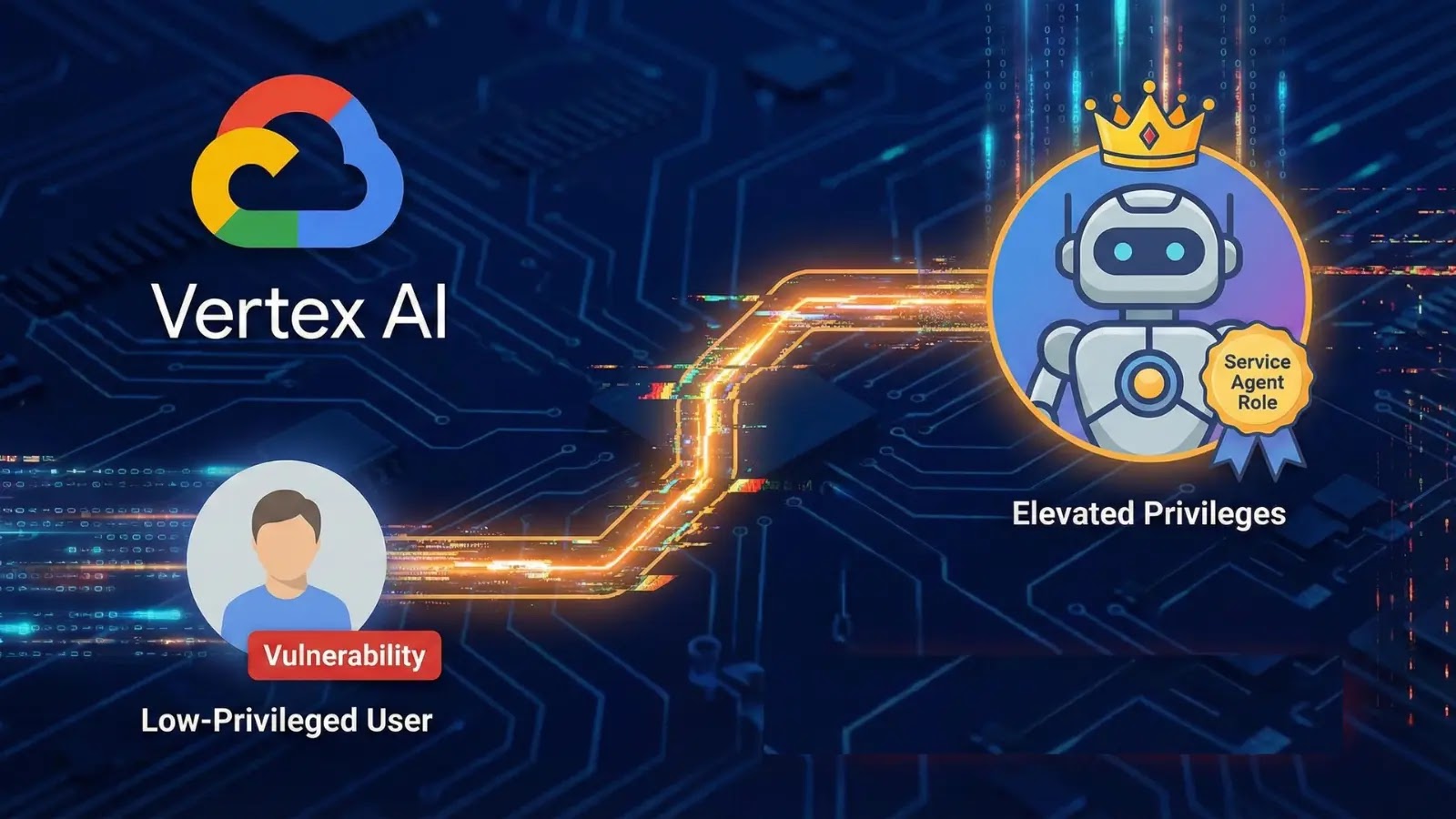
Google’s Vertex AI comprises default configurations that enable low-privileged customers to escalate privileges by hijacking Service Agent roles.
XM Cyber researchers recognized two assault vectors within the Vertex AI Agent Engine and Ray on Vertex AI, which Google deemed “working as meant.
Service Brokers are managed identities that Google Cloud attaches to Vertex AI cases for inner operations. These accounts obtain broad mission permissions by default, creating dangers when low-privileged customers entry them.
Attackers exploit this by confused deputy eventualities, the place minimal entry grants distant code execution (RCE) and permits credential theft from occasion metadata.
Each paths begin with read-only permissions however finish with high-privilege actions, corresponding to accessing Cloud Storage (GCS) or BigQuery. The diagram illustrates the Ray on Vertex AI stream, from persistent assets entry to the Customized Code Service Agent compromise.
FeatureVertex AI Agent EngineRay on Vertex AIPrimary TargetReasoning Engine Service AgentCustom Code Service AgentVulnerability TypeMalicious Device Name (RCE)Insecure Default Entry (Viewer to Root)Preliminary Permissionaiplatform.reasoningEngines.updateaiplatform.persistentResources.get/listImpactLLM reminiscences, chats, GCS accessRay cluster root; BigQuery/GCS R/W
Builders deploy AI brokers through frameworks like Google’s Agent Growth Package (ADK), which pickles Python code and levels it in GCS buckets. Attackers with aiplatform.reasoningEngines.replace permission add malicious code disguised as a instrument, corresponding to a reverse shell in a foreign money converter perform.
Vulnerability Chain
A question triggers the instrument, executing the shell on the reasoning engine occasion. Attackers then question metadata for the Reasoning Engine Service Agent token ([email protected]), gaining permissions for reminiscences, classes, storage, and logging. This reads chats, LLM information, and buckets. Public buckets work as staging, needing no storage rights, XM Cyber mentioned.
Ray clusters for scalable AI workloads connect the Customized Code Service Agent to the top node robotically. Customers with aiplatform.persistentResources.record/get a part of Vertex AI Viewer position entry the GCP Console’s “Head node interactive shell” hyperlink.
Vulnerability Chain
This grants root shell entry regardless of viewer limits. Attackers extract the agent’s token through metadata, enabling GCS/BigQuery read-write, although IAM actions like signBlob are scoped-limited in assessments. The second diagram exhibits the pivot to cloud storage and logging.
Revoke pointless Service Agent permissions utilizing customized roles. Disable head node shells and validate instrument code earlier than updates. Monitor metadata accesses through Safety Command Middle’s Agent Engine Risk Detection, which flags RCE and token grabs.
Audit persistent assets and reasoning engines usually. Enterprises adopting Vertex AI should deal with these defaults as dangers, not options.
Comply with us on Google Information, LinkedIn, and X for every day cybersecurity updates. Contact us to function your tales.