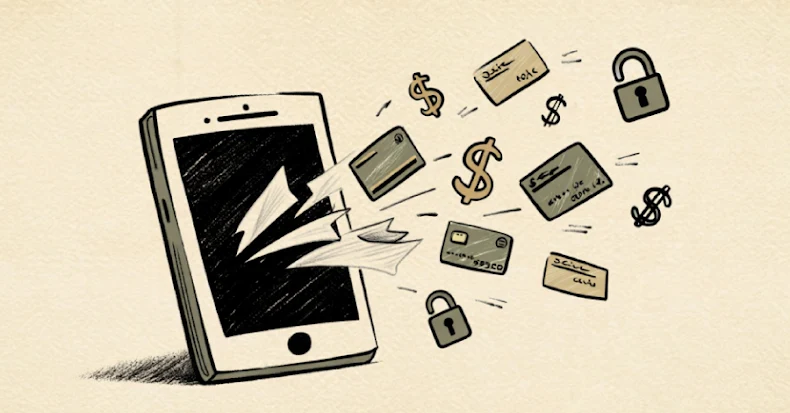
The U.S. Federal Bureau of Investigation (FBI) has warned that cybercriminals are impersonating monetary establishments with an purpose to steal cash or delicate data to facilitate account takeover (ATO) fraud schemes.
The exercise targets people, companies, and organizations of various sizes and throughout sectors, the company stated, including the fraudulent schemes have led to greater than $262 million in losses for the reason that begin of the 12 months. The FBI stated it has acquired over 5,100 complaints.
ATO fraud sometimes refers to assaults that allow risk actors to acquire unauthorized entry to a web based monetary establishment, payroll system, or well being financial savings account to siphon knowledge and funds for private achieve. The entry is usually obtained by approaching targets via social engineering methods, akin to texts, calls, and emails that prey on customers’ fears, or by way of bogus web sites.
These strategies make it attainable for attackers to deceive customers into offering their login credentials on a phishing website, in some cases, urging them to click on on a hyperlink to report purported fraudulent transactions recorded in opposition to their accounts.
“A cybercriminal manipulates the account proprietor into making a gift of their login credentials, together with multi-factor authentication (MFA) code or One-Time Passcode (OTP), by impersonating a monetary establishment worker, buyer help, or technical help personnel,” the FBI stated.
“The cybercriminal then makes use of login credentials to log into the official monetary establishment web site and provoke a password reset, finally gaining full management of the accounts.”
Different circumstances contain risk actors masquerading as monetary establishments contacting account house owners, claiming their data was used to make fraudulent purchases, together with firearms, after which convincing them to offer their account data to a second cybercriminal impersonating regulation enforcement.
The FBI stated ATO fraud may contain using Search Engine Optimization (web optimization) poisoning to trick customers on the lookout for companies on search engines like google into clicking on phony hyperlinks that redirect to a lookalike website by way of malicious search engine adverts.
Whatever the technique used, the assaults have one purpose: to grab management of the accounts and swiftly wire funds to different accounts underneath their management, and alter the passwords, successfully locking out the account proprietor. The accounts to which the cash is transferred are additional linked to cryptocurrency wallets to transform them into digital belongings and obscure the cash path.
To remain protected in opposition to the risk, customers are suggested to watch out when sharing about themselves on-line or on social media, usually monitor accounts for any monetary irregularities, use distinctive, advanced passwords, make sure the URL of the banking web sites earlier than signing in, and keep vigilant in opposition to phishing assaults or suspicious callers.
“By overtly sharing data like a pet’s title, faculties you’ve gotten attended, your date of delivery, or details about your loved ones members, you might give scammers the knowledge they should guess your password or reply your safety questions,” the FBI stated.
“The massive majority of ATO accounts referenced within the FBI announcement happen via compromised credentials utilized by risk actors intimately aware of the inner processes and workflows for cash motion inside monetary establishments,” Jim Routh, chief belief officer at Saviynt, stated in an announcement.
“The simplest controls to stop these assaults are handbook (telephone requires verification) and SMS messages for approval. The basis trigger continues to be the accepted use of credentials for cloud accounts regardless of having passwordless choices accessible.”
The event comes as Darktrace, Flashpoint, Forcepoint, Fortinet, and Zimperium have highlighted the most important cybersecurity threats forward of the vacation season, together with Black Friday scams, QR code fraud, present card draining, and high-volume phishing campaigns that mimic well-liked manufacturers like Amazon and Temu.
Many of those actions leverage synthetic intelligence (AI) instruments to supply extremely persuasive phishing emails, pretend web sites, and social media adverts, permitting even low-skill attackers to tug off assaults that seem reliable and improve the success price of their campaigns.
Fortinet FortiGuard Labs stated it detected at the very least 750 malicious, holiday-themed domains registered during the last three months, with many utilizing key phrases like “Christmas,” “Black Friday,” and “Flash Sale.” “Over the past three months, greater than 1.57 million login accounts tied to main e-commerce websites, accessible via stealer logs, have been collected throughout underground markets,” the corporate stated.
Attackers have additionally been discovered actively exploiting safety vulnerabilities throughout Adobe/Magento, Oracle E-Enterprise Suite, WooCommerce, Bagisto, and different frequent e-commerce platforms. Among the exploited vulnerabilities embody CVE-2025-54236, CVE-2025-61882, and CVE-2025-47569.
In response to Zimperium zLabs, there was a 4x improve in cellular phishing (aka mishing) websites, with attackers leveraging trusted model names to create urgency and deceive customers into clicking, logging in, or downloading malicious updates.”
What’s extra, Recorded Future has referred to as consideration to buy scams the place risk actors use pretend e-commerce shops to steal sufferer knowledge and authorize fraudulent funds for non-existent items and providers. It described the scams as a “main rising fraud risk.”
“A classy darkish net ecosystem permits risk actors to shortly set up new buy rip-off infrastructure and amplify their influence,” the corporate stated. “Promotional actions mirroring conventional advertising – together with a suggestion to promote stolen card knowledge on the darkish net carding store PP24 – are widespread on this underground.”
“Menace actors fund advert campaigns with stolen cost playing cards to unfold buy scams, which in flip compromise extra cost card knowledge, fueling a unbroken cycle of fraud.