The Black Lotus Labs workforce at Lumen Applied sciences mentioned it null-routed site visitors to greater than 550 command-and-control (C2) nodes related to the AISURU/Kimwolf botnet since early October 2025.
AISURU and its Android counterpart, Kimwolf, have emerged as among the greatest botnets in latest instances, able to directing enslaved units to take part in distributed denial-of-service (DDoS) assaults and relay malicious site visitors for residential proxy companies.
Particulars about Kimwolf emerged final month when QiAnXin XLab revealed an exhaustive evaluation of the malware, which turns compromised units – principally unsanctioned Android TV streaming units – right into a residential proxy by delivering a software program growth equipment (SDK) referred to as ByteConnect both instantly or by means of sketchy apps that come pre-installed on them.
The online result’s that the botnet has expanded to contaminate greater than 2 million Android units with an uncovered Android Debug Bridge (ADB) service by tunneling by means of residential proxy networks, thereby permitting the menace actors to compromise a large swath of TV containers.
A subsequent report from Synthient has revealed Kimwolf actors trying to dump proxy bandwidth in trade for upfront money.
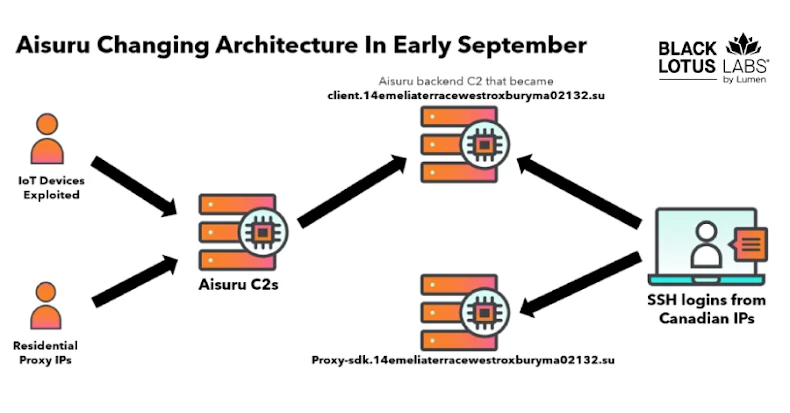
Black Lotus Labs mentioned it recognized in September 2025 a bunch of residential SSH connections originating from a number of Canadian IP addresses primarily based on its evaluation of backend C2 for Aisuru at 65.108.5[.]46, with the IP addresses utilizing SSH to entry 194.46.59[.]169, which proxy-sdk.14emeliaterracewestroxburyma02132[.]su.
It is price noting that the second-level area surpassed Google in Cloudflare’s checklist of prime 100 domains in November 2025, prompting the net infrastructure firm to clean it from the checklist.
Then, in early October 2025, the cybersecurity firm mentioned it recognized one other C2 area – greatfirewallisacensorshiptool.14emeliaterracewestroxburyma02132[.]su – that resolved to 104.171.170[.]21, an IP tackle belonging to Utah-based internet hosting supplier Resi Rack LLC. The corporate advertises itself as a “Premium Recreation Server Internet hosting Supplier.”
This hyperlink is essential, as a latest report from impartial safety journalist Brian Krebs revealed how folks behind numerous proxy companies primarily based on the botnets have been peddling their warez on a Discord server referred to as resi[.]to. This additionally contains Resi Rack’s co-founders, who’re mentioned to have been actively engaged in promoting proxy companies through Discord for practically two years.
The server, which has since disappeared, was owned by somebody named “d” (assessed to be quick for the deal with “Dort”), with Snow believed to be the botmaster.
“In early October, we noticed a 300% surge within the variety of new bots added to Kimwolf over a 7-day interval, which was the beginning of a rise that reached 800,000 whole bots by mid-month,” Black Lotus Labs mentioned. “Almost the entire bots on this surge have been discovered listed on the market on a single residential proxy service.”
Subsequently, the Kimwolf C2 structure was discovered to scan PYPROXY and different companies for susceptible units between October 20, 2025, and November 6, 2025 — a habits defined by the botnet’s exploitation of a safety flaw in lots of proxy companies that made it potential to work together with units on the interior networks of residential proxy endpoints and drop the malware.
This, in flip, turns the gadget right into a residential proxy node, inflicting its public IP tackle (assigned by the Web Service Supplier) to be listed for lease on a residential proxy supplier web site. Menace actors, corresponding to these behind these botnets, then lease entry to the contaminated node and weaponize it to scan the native community for units with ADB mode enabled for additional propagation.
“After one profitable null route [in October 2025], we noticed the greatfirewallisacensorshiptool area transfer to 104.171.170[.]201, one other Resi Rack LLC IP,” Black Lotus Labs famous. “As this server stood up, we noticed a big spike of site visitors with 176.65.149[.]19:25565, a server used to host their malware. This was on a standard ASN that was utilized by the Aisuru botnet on the similar time.”
The disclosure comes towards the backdrop of a report from Chawkr that detailed a complicated proxy community containing 832 compromised KeeneticOS routers working throughout Russian ISPs, corresponding to Internet By Internet Holding LLC, VladLink, and GorodSamara.
“The constant SSH fingerprints and similar configurations throughout all 832 units level towards automated mass exploitation, whether or not leveraging stolen credentials, embedded backdoors, or recognized safety flaws within the router firmware,” it mentioned. “Every compromised router maintains each HTTP (port 80) and SSH (port 22) entry.”
Provided that these compromised SOHO routers perform as residential proxy nodes, they supply menace actors with the flexibility to conduct malicious actions by mixing into regular web site visitors. This illustrates how adversaries are more and more leveraging client units as conduits for multi-stage assaults.
“Not like datacenter IPs or addresses from recognized internet hosting suppliers, these residential endpoints function beneath the radar of most safety vendor popularity lists and menace intelligence feeds,” Chawkr famous.
“Their official residential classification and clear IP popularity permit malicious site visitors to masquerade as atypical client exercise, evading detection mechanisms that will instantly flag requests originating from suspicious internet hosting infrastructure or recognized proxy companies.”