Dec 18, 2025Ravie LakshmananCybersecurity / Hacking Information
This week’s ThreatsDay Bulletin tracks how attackers hold reshaping previous instruments and discovering new angles in acquainted techniques. Small modifications in techniques are stacking up quick, and each hints at the place the subsequent large breach may come from.
From shifting infrastructures to intelligent social hooks, the week’s exercise exhibits simply how fluid the risk panorama has turn into.
This is the complete rundown of what moved within the cyber world this week.
Worldwide rip-off ring busted
Authorities from the Czech Republic, Latvia, Lithuania, and Ukraine, together with Eurojust, took motion in opposition to a legal community working name facilities in Dnipro, Ivano-Frankivsk, and Kyiv that scammed greater than 400 victims throughout Europe out of greater than €10 million ($11.7 million). “The legal group established an expert organisation with staff who obtained a proportion of the proceeds for every accomplished rip-off,” Eurojust mentioned. “The fraudsters used numerous scams, equivalent to posing as cops to withdraw cash utilizing their victims’ playing cards and particulars, or pretending that their victims’ financial institution accounts had been hacked. They satisfied their victims to switch massive sums of cash from their ‘compromised’ financial institution accounts to ‘protected’ financial institution accounts managed by the community. Additionally they lured victims into downloading distant entry software program and getting into their banking particulars, enabling the legal group to entry and management the victims’ financial institution accounts.” The decision facilities employed roughly 100 individuals and have been recruited from the Czech Republic, Latvia, Lithuania, and different nations. They performed completely different roles, starting from making calls and forging official certificates from the police and banks to amassing money from their victims. Staff who efficiently managed to acquire cash from their victims would obtain as much as 7% of the proceeds to encourage them to proceed the rip-off. The legal enterprise additionally promised money bonuses, automobiles, or residences in Kyiv for workers who obtained greater than €100,000. The operation led to the arrest of 12 suspects on December 9, 2025. Authorities additionally seized money, 21 autos, and numerous weapons and ammunition.
UK nudity filter push
The U.Ok. authorities reportedly will “encourage” Apple and Google to forestall telephones from displaying nude photographs besides when customers confirm that they’re adults. In accordance with a brand new report from The Monetary Occasions, the push for nudity-detection will not be a authorized requirement “for now,” however is claimed to be a part of the federal government’s technique to deal with violence in opposition to ladies and ladies. “The U.Ok. authorities desires expertise firms to dam express photographs on telephones and computer systems by default to guard youngsters, with adults having to confirm their age to create and entry such content material,” the report mentioned. “Ministers need the likes of Apple and Google to include nudity-detection algorithms into their machine working techniques to forestall customers from taking pictures or sharing photographs of genitalia except they’re verified as adults.”
Modular infostealer emerges
A brand new, modular data stealer named SantaStealer is being marketed by Russian-speaking operators on Telegram and underground boards like Lolz. “The malware collects and exfiltrates delicate paperwork, credentials, wallets, and information from a broad vary of functions, and goals to function fully in-memory to keep away from file-based detection,” Rapid7 mentioned. “Stolen information is then compressed, break up into 10 MB chunks, and despatched to a C2 server over unencrypted HTTP.” SantaStealer makes use of 14 distinct data-collection modules, every working in its personal thread and exfiltrating the stolen data. It additionally makes use of an embedded DLL to bypass Chrome’s app-bound encryption protections and harvest browser credentials, together with passwords, cookies, and saved bank cards from the net browser. Assessed to be a rebranding of BluelineStealer, the malware is on the market for $175 per 30 days for a primary plan and $300 per 30 days for a premium plan that lets clients edit execution delays and allow clipper performance to substitute pockets addresses copied to the clipboard with an attacker-controlled one to reroute transactions. The risk actor has been energetic on Telegram since no less than July 2025.
Bulletproof internet hosting uncovered
Risk actors leveraging Bulletproof Internet hosting (BPH) suppliers transfer sooner than defenders can reply, typically migrating operations, re-registering domains, and re-establishing providers inside hours of takedowns, Silent Push mentioned in a brand new exhaustive evaluation of BPH providers. “With out data of the place this infrastructure shifts, takedowns lack the permanence they want,” Silent Push mentioned. “And with out a coordinated shift in each regulatory stress and the law-enforcement motion geared toward these suppliers, […] Bulletproof Internet hosting as a service will proceed to thrive – as will the malicious operations constructed on prime of it.”
C2 servers tracked
An evaluation of DDoSia’s multi-layered command-and-control (C2) infrastructure has revealed a median of 6 management servers energetic at any given time. “Nevertheless, servers usually have a comparatively brief lifespan — averaging 2.53 days,” Censys mentioned. “Some servers we now have noticed are energetic for over every week, however most cases we solely see for lower than a couple of hours.” DDoSia is a participatory distributed denial-of-service (DDoS) functionality constructed by Russian hacktivists in 2022, coinciding with the early days of the Russo-Ukrainian struggle. It is operated by the pro-Russian hacktivist group NoName057(16), which was taken down earlier this July. It has since made a comeback. Focusing on of DDoSia is closely centered on Ukraine, European allies, and NATO states in authorities, navy, transportation, public utilities, monetary, and tourism sectors.
WhatsApp hijack marketing campaign
Risk actors are utilizing a brand new social engineering method to hijack WhatsApp accounts. The brand new GhostPairing assault lures victims by sending messages from compromised accounts that include a hyperlink to a Fb-style preview. Clicking on the hyperlink takes the sufferer to a web page that imitates a Fb viewer and asks them to confirm earlier than the content material might be served. As a part of this step, they’re both requested to scan a QR code that can hyperlink an attacker’s browser to the sufferer’s WhatsApp account, granting them unauthorized entry to the sufferer’s account. “To abuse this movement, an attacker would open WhatsApp Net in their very own browser, seize the QR code proven there, and embed it into the pretend Fb viewer web page. The sufferer would then be advised to open WhatsApp, go to Linked gadgets, and scan that QR to be able to ‘view the photograph,'” Gen Digital mentioned. Alternately, they’re instructed to enter their cellphone quantity on the bogus web page, which then forwards that quantity to WhatsApp’s official “hyperlink machine by way of cellphone quantity” function. As soon as WhatsApp generates a pairing numeric code, it is relayed again to the pretend web page, together with directions to enter the code into WhatsApp to substantiate a login. The assault, which abuses the official device-linking function on the platform, is a variation of a method that was utilized by Russian state-sponsored actors to intercept Sign messages earlier this yr. To examine for any indicators of compromise, customers can navigate to Settings -> Linked Units.
RuTube malware lure
Unhealthy actors have been noticed internet hosting movies on the Russian video-sharing platform RuTube that publicize cheats for Roblox, tricking customers into clicking on hyperlinks that result in Trojan and stealer malware like Salat Stealer. It is price noting that related techniques have been widespread on YouTube.
Legacy cipher retired
Microsoft has introduced that it is deprecating RC4 (Rivest Cipher 4) encryption in Kerberos to strengthen Home windows authentication. By mid-2026, area controller defaults will likely be up to date for the Kerberos Key Distribution Heart (KDC) on Home windows Server 2008 and later to solely permit AES-SHA1 encryption. RC4 will likely be disabled by default and solely utilized in eventualities the place a website administrator explicitly configures an account or the KDC to make use of it. “RC4, as soon as a staple for compatibility, is prone to assaults like Kerberoasting that can be utilized to steal credentials and compromise networks,” the corporate mentioned. “It’s essential to discontinue utilizing RC4.” The choice additionally comes after U.S. Senator Ron Wyden known as on the U.S. Federal Commerce Fee (FTC) to research the corporate over its use of the out of date cipher.
IMSI catcher arrests
Serbian police have detained two Chinese language nationals for driving round with an improvised IMSI catcher of their automotive that functioned as a pretend cellular base station. The pair is alleged to have despatched SMS phishing messages that tricked individuals into visiting phishing websites that masqueraded as cellular operators, authorities portals, and huge firms to gather fee card particulars. The captured card information was later abused abroad to pay for items and providers. The names of the arrested people weren’t disclosed. However they’re suspected to be a part of an organized legal group.
Uncovered AI servers danger
New analysis from Bitsight has discovered roughly 1,000 Mannequin Context Protocol (MCP) servers uncovered on the web with no authorization in place and leaking delicate information. A few of them may permit administration of a Kubernetes cluster and its pods, entry to a Buyer Relationship Administration (CRM) device, ship WhatsApp messages, and even obtain distant code execution. “Whereas Anthropic authored the MCP specification, it is not their job to implement how each server handles authorization,” Bitsight mentioned. “As a result of authorization is elective, it is easy to skip it when shifting from a demo to a real-world deployment, doubtlessly exposing delicate instruments or information. Many MCP servers are designed for native use, however as soon as one is uncovered over HTTP, the assault floor expands dramatically.” To counter the chance, it is important that customers don’t expose MCP servers except it is completely crucial and implement OAuth protections for authorization. The event comes as publicity administration firm Intruder revealed {that a} scan of roughly 5 million single-page functions discovered greater than 42,000 tokens uncovered of their code. The tokens span 334 forms of secrets and techniques.
Pretend tax rip-off deploys RATs
A phishing marketing campaign impersonating the Revenue Tax Division of India has been discovered utilizing themes associated to alleged tax irregularities to create a false sense of urgency and deceive customers into clicking on malicious hyperlinks that deploy official distant entry instruments like LogMeIn Resolve (previously GoTo Resolve) that grant attackers unauthorized management over compromised techniques. “The marketing campaign delivered a two-stage malware chain consisting of a shellcode-based RAT loader packaged in a ZIP file and a rogue distant administration executable disguised as a GoTo Resolve updater,” Raven AI mentioned. “Conventional Safe E-mail Gateway defenses did not detect these messages as a result of the sender authenticated accurately, the attachments have been password-protected, and the content material imitated actual authorities communication.”
CBI busts SMS rip-off ring
India’s Central Bureau of Investigation (CBI) mentioned it disrupted a big cyber fraud setup that was getting used to ship phishing messages throughout the nation with the purpose of tricking individuals into bogus schemes like pretend digital arrests, mortgage scams, and funding frauds. Three individuals have been arrested in reference to the case below Operation Chakra V. The investigation recognized an organized cyber gang working from the Nationwide Capital Area (NCR) and the Chandigarh space that managed to acquire round 21,000 SIM playing cards in violation of the Division of Telecommunications (DoT) guidelines. “This gang was offering bulk SMS providers to cyber criminals,” the CBI mentioned. “It was discovered that even overseas cyber criminals have been utilizing this service to cheat Indian residents. These SIM playing cards have been managed by way of a web-based platform to ship bulk messages. The messages supplied pretend loans, funding alternatives, and different monetary advantages, with the intention of stealing private and banking particulars of harmless individuals.” Individually, the company additionally filed costs in opposition to 17 people, together with 4 overseas nationals and 58 firms, in reference to an organized transnational cyber fraud community working throughout a number of States in India. “The cyber criminals adopted a extremely layered and technology-driven modus operandi, involving the usage of Google ads, bulk SMS campaigns, SIM box-based messaging techniques, cloud infrastructure, fintech platforms, and a number of mule financial institution accounts,” the CBI mentioned. “Every stage of the operation—from luring victims to assortment and motion of funds—was intentionally structured to hide the identities of the particular controllers and evade detection by regulation enforcement companies.”
APT phishing throughout Europe
StrikeReady Labs has disclosed particulars of a phishing marketing campaign that has focused Transnistria’s governing physique with a credential phishing e mail attachment by spoofing the Pridnestrovian Moldavian Republic. The HTML attachment exhibits a blurred decoy doc together with a pop-up that prompts victims to enter their credentials. The entered data is transmitted to an attacker-controlled server. The marketing campaign is believed to be energetic since no less than 2023. Different targets possible embody entities in Ukraine, Bosnia and Herzegovina, Macedonia, Montenegro, Spain, Lithuania, Bulgaria, and Moldova.
Pretend CAPTCHA delivers malware
A brand new wave of ClickFix assaults has leveraged pretend CAPTCHA checks that trick customers into pasting within the Home windows Run dialog, which runs the finger.exe device to retrieve malicious PowerShell code. The assaults have been attributed to clusters tracked as KongTuke and SmartApeSG. The decades-old finger command is used to lookup details about native and distant customers on Unix and Linux techniques by way of the Finger protocol. It was later added to Home windows techniques. In one other ClickFix assault detected by Level Wild, phony browser notifications immediate customers to click on ” repair” or copy-paste a PowerShell command that results in the deployment of DarkGate malware by way of a malicious HTA file.
Google service abused
Risk actors are abusing Google’s Software Integration service to ship phishing emails from genuine @google.com addresses and bypass SPF, DKIM, and DMARC checks. The method, based on xorlab, is getting used within the wild to focus on organizations with extremely convincing lures mimicking new sign-in alerts for Google accounts, successfully deceiving them into clicking on suspicious hyperlinks. “To evade detection, attackers use multi-hop redirect chains that bounce by way of a number of official providers,” the corporate mentioned. “Every hop makes use of trusted infrastructure — Google, Microsoft, AWS – making the assault troublesome to detect or block at any single level. Whatever the entry level, victims ultimately land on the Microsoft 365 login web page, revealing the attackers’ main goal: M365 credentials.”
AI-driven ICS scans
Cato Networks mentioned it noticed large-scale reconnaissance and exploitation makes an attempt focusing on Modbus gadgets, together with string monitoring packing containers that instantly management photo voltaic panel output. “In such circumstances, a risk actor with nothing greater than an web connection and a free device may difficulty a easy command, ‘SWITCH OFF,’ slicing energy on a vibrant, cloudless day,” the corporate mentioned. “What as soon as required time, endurance, and handbook talent can now be scaled and accelerated by way of automation. With the rise of agentic AI instruments, attackers can now automate reconnaissance and exploitation, lowering the time wanted to execute such assaults from days to only minutes.”
Ransomware joins exploit wave
The fallout from React2Shell (CVE-2025-55182) has continued to unfold as a number of risk actors have jumped on the exploitation bandwagon to distribute a big selection of malware. The proliferation of public exploits and stealth backdoors has been complemented by assaults of various origins and motivations, with cybersecurity agency S-RM revealing that the vulnerability was used as an preliminary entry vector in a Weaxor ransomware assault on December 5, 2025. “This marks a shift from beforehand reported exploitation,” S-RM mentioned. “It signifies risk actors whose modus operandi entails cyber extortion are additionally efficiently exploiting this vulnerability, albeit on a a lot smaller scale and sure in an automatic style.” Weaxor is assessed to be a rebrand of Mallox ransomware. The ransomware binary was dropped and executed on the system inside lower than one minute of preliminary entry, indicating that this was possible a part of an automatic marketing campaign. In accordance with Palo Alto Networks Unit 42, greater than 60 organizations have been impacted by incidents exploiting the vulnerability. Microsoft mentioned it discovered “a number of hundred machines throughout a various set of organizations” that have been compromised by way of React2Shell.
The patterns behind these tales hold repeating — sooner code, smarter lures, and fewer pauses between discovery and abuse. Every case provides one other piece to the broader map of how assaults adapt when consideration fades.
Subsequent week will deliver a contemporary set of shifts, however for now, these are the alerts price noting. Keep sharp, join the dots, and watch what modifications subsequent.
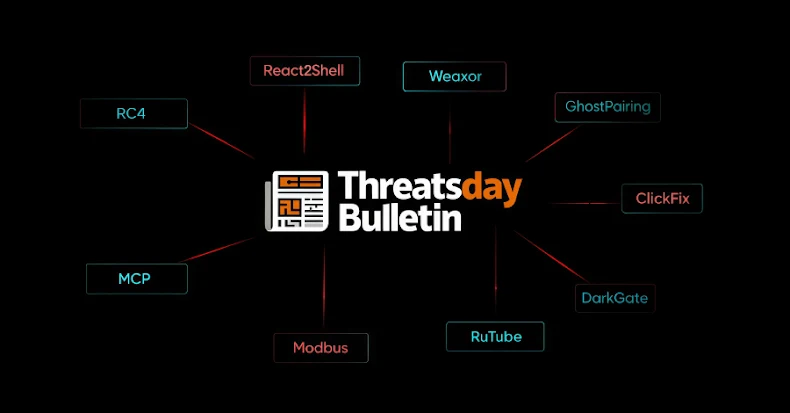
That is all for this version of the ThreatsDay Bulletin — the heartbeat of what is shifting beneath the floor each Thursday.