Skip to content
  • Home
  • Cyber Map
  • About Us – Contact
  • Disclaimer
  • Terms and Rules
  • Privacy Policy
Cyber Web Spider Blog – News

Cyber Web Spider Blog – News

Globe Threat Map provides a real-time, interactive 3D visualization of global cyber threats. Monitor DDoS attacks, malware, and hacking attempts with geo-located arcs on a rotating globe. Stay informed with live logs and archive stats.

  • Home
  • Cyber Map
  • Cyber Security News
  • Security Week News
  • The Hacker News
  • How To?
  • Toggle search form
VS Code Forks Recommend Missing Extensions, Creating Supply Chain Risk in Open VSX

VS Code Forks Recommend Missing Extensions, Creating Supply Chain Risk in Open VSX

Posted on January 6, 2026January 6, 2026 By CWS

Jan 06, 2026Ravie LakshmananThreat Intelligence / Cloud Safety
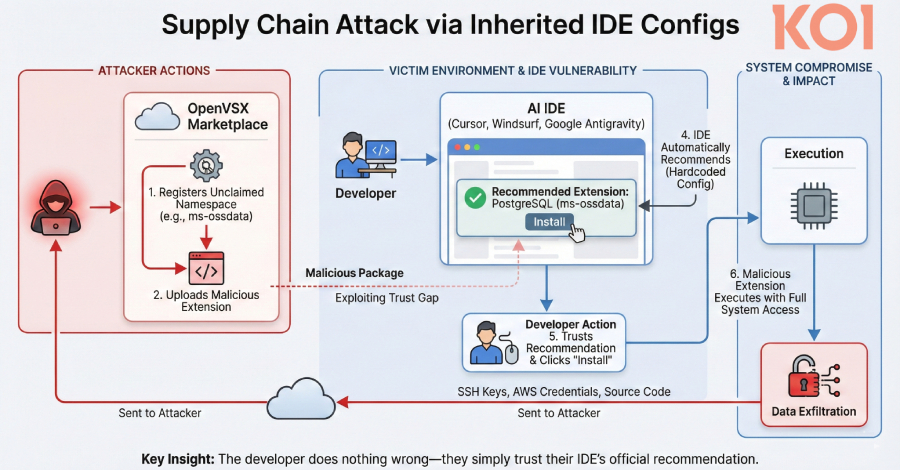
Well-liked synthetic intelligence (AI)-powered Microsoft Visible Studio Code (VS Code) forks reminiscent of Cursor, Windsurf, Google Antigravity, and Trae have been discovered to advocate extensions which can be non-existent within the Open VSX registry, doubtlessly opening the door to produce chain dangers when unhealthy actors publish malicious packages underneath these names.
The issue, in response to Koi, is that these built-in growth environments (IDEs) inherit the record of formally really useful extensions from Microsoft’s extensions market. These extensions do not exist in Open VSX.
The VS Code extension suggestions can take two totally different kinds: file-based, that are displayed as toast notifications when customers open a file in particular codecs, or software-based, that are advised when sure packages are already put in on the host.
“The issue: these really useful extensions did not exist on Open VSX,” Koi safety researcher Oren Yomtov stated. “The namespaces had been unclaimed. Anybody may register them and add no matter they needed.”

In different phrases, an attacker may weaponize the absence of those VS Code extensions and the truth that the AI-powered IDEs are VS Code forks to add a malicious extension to the Open VSX registry, reminiscent of ms-ossdata.vscode-postgresql.

In consequence, any time a developer with PostgreSQL put in opens one of many aforementioned IDEs and sees the message “Advisable: PostgreSQL extension,” a trivial set up motion is sufficient to outcome within the deployment of the rogue extension on their system as an alternative.
This straightforward act of belief can have extreme penalties, doubtlessly resulting in the theft of delicate information, together with credentials, secrets and techniques, and supply code. Koi stated its placeholder PostgreSQL extension attracted at least 500 installs, indicating that builders are downloading it just because the IDE advised it as a advice.
The names of a number of the extensions which were claimed by Koi with a placeholder are listed under –

ms-ossdata.vscode-postgresql
ms-azure-devops.azure-pipelines
msazurermtools.azurerm-vscode-tools
usqlextpublisher.usql-vscode-ext
cake-build.cake-vscode
pkosta2005.heroku-command

In response to accountable disclosure, Cursor, Windsurf, and Google have rolled out fixes to deal with the problem. The Eclipse Basis, which oversees Open VSX, has since eliminated non-official contributors and enforced broader registry-level safeguards.
With risk actors more and more specializing in exploiting the safety gaps in extension marketplaces and open-source repositories, it is important that builders train warning previous to downloading any packages or approving installs by verifying they arrive from a trusted writer.


The Hacker News Tags:Chain, Code, Creating, Extensions, Forks, Missing, Open, Recommend, Risk, Supply, VSX

Post navigation

Previous Post: NordVPN Denies Breach After Hacker Leaks Data
Next Post: New Critical n8n Vulnerability Allow Attackers to Execute Arbitrary Commands

Related Posts

MuddyWater Deploys UDPGangster Backdoor in Targeted Turkey-Israel-Azerbaijan Campaign MuddyWater Deploys UDPGangster Backdoor in Targeted Turkey-Israel-Azerbaijan Campaign The Hacker News
From Browser Stealer to Intelligence-Gathering Tool From Browser Stealer to Intelligence-Gathering Tool The Hacker News
eScan Antivirus Update Servers Compromised to Deliver Multi-Stage Malware eScan Antivirus Update Servers Compromised to Deliver Multi-Stage Malware The Hacker News
New EDDIESTEALER Malware Bypasses Chrome’s App-Bound Encryption to Steal Browser Data New EDDIESTEALER Malware Bypasses Chrome’s App-Bound Encryption to Steal Browser Data The Hacker News
Preinstalled Apps on Ulefone, Krüger&Matz Phones Let Any App Reset Device, Steal PIN Preinstalled Apps on Ulefone, Krüger&Matz Phones Let Any App Reset Device, Steal PIN The Hacker News
Critical SolarWinds Vulnerability Listed as Actively Exploited Critical SolarWinds Vulnerability Listed as Actively Exploited The Hacker News

Categories

  • Cyber Security News
  • How To?
  • Security Week News
  • The Hacker News

Recent Posts

  • Rapid SSH Worm Exploits Linux Systems with Credential Stuffing
  • Odido Telecom Hacked: 6.2 Million Accounts Compromised
  • Lazarus Group Targets npm and PyPI with Malicious Packages
  • DragonForce Ransomware Group’s Expanding Cartel Operations
  • North Korean Hackers Exploit AI for Enhanced Cyber Attacks

Pages

  • About Us – Contact
  • Disclaimer
  • Privacy Policy
  • Terms and Rules

Archives

  • February 2026
  • January 2026
  • December 2025
  • November 2025
  • October 2025
  • September 2025
  • August 2025
  • July 2025
  • June 2025
  • May 2025

Recent Posts

  • Rapid SSH Worm Exploits Linux Systems with Credential Stuffing
  • Odido Telecom Hacked: 6.2 Million Accounts Compromised
  • Lazarus Group Targets npm and PyPI with Malicious Packages
  • DragonForce Ransomware Group’s Expanding Cartel Operations
  • North Korean Hackers Exploit AI for Enhanced Cyber Attacks

Pages

  • About Us – Contact
  • Disclaimer
  • Privacy Policy
  • Terms and Rules

Categories

  • Cyber Security News
  • How To?
  • Security Week News
  • The Hacker News