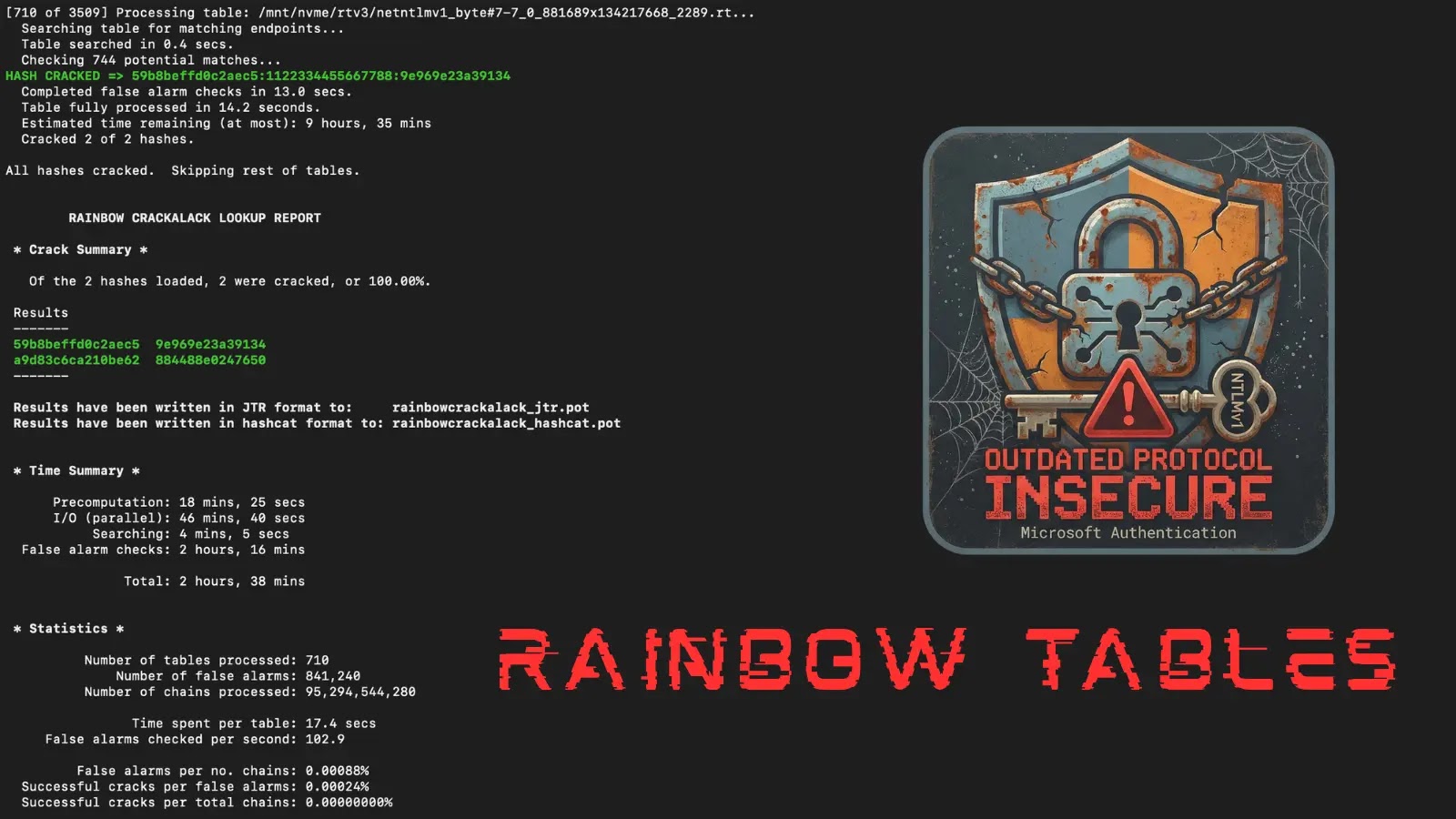
Google-owned Mandiant has publicly launched a complete dataset of Web-NTLMv1 rainbow tables, marking a major escalation in demonstrating the safety dangers of legacy authentication protocols.
The discharge underscores an pressing message: organizations should instantly migrate away from Web-NTLMv1, a deprecated protocol that has been cryptographically damaged since 1999 and extensively identified to be insecure since no less than 2012.
Regardless of twenty years of safety warnings, Mandiant consultants proceed figuring out Web-NTLMv1 in energetic enterprise environments, suggesting organizational inertia stays a essential barrier to remediation.
NTLMv1 brute-force (Supply: Mandiant)
The importance of this launch lies in dramatically decreasing the operational barrier for credential restoration. Beforehand, exploiting Web-NTLMv1 required both importing delicate authentication information to third-party providers or costly devoted {hardware} for brute-force assaults.
Mandiant’s dataset now allows safety professionals to recuperate authentication keys in underneath 12 hours utilizing consumer-grade {hardware} costing lower than $600 USD. This accessibility transforms Web-NTLMv1 from a theoretical vulnerability right into a sensible assault vector accessible to a far broader risk actor base.
Rainbow Tables Enabling NTLMv1 Admin Hack
The vulnerability stems from Web-NTLMv1’s reliance on a identified plaintext assault (KPA) mechanism. When an attacker obtains a Web-NTLMv1 hash with out Prolonged Session Safety (ESS) for the identified plaintext worth of 1122334455667788, they’ll apply cryptographic assaults to recuperate the important thing materials, which equates to the password hash of the authenticating Energetic Listing object.
The assault chain sometimes begins with authentication coercion towards extremely privileged targets, equivalent to area controllers, utilizing instruments like PetitPotam or DFSCoerce to power incoming connections.
As soon as captured, attackers preprocess Web-NTLMv1 hashes into DES parts utilizing utilities like ntlmv1-multi, then apply Mandiant’s rainbow tables with instruments equivalent to RainbowCrack or RainbowCrack-NG to recuperate the DES keys.
The ultimate key part might be calculated or seemed up utilizing specialised instruments, reconstructing the complete NT hash for credential compromise.
A typical escalation path includes recovering a site controller machine account hash, which then allows DCSync assaults to compromise any account inside Energetic Listing.
Rainbow tables symbolize a time-memory trade-off approach first proposed by Martin Hellman in 1980, with formal growth revealed by Philippe Oechslin in 2003.
Hashcat added assist for cracking DES keys utilizing identified plaintext in August 2016, additional democratizing Web-NTLMv1 exploitation. Mandiant’s launch combines Google Cloud’s computational sources with frontline safety experience to remove a whole class of authentication assaults at scale.
Cracking utilizing hashcat (Supply: Mandiant)
The dataset is accessible by means of the Google Cloud Analysis Dataset portal or by way of gsutil instructions. SHA512 checksums allow verification of dataset integrity, and the safety neighborhood has already created by-product implementations optimized for each CPU and GPU processing.
Attackers make use of Responder with the –lm and –disable-ess flags, setting authentication to the static worth 1122334455667788 to power Web-NTLMv1 negotiation.
Consequence (Supply: Mandiant)
Organizations can detect this exercise by filtering Home windows Occasion Log Occasion ID 4624 (“An Account was efficiently logged on”) for the “Authentication Bundle” area, alerting when “LM” or “NTLMv1” values seem.
Instant mitigation requires disabling Web-NTLMv1 throughout the group. Home windows programs should be configured to “Ship NTLMv2 response solely” by way of Native Safety Settings or Group Coverage, particularly by means of “Community Safety: LAN Supervisor authentication degree” settings.
Nonetheless, organizations ought to notice that native system configuration allows attackers with administrative entry to downgrade settings post-compromise, necessitating steady monitoring and detection mechanisms past coverage enforcement alone.
The discharge of Mandiant’s rainbow tables marks a major second in Web-NTLMv1 safety discussions. What was as soon as a tutorial concern has remodeled right into a sensible, accessible assault vector that requires fast organizational consideration and complete remediation methods.
Observe us on Google Information, LinkedIn, and X for day by day cybersecurity updates. Contact us to characteristic your tales.