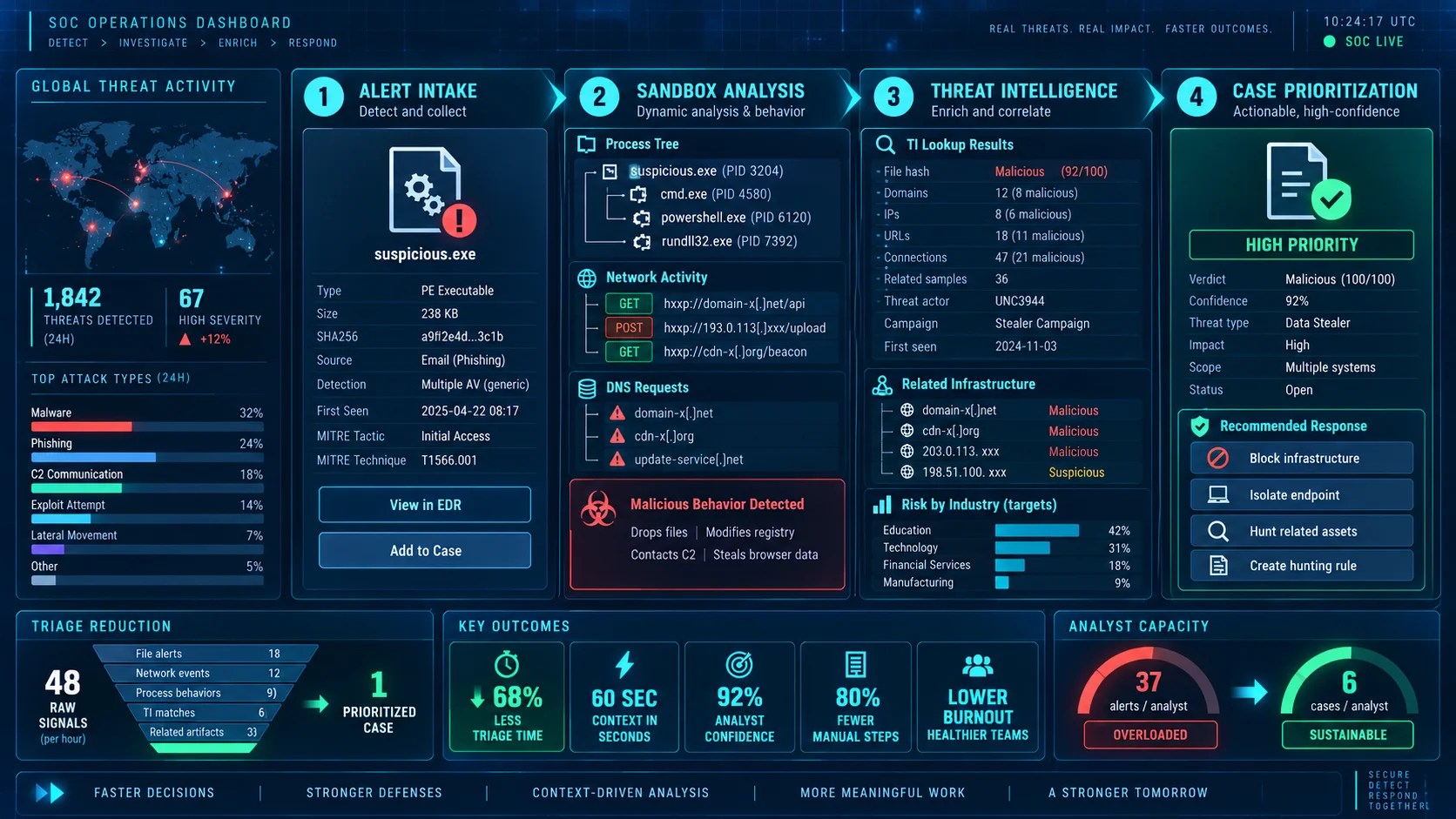
Security Operations Centers (SOCs) face the challenge of swiftly addressing alerts triggered by suspicious indicators like IP addresses or file hashes. These indicators, often known as Indicators of Compromise (IOCs), require thorough analysis to understand their implications fully. While IOCs can prompt quick reactions, they rarely provide a complete picture of the threat landscape.
Understanding Threat Context
To effectively analyze IOCs, analysts must determine the type of threat, associated malware, or infrastructure involved, and any related behaviors or techniques. This process typically involves consulting various threat intelligence sources, which can be time-consuming. Integrating threat intelligence lookup systems can streamline this effort by linking individual IOCs with broader threat information.
Advanced threat intelligence goes beyond simple reputation checks. It connects indicators with related infrastructure and behaviors, offering a holistic view of potential threats. For instance, a suspicious domain found in an email alert may be tied to a malware sample examined in an interactive sandbox, unveiling additional domains, IPs, and techniques used in the attack.
The Role of Interactive Sandbox Data
Interactive sandbox data plays a crucial role in providing behavioral context, revealing how a suspicious file behaves during an attack. This data can illustrate processes created, network connections made, and registry changes triggered by the malware. Such insights help analysts connect IOCs to broader attack patterns.
ANY.RUN leverages contributions from over 16,000 SOCs and 700,000 analysts to build its threat intelligence. This collaborative approach ensures that the intelligence is not only up-to-date but also actionable, offering detailed examples of how threats manifest in real-world scenarios.
Optimizing Investigations with TI Lookup
ANY.RUN’s Threat Intelligence Lookup (TI Lookup) consolidates sandbox research, enabling analysts to search for indicators and trace them to related activities. This tool supports investigations by allowing searches across numerous parameters such as hashes, IP addresses, domains, and more, facilitating both alert investigations and proactive threat hunting.
By providing access to six months of research data, TI Lookup shortens the path from isolated indicators to comprehensive understanding. This capability not only strengthens investigations but also boosts detection rates by linking results to relevant sandbox sessions and MITRE ATT&CK entries.
Enhancing Threat Detection and Response
Combining TI Lookup with continuously updated threat intelligence feeds enhances its utility. ANY.RUN’s TI Feeds offer fresh, context-rich data on malicious activities, helping analysts quickly identify and investigate emerging threats with minimal false positives.
For SOC teams, the integration of lookup, feeds, reports, and sandbox intelligence supports faster alert triage, reduces alert fatigue, and facilitates more effective threat hunting. This approach allows analysts to connect isolated alerts to wider campaigns, improving detection and response strategies.
In conclusion, threat intelligence becomes significantly more valuable when it helps analysts move seamlessly from identifying an IOC to understanding the broader threat and determining appropriate actions. By merging various intelligence sources, SOCs can enhance their efficiency, reducing response times and alleviating analyst burnout.