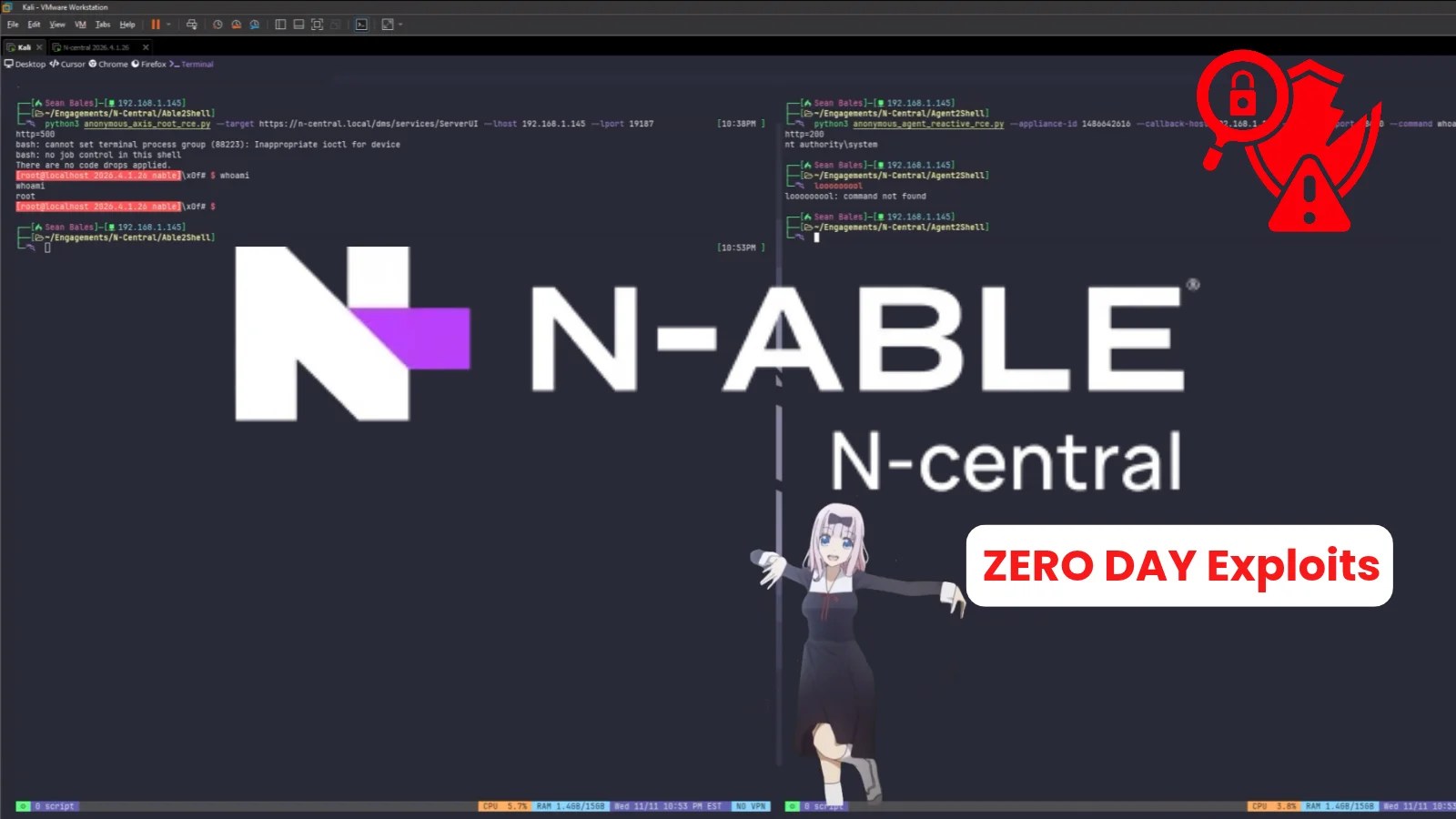
New security vulnerabilities have emerged for N-able N-central servers, causing alarm among cybersecurity experts. Despite the recent release of an emergency patch, servers remain at risk due to exploit tools identified as 4EverAble2Shell and Agent2Shell. These tools, revealed on November 11, specifically target N-central 2026.4 HF2, build 2026.4.1.26.
N-able Zero-Day Vulnerabilities
The cybersecurity firm Huntress has scrutinized the exploit code, advising that even fully patched servers should be considered vulnerable. This warning follows the deployment of an emergency update on November 10 by N-able, which aimed to rectify seven critical vulnerabilities disclosed alongside 33 other potential threats under the name Able2Shell.
These newly discovered exploits do not imply that previous patches were ineffective but highlight additional risks in the patched systems.
Understanding the Exploit Mechanisms
The main concern lies with the 4EverAble2Shell tool, which allows remote code execution without needing login credentials, ultimately granting root access on affected systems. This vulnerability requires Legacy API mode to be enabled on the appliance. According to initial evaluations by Huntress, there is a potential for unauthenticated root access, though no successful attacks have been reported on customer systems thus far.
Agent2Shell, on the other hand, threatens the communication pathways between N-central servers and their Windows Agents and Probes. Notably, over ten issues have been identified, including two exploit chains that could enable attackers to execute commands on managed Windows devices as SYSTEM users.
Implications for Managed Service Providers
These developments are particularly critical for managed service providers, as N-central facilitates remote administration across client networks. The exploit’s ability to access the management server poses a significant threat beyond a single appliance, potentially affecting all connected endpoints.
In response to these findings, a global shutdown of hosted N-central services was initiated. Huntress cautions that the newly released exploit chains could enable attackers to transition from compromised servers to the Windows systems they manage.
In a technical update on November 12, Huntress stated no fix was available for the latest vulnerabilities at that time. They recommended that on-premises users disconnect N-central from the internet or disable it entirely, even after applying the HF2 patch. Sole reliance on IP allowlisting may be insufficient, as affected interfaces also manage standard Agent and Probe connections.
Steps for Immediate Action
Security teams should closely monitor server logs for unusual requests, particularly those directed at /dms/services/ServerUI and /dms2/services2/ServerMMS2, using a session ID of -1. Additionally, they should be vigilant for unexpected script backups or symbolic links related to flag_default.json.
On Windows platforms, it is critical to inspect for encoded PowerShell commands initiated by N-able components, alterations to Software Probe files, and unexplained service restarts. While normal support activities can trigger similar processes, any anomalies from November 11 onward warrant thorough investigation.
Suspicious activity should prompt a comprehensive incident response that evaluates both the appliance and the devices it manages, rather than assuming that installing HF2 ensures security. Integrating threat intelligence can enhance the ability of Security Operations Centers (SOCs) to quickly address potential incidents.