Skip to content
  • Home
  • Cyber Map
  • About Us – Contact
  • Disclaimer
  • Terms and Rules
  • Privacy Policy
Cyber Web Spider Blog – News

Cyber Web Spider Blog – News

Globe Threat Map provides a real-time, interactive 3D visualization of global cyber threats. Monitor DDoS attacks, malware, and hacking attempts with geo-located arcs on a rotating globe. Stay informed with live logs and archive stats.

  • Home
  • Cyber Map
  • Cyber Security News
  • Security Week News
  • The Hacker News
  • How To?
  • Toggle search form
Critical NGINX HTTP/2 Vulnerabilities Threaten Web Servers

Critical NGINX HTTP/2 Vulnerabilities Threaten Web Servers

Posted on November 18, 2026 By CWS

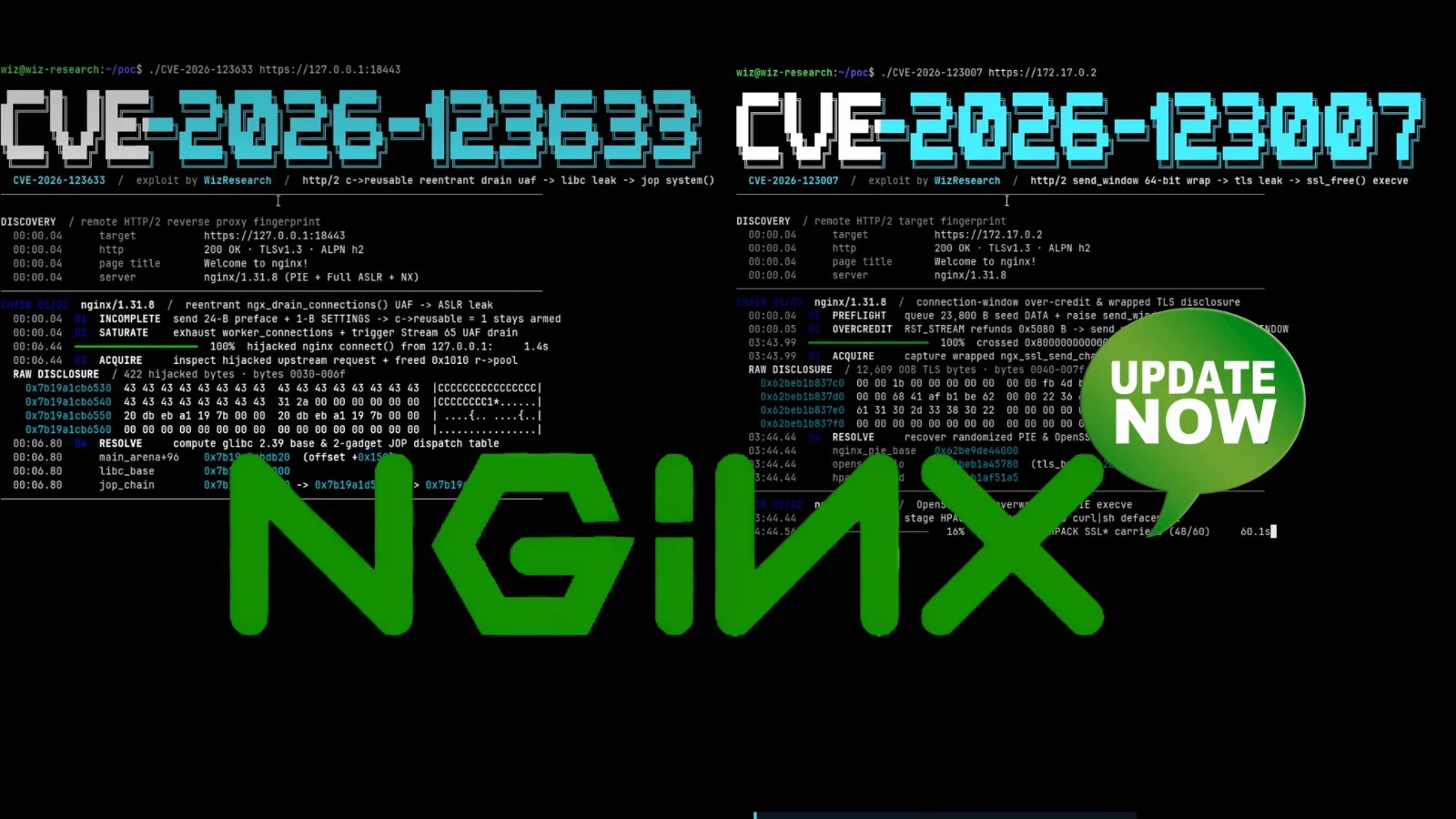
Two significant vulnerabilities have been identified in NGINX that could potentially allow remote attackers to execute code on susceptible web servers. These flaws, known as CVE-2026-123633 and CVE-2026-123007, were publicly disclosed on November 18, 2026, and pose a serious threat to the security of web servers utilizing NGINX.

Understanding the NGINX Vulnerabilities

The vulnerabilities require NGINX to be configured to accept HTTP/2 connections, but they manifest under different conditions. One vulnerability is specific to certain reverse proxy setups, while the other can impact servers that merely serve static files. These flaws are inherent in the NGINX software itself and not in the underlying websites or APIs it supports. Given that NGINX often manages HTTPS and directs incoming traffic to various applications, a compromised proxy can jeopardize multiple services, even if their application code is secure. The potential consequences of an exploit include data exposure, unauthorized data modification, and service disruption.

Discovery and Impact Analysis

Security researchers from Wiz Research, Ikotas Labs, Metnir, Rapid7, and Xint have been credited with discovering these vulnerabilities. Both have been assigned a critical severity score of 9.2 on the CVSS 4.0 scale, underscoring the potential for remote code execution. Although no active exploitation of these vulnerabilities has been reported, the widespread use of NGINX, as indicated by Netcraft’s survey of over 225 million sites, highlights the urgency of addressing these security gaps.

Mitigation and Future Outlook

To mitigate these vulnerabilities, administrators are advised to update their NGINX installations. Fixed versions are available with NGINX Open Source 1.31.9 on the mainline branch and 1.30.7 on the stable branch. NGINX Plus users should check for corresponding updated builds. Administrators should prioritize updating internet-facing servers and verify the running version after applying updates. In the interim, disabling HTTP/2 on affected listeners can reduce exposure while awaiting a permanent fix.

As organizations continue to navigate the complexities of cybersecurity, staying informed and proactive in applying updates is crucial. Monitoring advisories and implementing recommended security measures can significantly mitigate risks associated with these vulnerabilities. Ensuring a robust update process and regular security assessments will help maintain the integrity of web server operations in the face of evolving threats.


Cyber Security News Tags:CVE-2026-123007, CVE-2026-123633, Cybersecurity, F5, HTTP/2, internet security, NGINX, remote code execution, risk management, security updates, software patches, system administrators, Vulnerabilities, web security, web servers

Post navigation

Previous Post: Patti Degnan: Navigating a Non-Traditional CISO Journey
Next Post: Malicious Agent Framework Releases Threaten Credentials

Related Posts

Weaponized ScreenConnect RMM Tool Tricks Users into Downloading Xworm RAT Weaponized ScreenConnect RMM Tool Tricks Users into Downloading Xworm RAT Cyber Security News
2,000+ Devices Hacked Using Weaponized Social Security Statement Themes 2,000+ Devices Hacked Using Weaponized Social Security Statement Themes Cyber Security News
Coyote Malware Abuses Microsoft’s UI Automation in Wild to Exfiltrate Login Credentials Coyote Malware Abuses Microsoft’s UI Automation in Wild to Exfiltrate Login Credentials Cyber Security News
Lionishackers Threat Actors Exfiltrating and Selling Corporate Databases on Dark Web Lionishackers Threat Actors Exfiltrating and Selling Corporate Databases on Dark Web Cyber Security News
WhatsApp Introduces New Security Alerts for Unknown Numbers WhatsApp Introduces New Security Alerts for Unknown Numbers Cyber Security News
Hackers Exploit Shopify’s Shop App with Phony Invoices Hackers Exploit Shopify’s Shop App with Phony Invoices Cyber Security News

Categories

  • Cyber Security News
  • How To?
  • Security Week News
  • The Hacker News

Recent Posts

  • 2027 Cybersecurity Awards: New AI Categories Announced
  • Malicious Agent Framework Releases Threaten Credentials
  • Critical NGINX HTTP/2 Vulnerabilities Threaten Web Servers
  • Patti Degnan: Navigating a Non-Traditional CISO Journey
  • New Technique Threatens Windows Hello and BitLocker Security

Pages

  • About Us – Contact
  • Disclaimer
  • Privacy Policy
  • Terms and Rules

Archives

  • November 2026
  • October 2026
  • September 2026
  • August 2026
  • July 2026
  • June 2026
  • May 2026
  • April 2026
  • March 2026
  • February 2026
  • January 2026
  • December 2025
  • November 2025
  • October 2025
  • September 2025
  • August 2025
  • July 2025
  • June 2025
  • May 2025

Recent Posts

  • 2027 Cybersecurity Awards: New AI Categories Announced
  • Malicious Agent Framework Releases Threaten Credentials
  • Critical NGINX HTTP/2 Vulnerabilities Threaten Web Servers
  • Patti Degnan: Navigating a Non-Traditional CISO Journey
  • New Technique Threatens Windows Hello and BitLocker Security

Pages

  • About Us – Contact
  • Disclaimer
  • Privacy Policy
  • Terms and Rules

Categories

  • Cyber Security News
  • How To?
  • Security Week News
  • The Hacker News

Copyright © 2026 Cyber Web Spider Blog – News.

Powered by PressBook Masonry Dark