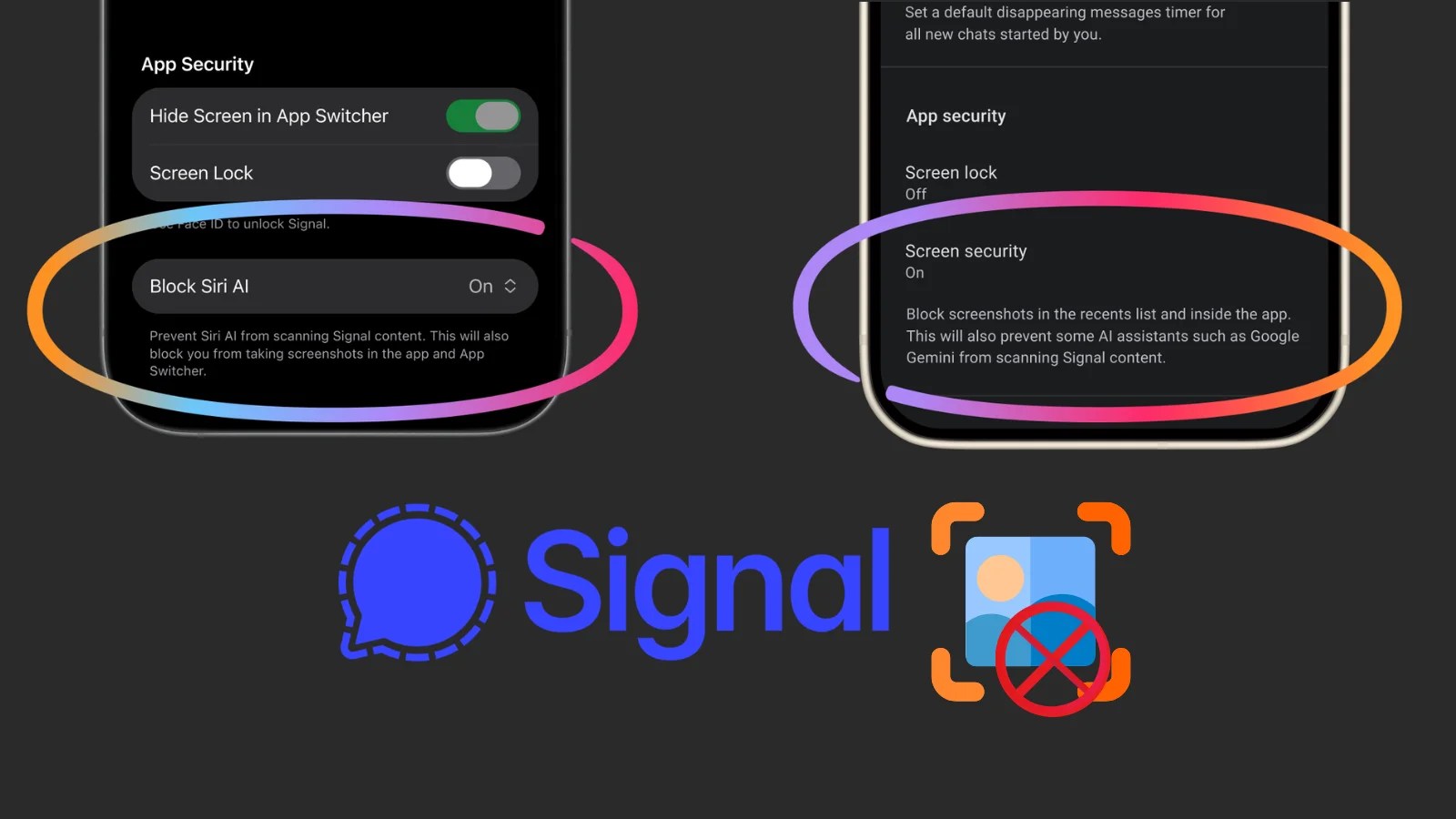
Signal has introduced a new feature aimed at enhancing user privacy by restricting screenshot capabilities on iOS 27 and select Android devices. This measure is designed to prevent AI assistants, such as Apple’s Siri and Google Gemini, from accessing private conversations via screen capture.
Enhanced Security on iOS and Android
On iOS 27, Signal has implemented a ‘Block Siri AI’ setting to inhibit Siri from scanning content within the app. This feature also prevents screenshots from being taken inside Signal and while using the App Switcher. For Android users, Signal activates ‘Screen security’ when it detects an AI assistant attempting to access the screen. However, Signal notes that this feature may function differently across various Android versions.
Addressing AI and Screen Access Risks
The update addresses privacy concerns that arise after a message is received. While Signal’s end-to-end encryption ensures message protection during transmission, the content must be displayed as readable text once a chat is accessed. AI assistants with screen-reading capabilities pose a risk by capturing this visible information without breaching encryption.
Signal’s decision to restrict AI access follows its 2025 initiative to disable screenshot functionality in its Windows 11 desktop app, safeguarding chats from being indexed by Microsoft Recall. Other applications, like Brave, have taken a different approach by blocking Microsoft’s service while maintaining regular screenshot capabilities.
Balancing Privacy and Functionality
While Apple asserts that Siri’s on-screen awareness aids in user interaction, and Google’s Gemini notes that screen actions may upload content for context, these capabilities raise privacy concerns. Signal emphasizes that once an AI captures a message, it cannot control how that data is subsequently managed. Users can disable this protection in Signal’s privacy settings to re-enable screenshots, but this exposes chat data to potential risks.
Despite these efforts, Signal acknowledges that complete protection cannot be ensured on all platforms, such as macOS. The organization urges Apple, Google, and Microsoft to provide developers with options to prevent AI from accessing screens and notifications without compromising standard features.
As the demand for secure communication grows, Signal’s proactive stance highlights the importance of safeguarding sensitive information from emerging AI and cyber risks. Users are encouraged to stay informed and leverage available privacy settings to protect their data.