Skip to content
  • Home
  • Cyber Map
  • About Us – Contact
  • Disclaimer
  • Terms and Rules
  • Privacy Policy
Cyber Web Spider Blog – News

Cyber Web Spider Blog – News

Globe Threat Map provides a real-time, interactive 3D visualization of global cyber threats. Monitor DDoS attacks, malware, and hacking attempts with geo-located arcs on a rotating globe. Stay informed with live logs and archive stats.

  • Home
  • Cyber Map
  • Cyber Security News
  • Security Week News
  • The Hacker News
  • How To?
  • Toggle search form
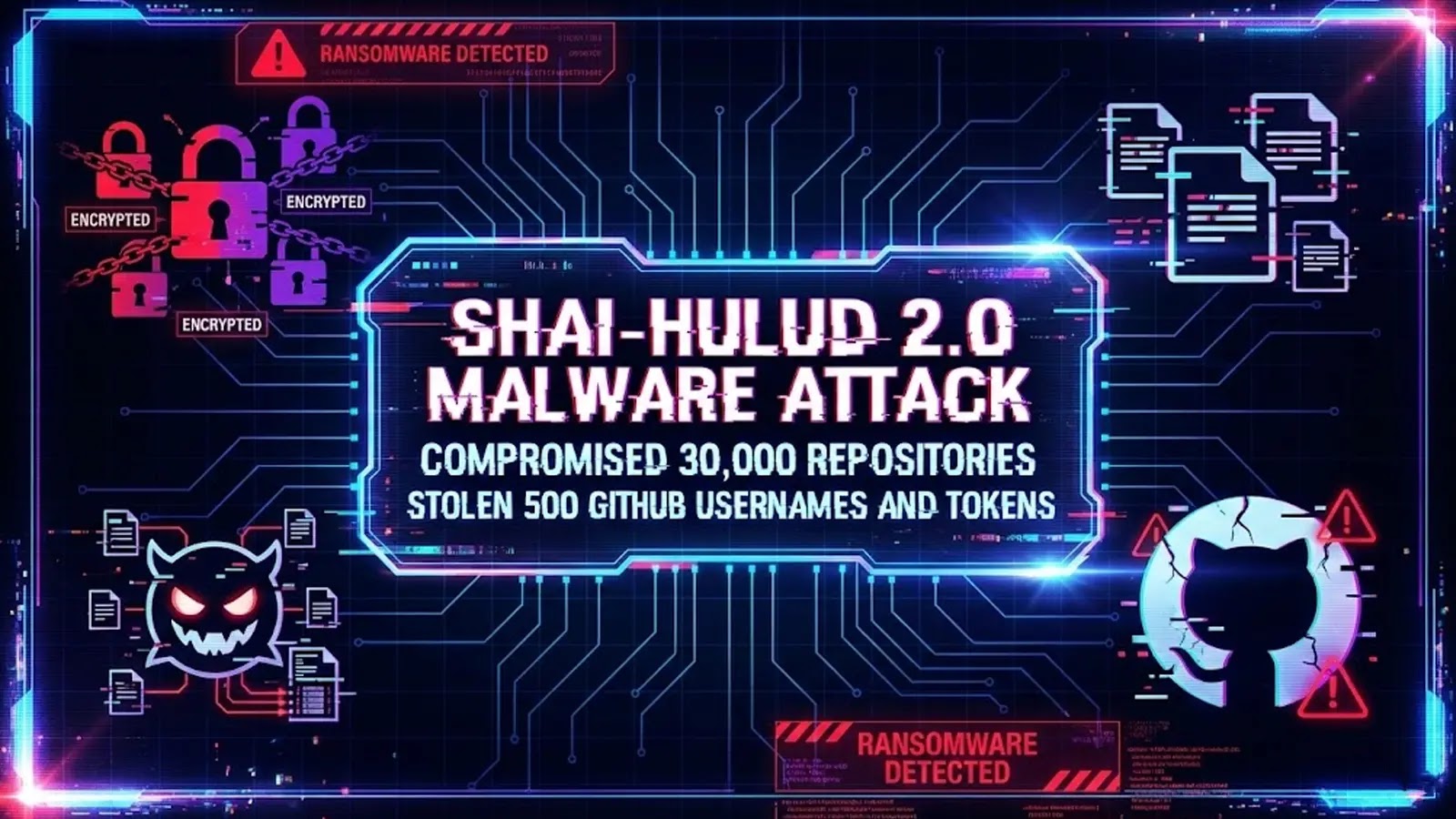
Shai-Hulud 2.0 Malware Attack Compromised 30,000 Repositories and Stolen 500 GitHub Usernames and Tokens

Shai-Hulud 2.0 Malware Attack Compromised 30,000 Repositories and Stolen 500 GitHub Usernames and Tokens

Posted on December 3, 2025December 3, 2025 By CWS

A major provide chain safety breach has emerged with the invention of Shai-Hulud 2.0, a complicated malware that has compromised over 30,000 GitHub repositories since its emergence on November 24, 2025.

This worm-like malware represents a rising menace to the developer ecosystem, particularly focusing on the NPM package deal supervisor and spreading throughout a number of platforms together with Maven and OpenVSX.

The assault demonstrates how attackers are more and more focusing on the instruments builders depend on day by day, stealing important credentials and delicate secrets and techniques from growth environments.

The malware infiltrates programs by way of poisoned NPM packages, with the first an infection vectors being @postman/tunnel-agent model 0.6.7 and @asyncapi/specs model 6.8.3, which collectively account for over 60 % of all infections.

asyncapi-preview IDE extension (Supply – Wiz.io)

As soon as executed throughout the package deal set up part, the malware operates by way of a pre-install script that runs routinely, establishing persistence and starting its credential harvesting operations.

The worm displays a self-propagating functionality, looking for present GitHub credentials inside compromised environments and utilizing them to add further malicious repositories, making a cascading chain of infections.

Wiz.io safety analysts famous that the malware has stolen roughly 500 distinctive GitHub usernames and tokens from the contents.json information discovered throughout compromised repositories.

Past GitHub credentials, the assault has exfiltrated as much as 400,000 secrets and techniques recognized by way of Trufflehog scanning, although solely about 2.5 % of those are verified as reliable.

Package deal prevalence (Supply – Wiz.io)

Critically, over 60 % of leaked NPM tokens stay legitimate and pose an energetic threat for additional provide chain assaults.

Credential Harvesting and Persistence Mechanisms

The an infection mechanism depends on injecting malicious code into the pre-install lifecycle script, which executes throughout package deal set up with minimal person consciousness.

The malware collects setting variables and system data into an setting.json file, creating an in depth fingerprint of every compromised system.

Most contaminated machines are Linux-based containers inside CI/CD environments, with GitHub Actions being the main focused platform.

The malware makes an attempt cloud secret extraction from AWS, Google Cloud, and Azure environments, although evaluation reveals implementation flaws on this performance as a result of lacking error dealing with that forestalls correct secret harvesting from a number of cloud suppliers concurrently.

This technical oversight inadvertently restricted the scope of cloud credential theft, although native secrets and techniques and growth credentials stay totally compromised throughout 1000’s of organizations worldwide.

Observe us on Google Information, LinkedIn, and X to Get Extra On the spot Updates, Set CSN as a Most popular Supply in Google.

Cyber Security News Tags:Attack, Compromised, GitHub, Malware, Repositories, ShaiHulud, Stolen, Tokens, Usernames

Post navigation

Previous Post: Malicious Rust Evm-Units Mimic as EVM Version Silently Executes OS-specific Payloads
Next Post: K7 Antivirus Vulnerability Allows Attackers Gain SYSTEM-level Privileges

Related Posts

CISA Demands Removal of Outdated Network Devices CISA Demands Removal of Outdated Network Devices Cyber Security News
Yurei Ransomware Leverages SMB Shares and Removable Drives to Encrypt Files Yurei Ransomware Leverages SMB Shares and Removable Drives to Encrypt Files Cyber Security News
UAC‑0099 Tactics, Techniques, Procedures and Attack Methods Unveiled UAC‑0099 Tactics, Techniques, Procedures and Attack Methods Unveiled Cyber Security News
OpenSSL Vulnerabilities Allow Remote Attackers to Execute Malicious Code OpenSSL Vulnerabilities Allow Remote Attackers to Execute Malicious Code Cyber Security News
Sprocket Security Earns Repeat Recognition in G2’s Winter 2025 Relationship Index for Penetration Testing Sprocket Security Earns Repeat Recognition in G2’s Winter 2025 Relationship Index for Penetration Testing Cyber Security News
New Android Malware Mimics as SBI Card, Axis Bank Apps to Steal Users Financial Data New Android Malware Mimics as SBI Card, Axis Bank Apps to Steal Users Financial Data Cyber Security News

Categories

  • Cyber Security News
  • How To?
  • Security Week News
  • The Hacker News

Recent Posts

  • Muddled Libra Exploits VMware vSphere in Cyber Attack
  • Feiniu NAS Devices Targeted in Major Botnet Attack
  • Rapid SSH Worm Exploits Linux Systems with Credential Stuffing
  • Odido Telecom Hacked: 6.2 Million Accounts Compromised
  • Lazarus Group Targets npm and PyPI with Malicious Packages

Pages

  • About Us – Contact
  • Disclaimer
  • Privacy Policy
  • Terms and Rules

Archives

  • February 2026
  • January 2026
  • December 2025
  • November 2025
  • October 2025
  • September 2025
  • August 2025
  • July 2025
  • June 2025
  • May 2025

Recent Posts

  • Muddled Libra Exploits VMware vSphere in Cyber Attack
  • Feiniu NAS Devices Targeted in Major Botnet Attack
  • Rapid SSH Worm Exploits Linux Systems with Credential Stuffing
  • Odido Telecom Hacked: 6.2 Million Accounts Compromised
  • Lazarus Group Targets npm and PyPI with Malicious Packages

Pages

  • About Us – Contact
  • Disclaimer
  • Privacy Policy
  • Terms and Rules

Categories

  • Cyber Security News
  • How To?
  • Security Week News
  • The Hacker News