Skip to content
  • Home
  • Cyber Map
  • About Us – Contact
  • Disclaimer
  • Terms and Rules
  • Privacy Policy
Cyber Web Spider Blog – News

Cyber Web Spider Blog – News

Globe Threat Map provides a real-time, interactive 3D visualization of global cyber threats. Monitor DDoS attacks, malware, and hacking attempts with geo-located arcs on a rotating globe. Stay informed with live logs and archive stats.

  • Home
  • Cyber Map
  • Cyber Security News
  • Security Week News
  • The Hacker News
  • How To?
  • Toggle search form
Microsoft Teams to Enforce Messaging Safety Defaults Starting January 2026

Microsoft Teams to Enforce Messaging Safety Defaults Starting January 2026

Posted on December 23, 2025December 23, 2025 By CWS

Microsoft is strengthening the safety posture of enterprise collaboration by robotically enabling crucial messaging security options in Microsoft Groups.

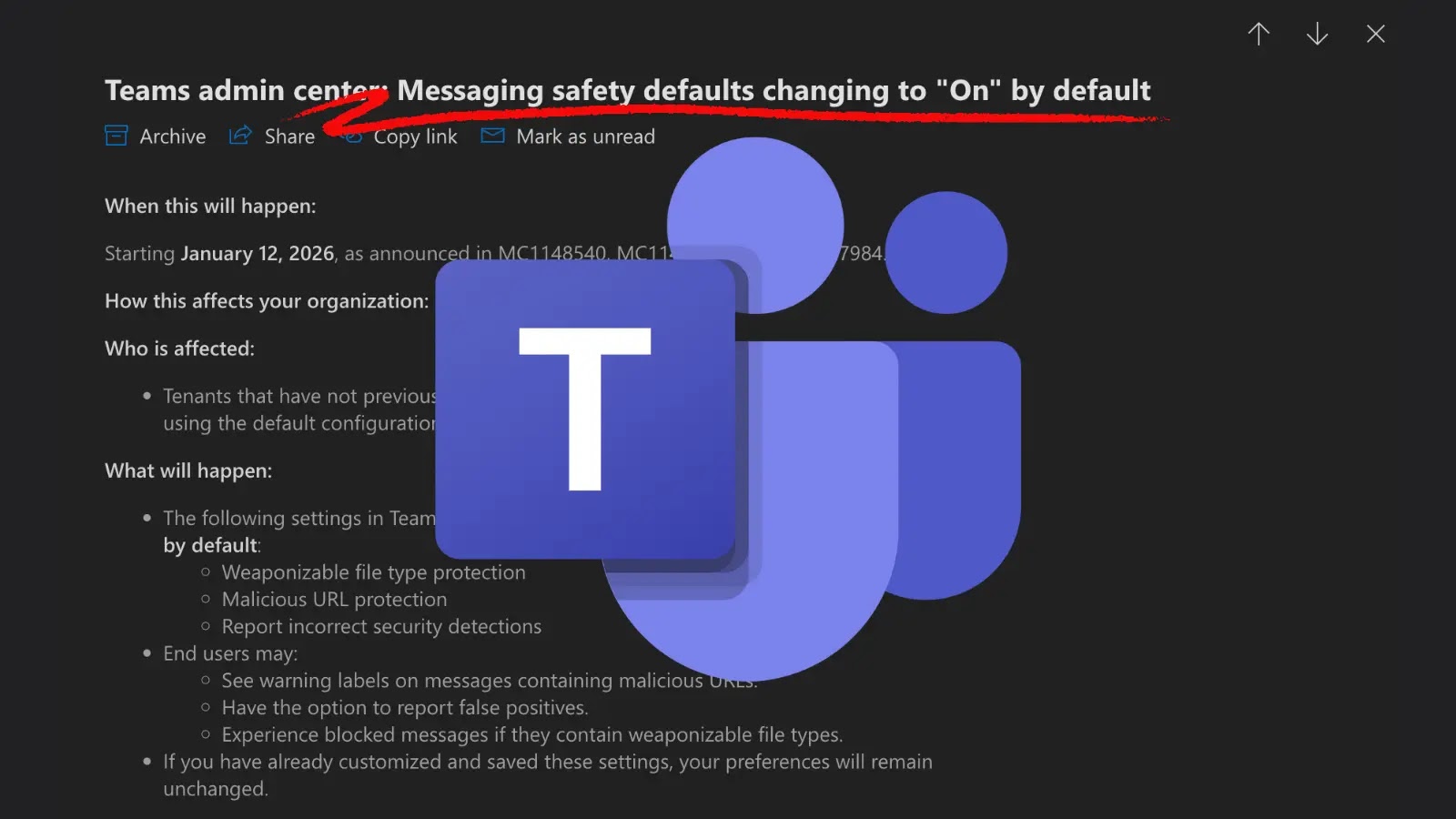
In response to a brand new administrative replace, the corporate will swap a number of protecting settings to “On” by default beginning January 12, 2026, affecting tenants who depend on normal configurations.

The initiative represents a shift towards “secure-by-default” rules, aiming to cut back the assault floor for organizations which will have neglected guide safety hardening.

As detailed in administrative advisories MC1148540, MC1148539, and MC1147984, the replace targets the Messaging Security part of the Groups Admin Middle.

What Is Altering?

For tenants that haven’t modified their messaging security settings, three particular protections can be robotically activated:

Weaponizable File Sort Safety: This function blocks the transmission of file extensions identified to be high-risk vectors for malware execution.

Malicious URL Safety: Groups will scan shared hyperlinks in real-time to detect and flag identified phishing websites or malicious domains.

Report Incorrect Safety Detections: This suggestions mechanism empowers end-users to report false positives, serving to Microsoft fine-tune its risk detection algorithms.

This rollout particularly impacts tenants using the default configuration. Organizations which have beforehand personalized and saved their messaging security settings is not going to be impacted; their established preferences will take priority over the brand new defaults.

As soon as the replace takes impact, end-users could discover speedy modifications of their every day workflows. Workers sharing content material may even see warning labels hooked up to messages containing suspicious URLs.

Moreover, customers making an attempt to switch file varieties deemed “weaponizable” will expertise blocked messages. Nonetheless, the inclusion of the reporting function ensures that legit enterprise workflows should not completely disrupted by false alarms.

For IT directors, the window to evaluate these modifications is now open. Microsoft advises directors to navigate to Groups admin middle > Messaging > Messaging settings > Messaging security to examine present values.

Admins who want to decide out of those defaults should manually regulate and save their settings earlier than the January 12, 2026, deadline. If no motion is taken, the brand new safety protocols will apply robotically.

To make sure a clean transition, safety groups are inspired to replace inside documentation concerning acceptable file varieties and URL warnings. Microsoft additionally recommends that organizations inform helpdesk workers in regards to the upcoming modifications.

Making ready assist groups now will assist them differentiate between legit safety blocks and potential system errors when customers start reporting points in early 2026.

By standardizing these protections, Microsoft goals to mitigate the rising development of risk actors using collaboration platforms for lateral motion and malware distribution.

Observe us on Google Information, LinkedIn, and X for every day cybersecurity updates. Contact us to function your tales.

Cyber Security News Tags:Defaults, Enforce, January, Messaging, Microsoft, Safety, Starting, Teams

Post navigation

Previous Post: Two Chrome Extensions Caught Secretly Stealing Credentials from Over 170 Sites
Next Post: Operation PCPcat Hacked 59,000+ Next.js/React Servers Within 48 Hours

Related Posts

Threat Actors Leverages DeepSeek-R1 Popularity to Attack Users Running Windows Devices Threat Actors Leverages DeepSeek-R1 Popularity to Attack Users Running Windows Devices Cyber Security News
Severe Wazuh Flaw Allows Critical Security Breaches Severe Wazuh Flaw Allows Critical Security Breaches Cyber Security News
Top Simulated DDoS Testing Tools for 2026 Top Simulated DDoS Testing Tools for 2026 Cyber Security News
New Osiris Ransomware Using Wide Range of Living off the Land and Dual-use Tools in Attacks New Osiris Ransomware Using Wide Range of Living off the Land and Dual-use Tools in Attacks Cyber Security News
New Gmail Phishing Attack With Weaponized Login Flow Steals Login Credentials New Gmail Phishing Attack With Weaponized Login Flow Steals Login Credentials Cyber Security News
Botnet Disruption Successes and DDoS Adaptation Botnet Disruption Successes and DDoS Adaptation Cyber Security News

Categories

  • Cyber Security News
  • How To?
  • Security Week News
  • The Hacker News

Recent Posts

  • F-Droid 2.0 Debuts with Major Redesign for App Discovery
  • China and US to Create AI Safety Channel Amid Ongoing Talks
  • Lunex Stealer Exploits AMD Driver for Credential Theft
  • Local AI Model Evades EDR Detection with Modified Credential Dumper
  • Enhancing AI Agent Security with Zero Trust Principles

Pages

  • About Us – Contact
  • Disclaimer
  • Privacy Policy
  • Terms and Rules

Archives

  • September 2026
  • August 2026
  • July 2026
  • June 2026
  • May 2026
  • April 2026
  • March 2026
  • February 2026
  • January 2026
  • December 2025
  • November 2025
  • October 2025
  • September 2025
  • August 2025
  • July 2025
  • June 2025
  • May 2025

Recent Posts

  • F-Droid 2.0 Debuts with Major Redesign for App Discovery
  • China and US to Create AI Safety Channel Amid Ongoing Talks
  • Lunex Stealer Exploits AMD Driver for Credential Theft
  • Local AI Model Evades EDR Detection with Modified Credential Dumper
  • Enhancing AI Agent Security with Zero Trust Principles

Pages

  • About Us – Contact
  • Disclaimer
  • Privacy Policy
  • Terms and Rules

Categories

  • Cyber Security News
  • How To?
  • Security Week News
  • The Hacker News

Copyright © 2026 Cyber Web Spider Blog – News.

Powered by PressBook Masonry Dark