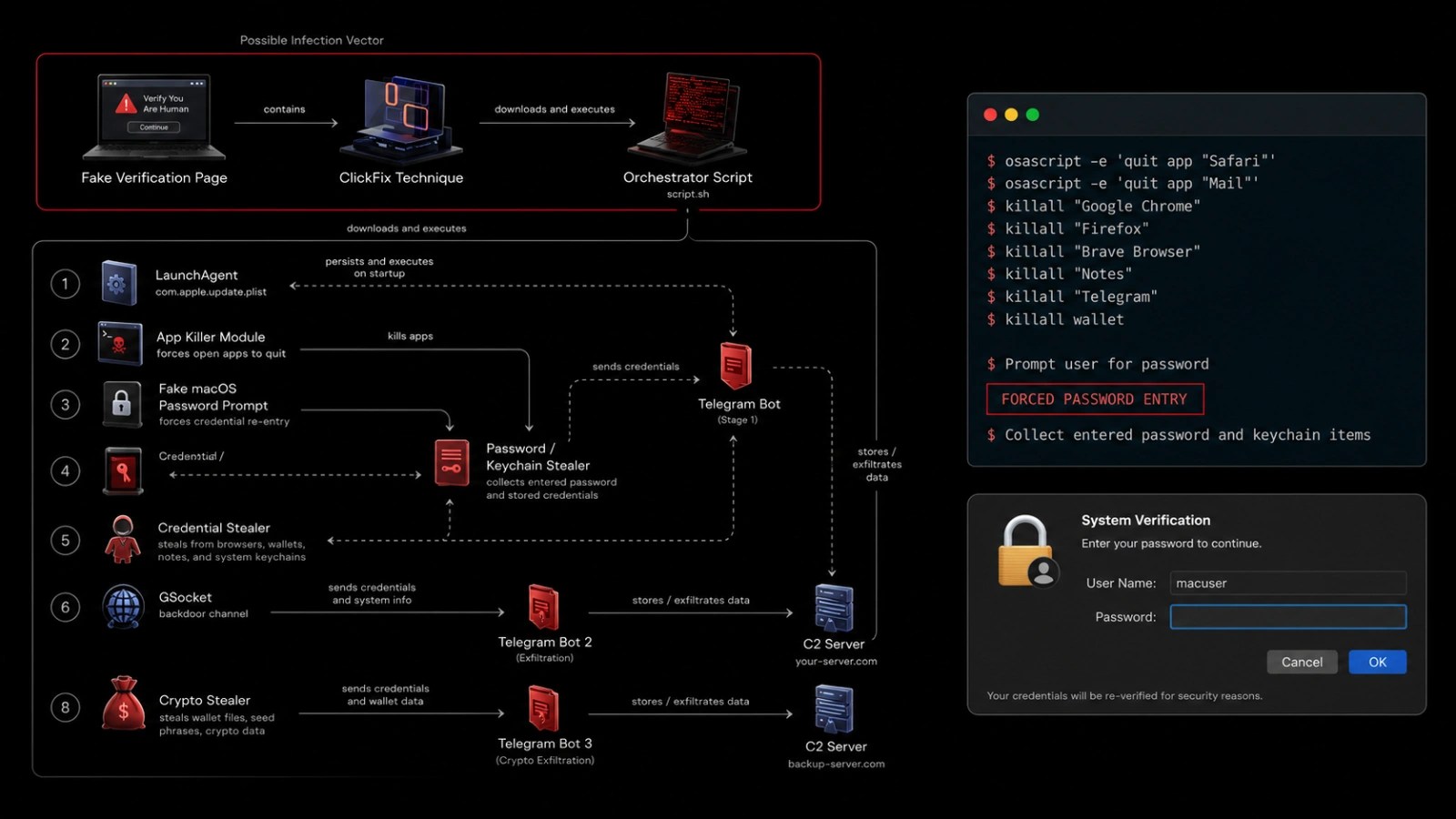
A new macOS malware known as ClickLock is causing significant concern among cybersecurity experts due to its aggressive approach to stealing user credentials. The malware, identified by researchers at Group-IB, employs a disruptive method that closes applications, effectively locking users out until they enter their macOS password.
Innovative Tactics in macOS Threat Landscape
ClickLock marks a noteworthy change in threats targeting macOS, combining traditional credential-stealing techniques with user manipulation commonly seen in ransomware. This trend reflects a growing focus on Mac endpoints through web-based attacks, similar to the Atomic Stealer ClickFix, which bypasses default security warnings.
The malware, once activated, executes a series of actions that destabilize the system environment. It systematically terminates active processes, leaving the system barely operational. This chaos is followed by a phony system prompt resembling legitimate macOS authentication requests, increasing the likelihood of users entering their credentials.
Deceptive Techniques and User Manipulation
The credentials entered during this disruption are captured and sent to the attackers’ control infrastructure. Group-IB highlights that ClickLock utilizes AppleScript and native macOS utilities, allowing it to blend with legitimate system activities, avoiding basic detection methods.
Rather than relying on complex exploits, ClickLock leverages social engineering and user trust in system prompts to achieve its goals. This approach aligns with quieter installation strategies seen in other Mac malware families, focusing on basic system utilities to remain undetected.
Potential for Expansion and Mitigation Strategies
In addition to credential theft, ClickLock gathers extensive system information, including device and user environment data, which could be used for future attacks or sold on cybercrime forums. Its modular design suggests potential for adding features like automated data theft or persistence mechanisms.
While the exact method of infection remains uncertain, researchers suspect it spreads through trojanized apps, malicious downloads, or phishing campaigns. As macOS usage grows in enterprise settings, attackers are increasingly targeting this platform to exploit perceived security gaps.
Organizations are advised to adopt behavioral guidelines to mitigate risks, such as verifying unexpected prompts, maintaining endpoint protection with behavioral detection, and reporting unusual system behavior to security teams.
Adapting to Evolving Cyber Threats
The emergence of ClickLock highlights the rapidly changing threat landscape for macOS systems, indicating that these platforms are now a priority for cybercriminals. As attackers enhance their methods by combining system-level disruptions with credential theft, defenders must strengthen both technical defenses and user awareness.
Enhance your security operations by integrating tools like ANY.RUN to accelerate threat detection and investigations.