A newly identified vulnerability in Microsoft Copilot Personal, referred to as CVE-2026-24301 and nicknamed CoSnitch, has been found to allow attackers to extract sensitive data with just a single click on a malicious link. This flaw has been patched by Microsoft as of August 18, 2026, marking a significant development in cybersecurity.
Discovery and Impact of CoSnitch
The vulnerability was uncovered by Varonis Threat Labs and is the third such flaw found in Microsoft Copilot this year. Previous vulnerabilities included Reprompt and SearchLeak, both of which exploited similar weaknesses. These vulnerabilities highlight a critical issue: minimal user interaction is needed for an attack to be initiated, often without user awareness.
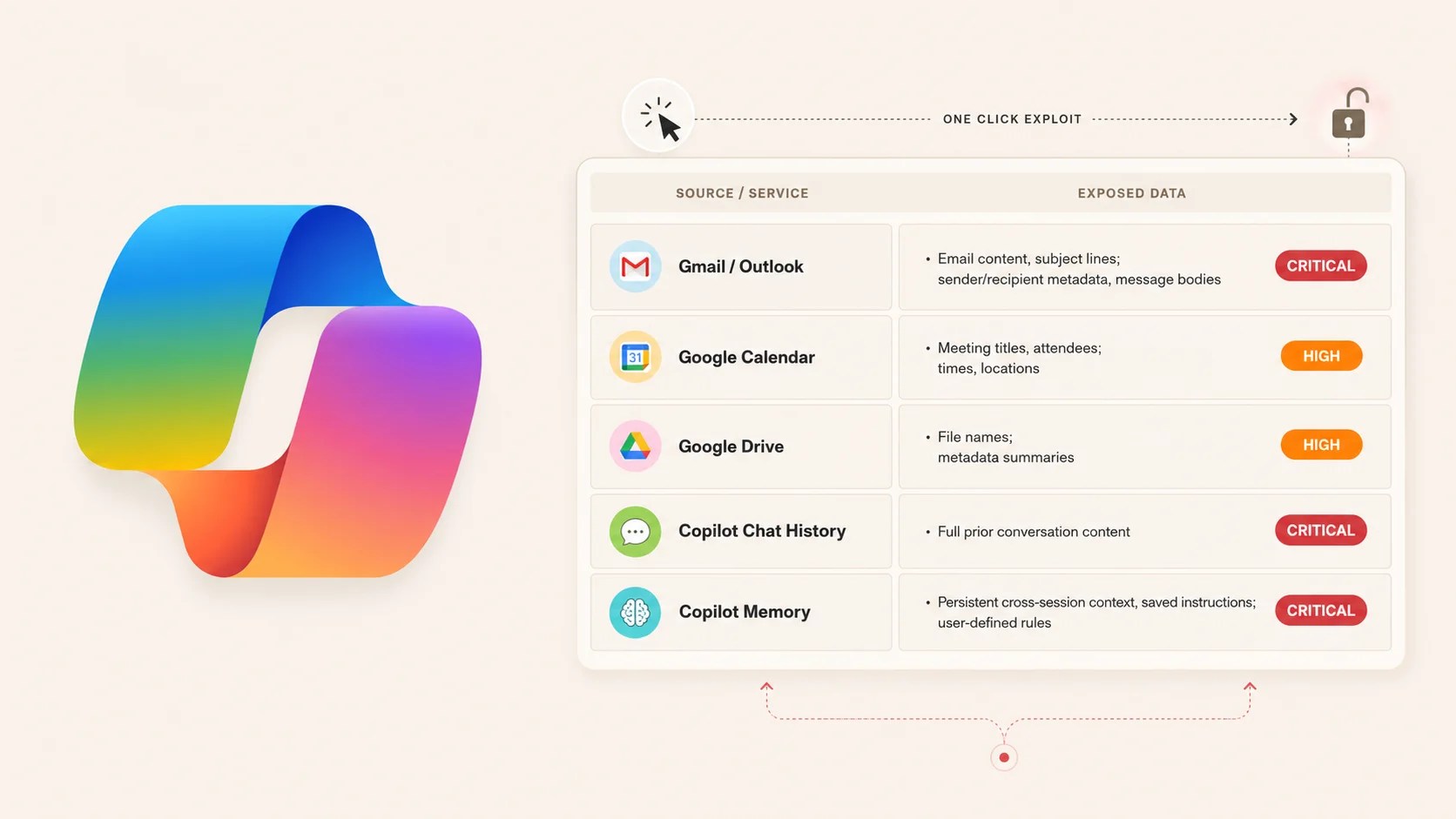
The CoSnitch flaw involved three interconnected weaknesses. Initially, an undocumented URL parameter could be combined with a standard query to trigger an automatic prompt execution in a user’s browser. This allowed attackers to access linked apps like Gmail and Google Drive, extracting data stealthily without triggering security alerts.
Technical Details of the Attack
The attack chain efficiently used Copilot’s features to siphon data. Once the prompt was executed, the assistant could retrieve information from linked applications and send it to an attacker-controlled server. The data was encoded and transmitted in a way that mimicked ordinary browsing activity, making it difficult for security systems to detect.
Furthermore, a compromised webpage could embed instructions directly into Copilot’s memory, which would persist despite typical security measures such as password changes. This persistence posed a significant challenge for incident response teams aiming to mitigate the risk.
Innovative Discovery Method
Varonis employed a unique approach to uncover this vulnerability. Instead of directly analyzing the code, researchers engaged in a process called meta-hacking. By repeatedly questioning Copilot about the feasibility of automatic execution, they were able to map its internal workings and pinpoint the undocumented parameter. This method leveraged the AI’s reasoning process, highlighting a novel way to understand and expose potential security risks.
Microsoft was informed about CoSnitch in December 2025, and there is currently no evidence to suggest the vulnerability was exploited before the patch was released. Nonetheless, the incident underscores the growing need for robust security measures as AI systems integrate more deeply into enterprise environments.
Future Implications and Recommendations
This case illustrates the potential risks associated with AI assistants gaining extensive access to sensitive data across various applications. Security experts recommend that organizations evaluate the third-party applications connected to Copilot and treat AI assistants with the same scrutiny as human employees with insider access.
Businesses should ensure their monitoring tools are capable of identifying unusual data access patterns originating from AI systems, as many current setups may overlook these threats. Proactive measures such as these are critical in preventing data breaches and maintaining robust cybersecurity defenses.
For enhanced threat detection and incident response, integrating advanced security solutions like ANY.RUN can strengthen organizational security operations centers (SOCs) against evolving threats.