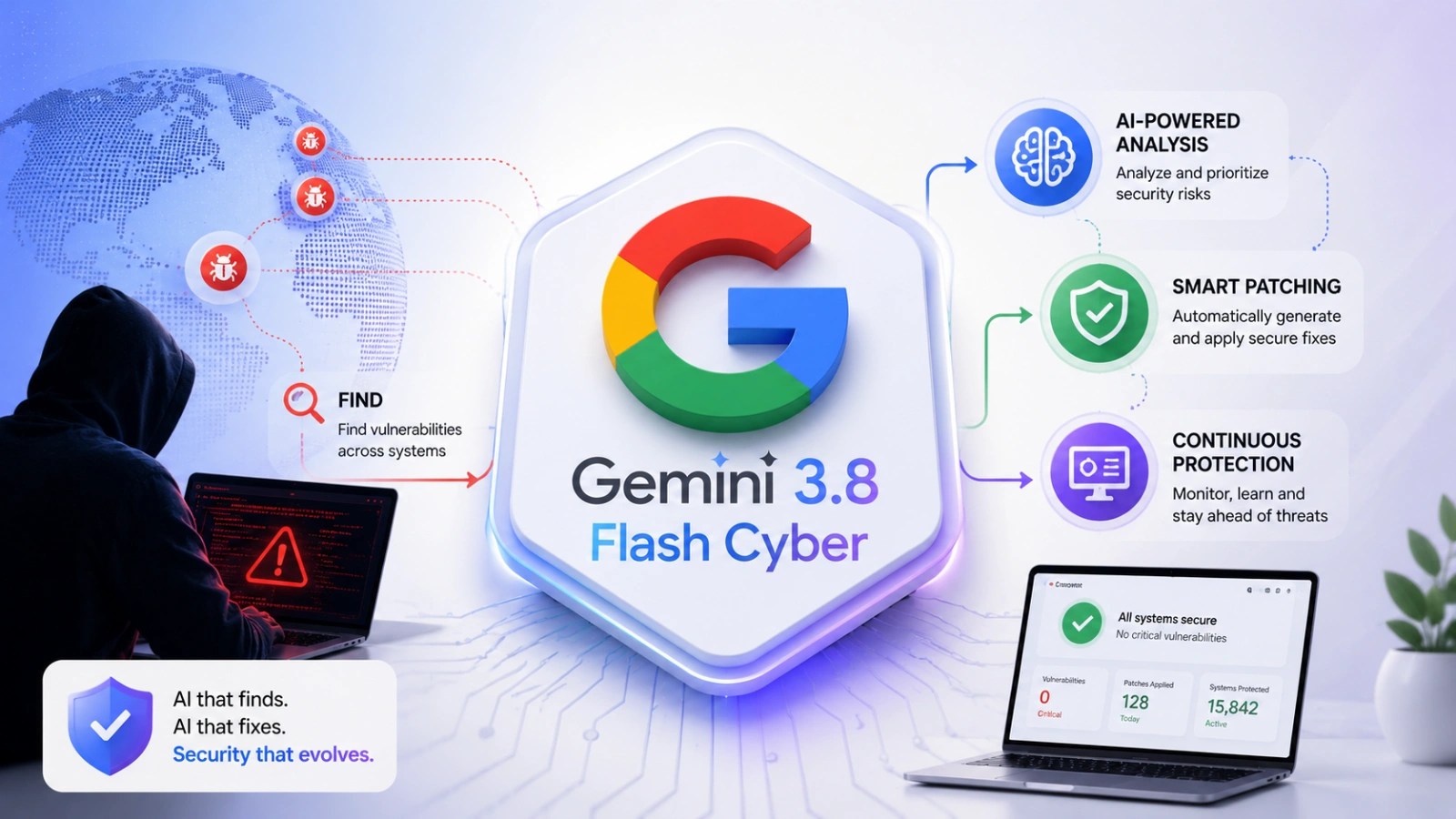
Google has introduced its latest AI model, Gemini 3.8 Flash Cyber, designed to autonomously detect and patch software vulnerabilities. This new release is part of the Gemini 3.8 family, a set of reasoning and coding models aimed at enhancing software security.
Introducing the Gemini 3.8 Family
The unveiling of Gemini 3.8 occurs just a few weeks following the release of Gemini 3.7 Flash, marking the third Flash-tier model revealed by Google in a short span of six weeks. Although both the models share a common architecture, they are optimized for distinct deployment scenarios.
While the general-purpose Gemini 3.8 Flash focuses on long-term software engineering tasks, the newly launched Flash Cyber variant is specifically tailored for cybersecurity applications. Both models maintain the introductory pricing of $0.75 per million input tokens and $3.75 per million output tokens.
Benchmark Performance and Capabilities
On the DeepSWE v1.1 benchmark, Gemini 3.8 Flash shows significant improvements over previous models, excelling in complex engineering tasks. It achieves a 54.9% score on the HLE-Verified scale, showcasing its advanced multi-step reasoning capabilities.
The Flash Cyber variant, in particular, has demonstrated superior performance on CyberGym, a leading industry benchmark for vulnerability detection. It surpasses its predecessor, the 3.5 Flash Cyber, and even larger frontier models, achieving over 70% success across 20 programming languages.
Exclusive Access Through Google’s Fairwind Program
Google offers Gemini 3.8 Flash Cyber exclusively to vetted security teams through its Fairwind Program, emphasizing the model’s sensitivity and focus on defensive capabilities. The model excels in automated patching, achieving a 47.2% pass@1 score on the CWE-Bench, a benchmark run by Collinear.
In real-world applications, Google’s Chrome Security team has reported that the model creates 2.6 times more accurate vulnerability patches than larger commercial competitors, while security firm Wiz noted a higher recall rate on penetration-testing benchmarks at a fraction of the cost.
Future Implications and Outlook
With Gemini 3.8 Flash Cyber, Google aims to provide cybersecurity defenders with an automated advantage over attackers, although access remains limited to trusted partners. The model has already secured critical vulnerabilities in Google’s codebases much faster than traditional methods.
By integrating domain-specific cybersecurity training and agentic reasoning, Google continues to advance AI-driven solutions for global cybersecurity challenges. As the Fairwind Program expands, the impact of this technology is expected to grow significantly.