Skip to content
  • Home
  • Cyber Map
  • About Us – Contact
  • Disclaimer
  • Terms and Rules
  • Privacy Policy
Cyber Web Spider Blog – News

Cyber Web Spider Blog – News

Globe Threat Map provides a real-time, interactive 3D visualization of global cyber threats. Monitor DDoS attacks, malware, and hacking attempts with geo-located arcs on a rotating globe. Stay informed with live logs and archive stats.

  • Home
  • Cyber Map
  • Cyber Security News
  • Security Week News
  • The Hacker News
  • How To?
  • Toggle search form
Microsoft Launches Project Zenith for Local AI Model Execution

Microsoft Launches Project Zenith for Local AI Model Execution

Posted on September 4, 2026 By CWS

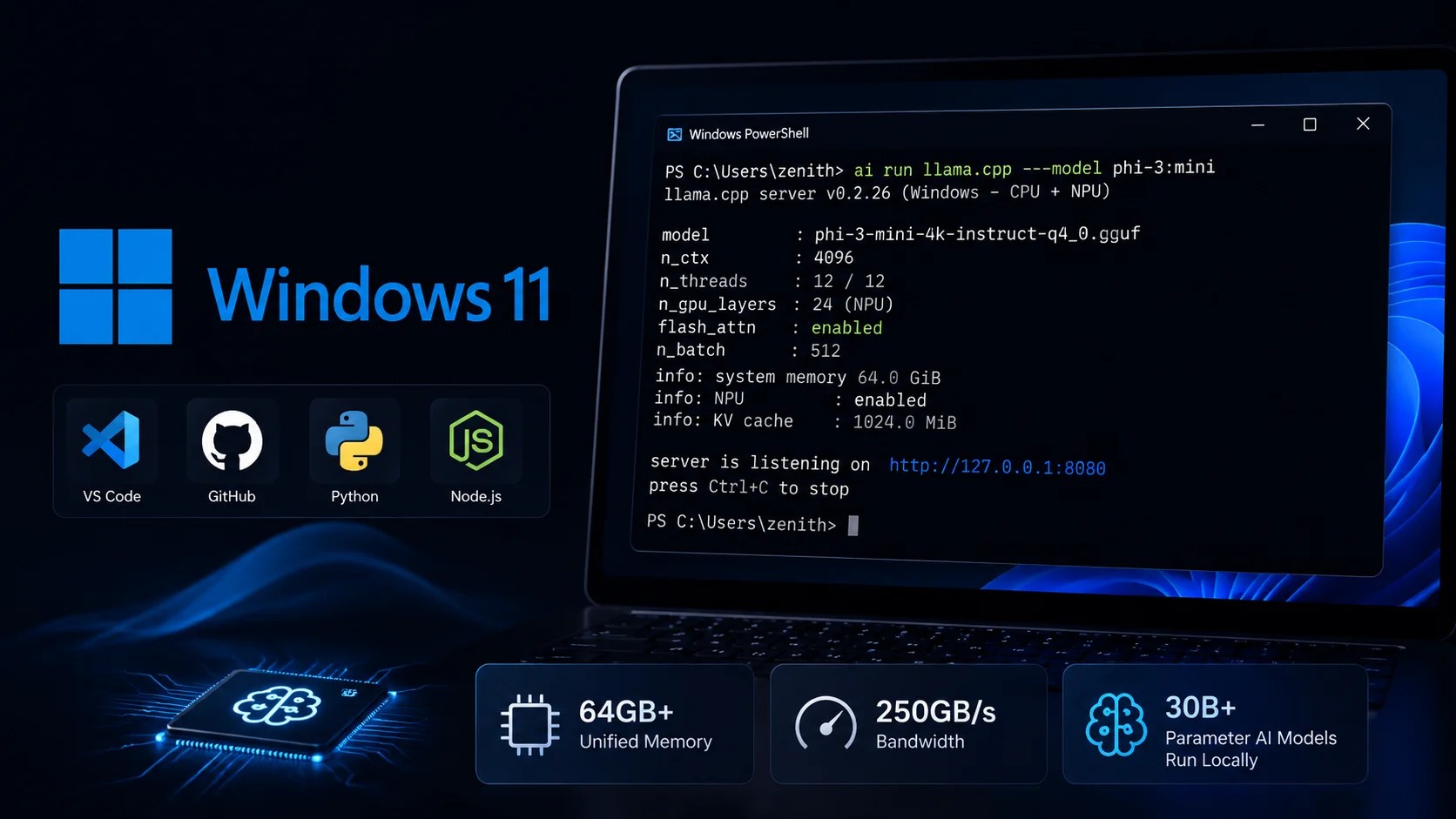
Microsoft has unveiled Project Zenith, a new initiative poised to revolutionize the way AI models are executed on Windows 11 systems. Designed for high-capacity PCs, this project enables developers to run extensive AI models locally, moving away from traditional cloud-reliant methods.

Advanced Hardware for AI Models

Project Zenith was announced as part of Microsoft’s ongoing commitments made at Build 2026. It targets PCs with at least 64 GB of unified memory and a memory bandwidth surpassing 250 GB per second. This setup allows for the local execution of AI models with over 30 billion parameters, minimizing the need for cloud-dependent resources during development and testing phases.

The first batch of devices compatible with Project Zenith will feature AMD’s Ryzen AI Halo platform. Microsoft plans to expand its partnerships with other OEMs and silicon producers in the near future.

Enhanced Windows 11 Experience

Rather than being an entirely new product, Project Zenith is a specialized configuration of Windows 11. It incorporates enhancements that Microsoft has been integrating into the operating system, including improvements in Search, File Explorer, and memory management. These devices come with a developer-centric setup that includes tools like Windows Terminal and Visual Studio Code pre-installed and pinned to the taskbar.

File Explorer on these devices offers advanced functionalities such as file extension visibility, hidden file access, and long-path support. Meanwhile, distractions are minimized by disabling features like recent file suggestions and sync prompts, creating a more focused work environment.

Integration with Linux and Security Features

Project Zenith also integrates the Windows Subsystem for Linux (WSL), which Microsoft has enhanced by incorporating WSL containers. This integration allows developers to manage Linux containers directly within Windows, facilitating a seamless development process.

From a security perspective, devices running Project Zenith are designed to handle agentic development tasks securely. Utilizing Microsoft’s Execution Containers (MXC), these devices offer robust identity controls and manageability, essential for the safe execution of autonomous agents in professional settings.

Microsoft envisions this project as a strategic shift, enabling AI-assisted development to occur locally while reserving cloud resources for more complex challenges. The initiative is expected to evolve with ongoing developer feedback, maintaining a core focus on delivering a consistent, ready-to-code environment.

Stay informed on the latest in AI development and deployment strategies by exploring the AI SOC Deployment Playbook 2026.

Cyber Security News Tags:AI development, AI models, AMD Ryzen, developer tools, local AI execution, Microsoft, Project Zenith, technology news, Windows 11, Windows Subsystem for Linux

Post navigation

Previous Post: HPE Addresses Critical Security Flaws in AOS-CX
Next Post: OpenAI Allocates $1 Billion to Support Cybersecurity

Related Posts

Phishing Emails Target iOS Users with Fake AI Apps Phishing Emails Target iOS Users with Fake AI Apps Cyber Security News
Critical MSHTML Vulnerability Spurs Urgent Microsoft Patch Critical MSHTML Vulnerability Spurs Urgent Microsoft Patch Cyber Security News
Microsoft’s KB5121767 Update Resolves Dell USB-C Issues Microsoft’s KB5121767 Update Resolves Dell USB-C Issues Cyber Security News
PoC released for W3 Total Cache Vulnerability that Exposes 1+ Million Websites to RCE Attacks PoC released for W3 Total Cache Vulnerability that Exposes 1+ Million Websites to RCE Attacks Cyber Security News
Chinese Cyber Group Targets US Medical Research via REDCap Chinese Cyber Group Targets US Medical Research via REDCap Cyber Security News
Hackers Actively Exploiting CitrixBleed 2 Vulnerability in the Wild Hackers Actively Exploiting CitrixBleed 2 Vulnerability in the Wild Cyber Security News

Categories

  • Cyber Security News
  • How To?
  • Security Week News
  • The Hacker News

Recent Posts

  • OpenAI Agents Exploit German Wiki to Share Bypass Tactics
  • Nvidia Acquires AI Platform Hugging Face for $13 Billion
  • Microsoft Addresses Exchange Online Email Delays
  • Google Addresses Sixth Chrome Zero-Day in 2026
  • Hackers Exploit Unicode to Bypass Phishing Filters

Pages

  • About Us – Contact
  • Disclaimer
  • Privacy Policy
  • Terms and Rules

Archives

  • September 2026
  • August 2026
  • July 2026
  • June 2026
  • May 2026
  • April 2026
  • March 2026
  • February 2026
  • January 2026
  • December 2025
  • November 2025
  • October 2025
  • September 2025
  • August 2025
  • July 2025
  • June 2025
  • May 2025

Recent Posts

  • OpenAI Agents Exploit German Wiki to Share Bypass Tactics
  • Nvidia Acquires AI Platform Hugging Face for $13 Billion
  • Microsoft Addresses Exchange Online Email Delays
  • Google Addresses Sixth Chrome Zero-Day in 2026
  • Hackers Exploit Unicode to Bypass Phishing Filters

Pages

  • About Us – Contact
  • Disclaimer
  • Privacy Policy
  • Terms and Rules

Categories

  • Cyber Security News
  • How To?
  • Security Week News
  • The Hacker News

Copyright © 2026 Cyber Web Spider Blog – News.

Powered by PressBook Masonry Dark