Jul 25, 2025Ravie LakshmananMalware / Cloud Safety
Risk hunters have disclosed two totally different malware campaigns which have focused vulnerabilities and misconfigurations throughout cloud environments to ship cryptocurrency miners.
The menace exercise clusters have been codenamed Soco404 and Koske by cloud safety corporations Wiz and Aqua, respectively.
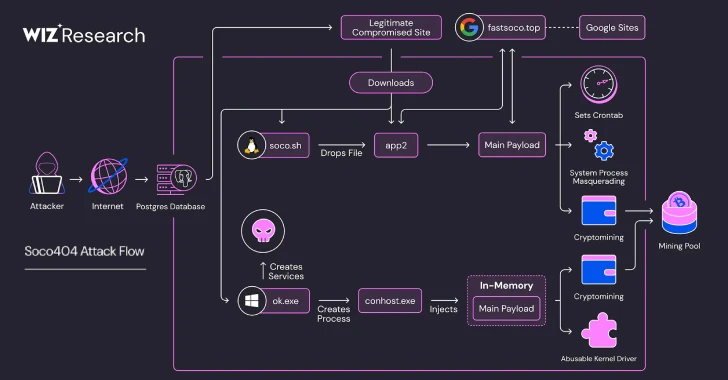
Soco404 “targets each Linux and Home windows programs, deploying platform-specific malware,” Wiz researchers Maor Dokhanian, Shahar Dorfman, and Avigayil Mechtinger stated. “They use course of masquerading to disguise malicious exercise as legit system processes.”
The exercise is a reference to the truth that payloads are embedded in faux 404 HTML pages hosted on web sites constructed utilizing Google Websites. The bogus websites have since been taken down by Google.
Wiz posited that the marketing campaign, which has been beforehand noticed going after Apache Tomcat providers with weak credentials, in addition to prone Apache Struts and Atlassian Confluence servers utilizing the Sysrv botnet, is a part of a broader crypto-scam infrastructure, together with fraudulent cryptocurrency buying and selling platforms.
The newest marketing campaign has additionally been discovered to focus on publicly-accessible PostgreSQL cases, with the attackers additionally abusing compromised Apache Tomcat servers to host payloads tailor-made for each Linux and Home windows environments. Additionally hacked by the attackers is a legit Korean transportation web site for malware supply.
As soon as preliminary entry is obtained, PostgreSQL’s COPY … FROM PROGRAM SQL command is exploited to run arbitrary shell instructions on the host and obtain distant code execution.
“The attacker behind Soco404 seems to be conducting automated scans for uncovered providers, aiming to take advantage of any accessible entry level,” Wiz stated. “Their use of a variety of ingress instruments, together with Linux utilities like wget and curl, in addition to Home windows-native instruments similar to certutil and PowerShell, highlights an opportunistic technique.”
On Linux programs, a dropper shell script is executed instantly in reminiscence to obtain and launch a next-stage payload, whereas concurrently taking steps to terminate competing miners to maximise monetary acquire and restrict forensic visibility by overwriting logs related to cron and wtmp.
The payload executed within the next-stage is a binary that serves as a loader for the miner by contacting an exterior area (“www.fastsoco[.]high”) that is based mostly on Google Websites.
The assault chain for Home windows leverages the preliminary post-exploitation command to obtain and execute a Home windows binary, which, like its Linux counterpart, capabilities akin to a loader that embeds each the miner and the WinRing0.sys driver, the latter getting used to acquire NTSYSTEM privileges.
On high of that, the malware makes an attempt to cease the Home windows occasion log service and executes a self-deletion command to evade detection.
“Relatively than counting on a single technique or working system, the attacker casts a large internet, deploying whichever software or method is on the market within the surroundings to ship their payload,” the corporate stated. “This versatile strategy is attribute of a broad, automated cryptomining marketing campaign centered on maximizing attain and persistence throughout assorted targets.”
The invention of Soco404 dovetails with the emergence of a brand new Linux menace dubbed Koske that is suspected to be developed with help from a big language mannequin (LLM) and makes use of seemingly innocuous photographs of pandas to propagate the malware.
The assault begins with the exploitation of a misconfigured server, similar to JupyterLab, to put in varied scripts from two JPEG photographs, together with a C-based rootkit that is used to cover malicious malware-related recordsdata utilizing LD_PRELOAD and a shell script that in the end downloads cryptocurrency miners on the contaminated system. Each payloads are instantly executed in reminiscence to keep away from leaving traces on disk.
Koske’s finish aim is to deploy CPU and GPU-optimized cryptocurrency miners that reap the benefits of the host’s computational assets to mine 18 distinct cash, similar to Monero, Ravencoin, Zano, Nexa, and Tari, amongst others.
“These photographs are polyglot recordsdata, with malicious payloads appended to the tip. As soon as downloaded, the malware extracts and executes the malicious segments in reminiscence, bypassing antivirus instruments,” Aqua researcher Assaf Morag stated.
“This method is not steganography however somewhat polyglot file abuse or malicious file embedding. This method makes use of a sound JPG file with malicious shellcode hidden on the finish. Solely the final bytes are downloaded and executed, making it a sneaky type of polyglot abuse.”