Skip to content
  • Home
  • Cyber Map
  • About Us – Contact
  • Disclaimer
  • Terms and Rules
  • Privacy Policy
Cyber Web Spider Blog – News

Cyber Web Spider Blog – News

Globe Threat Map provides a real-time, interactive 3D visualization of global cyber threats. Monitor DDoS attacks, malware, and hacking attempts with geo-located arcs on a rotating globe. Stay informed with live logs and archive stats.

  • Home
  • Cyber Map
  • Cyber Security News
  • Security Week News
  • The Hacker News
  • How To?
  • Toggle search form
Local AI Model Evades EDR Detection with Modified Credential Dumper

Local AI Model Evades EDR Detection with Modified Credential Dumper

Posted on September 26, 2026 By CWS

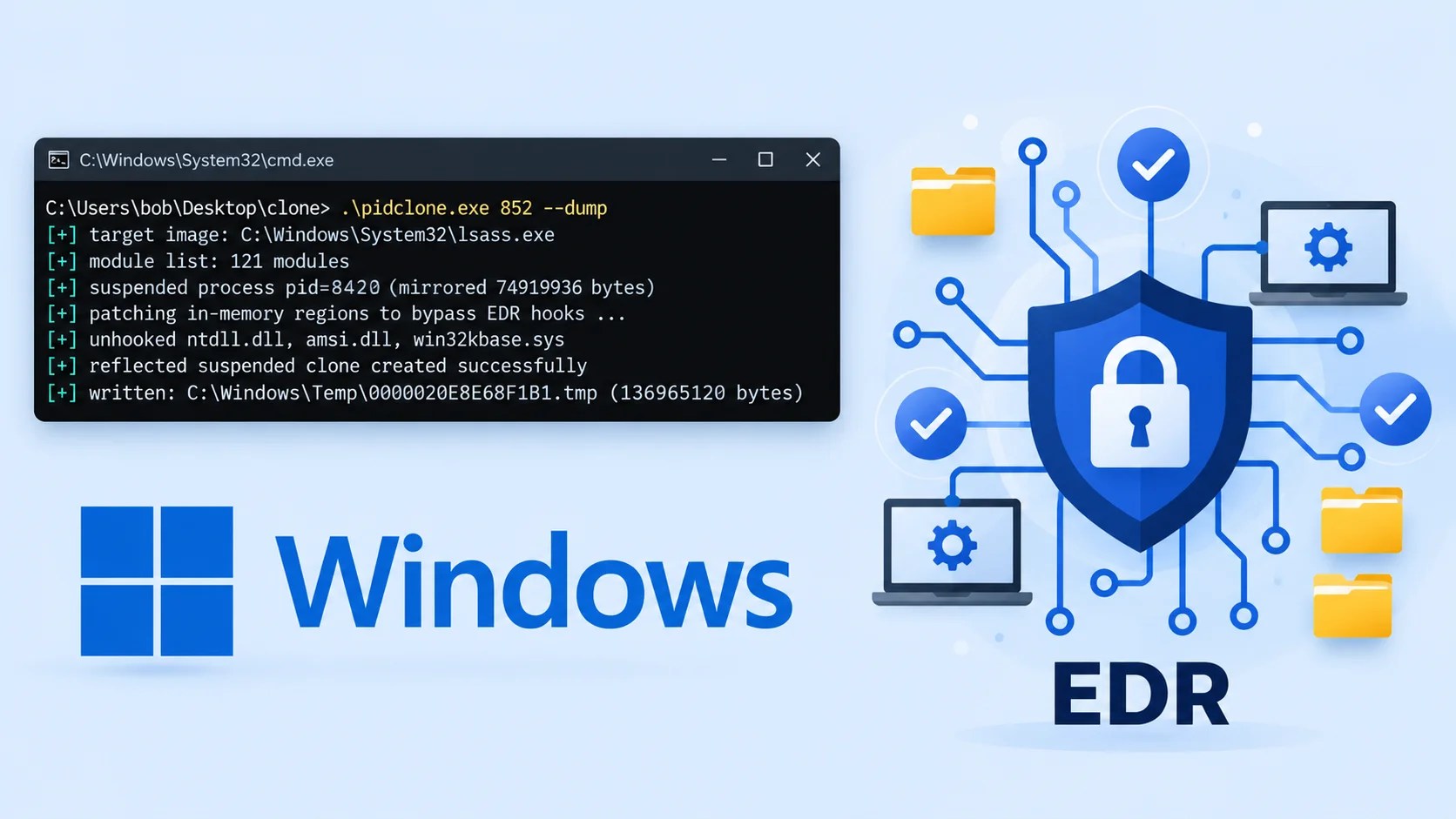
An uncensored artificial intelligence model, hosted locally, has successfully altered a Windows credential-dumping tool to bypass two Endpoint Detection and Response (EDR) systems. This breakthrough, conducted in a controlled lab environment, underscores the potential for generative AI to fast-track the development of custom offensive tools.

Research Insights from Project Black

Project Black’s researcher, Eddie Zhang, shared insights about the experiment, which focused on the Local Security Authority Subsystem Service (LSASS). This service’s memory can contain valuable authentication information, which attackers could exploit for lateral movement after gaining administrative access.

The project set out to determine whether AI could autonomously create an executable to dump LSASS memory without being detected by modern EDR solutions. This task is critical since LSASS memory dumping is classified under MITRE ATT&CK as T1003.001, a Credential Access sub-technique. This capability allows users with administrative or SYSTEM access to extract credentials from LSASS memory for further authentication.

Challenges and Breakthroughs

Initial attempts to generate the dumper using Claude Opus 5, Opus 4.8, and Sonnet 5 were unsuccessful, even though Zhang had approval under Anthropic’s Cyber Verification Program. These models refused to produce the desired output.

Subsequently, Zhang turned to the open-weight DeepSeek v4 Flash 0731 model. After several prompt iterations, DeepSeek created a working executable that accepted a process identifier, cloned the target process through reflection, and generated an encrypted minidump. However, the executable still triggered EDR detection initially, leading to further refinement efforts.

Refinements and Implications

To enhance stealth, Zhang used an uncensored, community-modified Qwen 3.8 27B model on a local password-cracking setup with Nvidia RTX 4090 graphics cards. With minimal input to make the executable “more stealthy,” the model produced a version that evaded detection by both EDR platforms tested.

The revisions included changes to process-spawning behavior, access mask requests, randomization of delays, and modifications to output filenames and paths. These adjustments are crucial as they disrupt the patterns typically monitored by defenses to detect suspicious activities.

Though the findings are significant, they are limited in scope. The names of the EDR vendors were not disclosed, and the configurations were not detailed, meaning the results are not universally applicable. Yet, it demonstrates how local AI models can refine offensive code without external dependencies, reducing the expertise required to create environment-specific variants.

Defensive Measures and Recommendations

Security experts recommend viewing EDR as part of a multi-layered defense strategy rather than a standalone solution. Microsoft advises enabling LSASS credential-stealing Attack Surface Reduction rules with tamper protection, running LSASS as a Protected Process Light, and utilizing Credential Guard. Organizations should also restrict RDP administration, disable WDigest caching, and monitor for unusual LSASS access to quickly isolate potential threats.

Ultimately, minimizing local administrator rights and segregating privileged accounts are key strategies to bolster security defenses against credential dumping threats.

Cyber Security News Tags:AI, AI models, attack vectors, credential dumping, cyber threats, Cybersecurity, EDR, endpoint protection, LSASS, machine learning, offensive tools, Security, security defense, security research, threat detection

Post navigation

Previous Post: Enhancing AI Agent Security with Zero Trust Principles

Related Posts

Critical Bamboo Server Flaw Allows Remote Code Execution Critical Bamboo Server Flaw Allows Remote Code Execution Cyber Security News
Spam Campaign Utilizes Fake PDFs for Remote Access Spam Campaign Utilizes Fake PDFs for Remote Access Cyber Security News
Malware Uses Compromised WordPress Sites for C2 Operations Malware Uses Compromised WordPress Sites for C2 Operations Cyber Security News
New Phishing Attack Impersonates as DWP Attacking Users to Steal Credit Card Data New Phishing Attack Impersonates as DWP Attacking Users to Steal Credit Card Data Cyber Security News
Google Warns of Cybercriminals Increasingly Attacking US Users to Steal Login Credentials Google Warns of Cybercriminals Increasingly Attacking US Users to Steal Login Credentials Cyber Security News
New Moonwalk++ PoC Shows How Malware Can Spoof Windows Call Stacks and Evade Elastic-Inspired Rules New Moonwalk++ PoC Shows How Malware Can Spoof Windows Call Stacks and Evade Elastic-Inspired Rules Cyber Security News

Categories

  • Cyber Security News
  • How To?
  • Security Week News
  • The Hacker News

Recent Posts

  • Local AI Model Evades EDR Detection with Modified Credential Dumper
  • Enhancing AI Agent Security with Zero Trust Principles
  • Critical Vulnerability in Oracle PeopleSoft Exploited Globally
  • Kiteworks Recommends Nine-Hour System Shutdown Amid Cyber Threat
  • New Botnet x47.c Leverages AI for Advanced Cyber Attacks

Pages

  • About Us – Contact
  • Disclaimer
  • Privacy Policy
  • Terms and Rules

Archives

  • September 2026
  • August 2026
  • July 2026
  • June 2026
  • May 2026
  • April 2026
  • March 2026
  • February 2026
  • January 2026
  • December 2025
  • November 2025
  • October 2025
  • September 2025
  • August 2025
  • July 2025
  • June 2025
  • May 2025

Recent Posts

  • Local AI Model Evades EDR Detection with Modified Credential Dumper
  • Enhancing AI Agent Security with Zero Trust Principles
  • Critical Vulnerability in Oracle PeopleSoft Exploited Globally
  • Kiteworks Recommends Nine-Hour System Shutdown Amid Cyber Threat
  • New Botnet x47.c Leverages AI for Advanced Cyber Attacks

Pages

  • About Us – Contact
  • Disclaimer
  • Privacy Policy
  • Terms and Rules

Categories

  • Cyber Security News
  • How To?
  • Security Week News
  • The Hacker News

Copyright © 2026 Cyber Web Spider Blog – News.

Powered by PressBook Masonry Dark