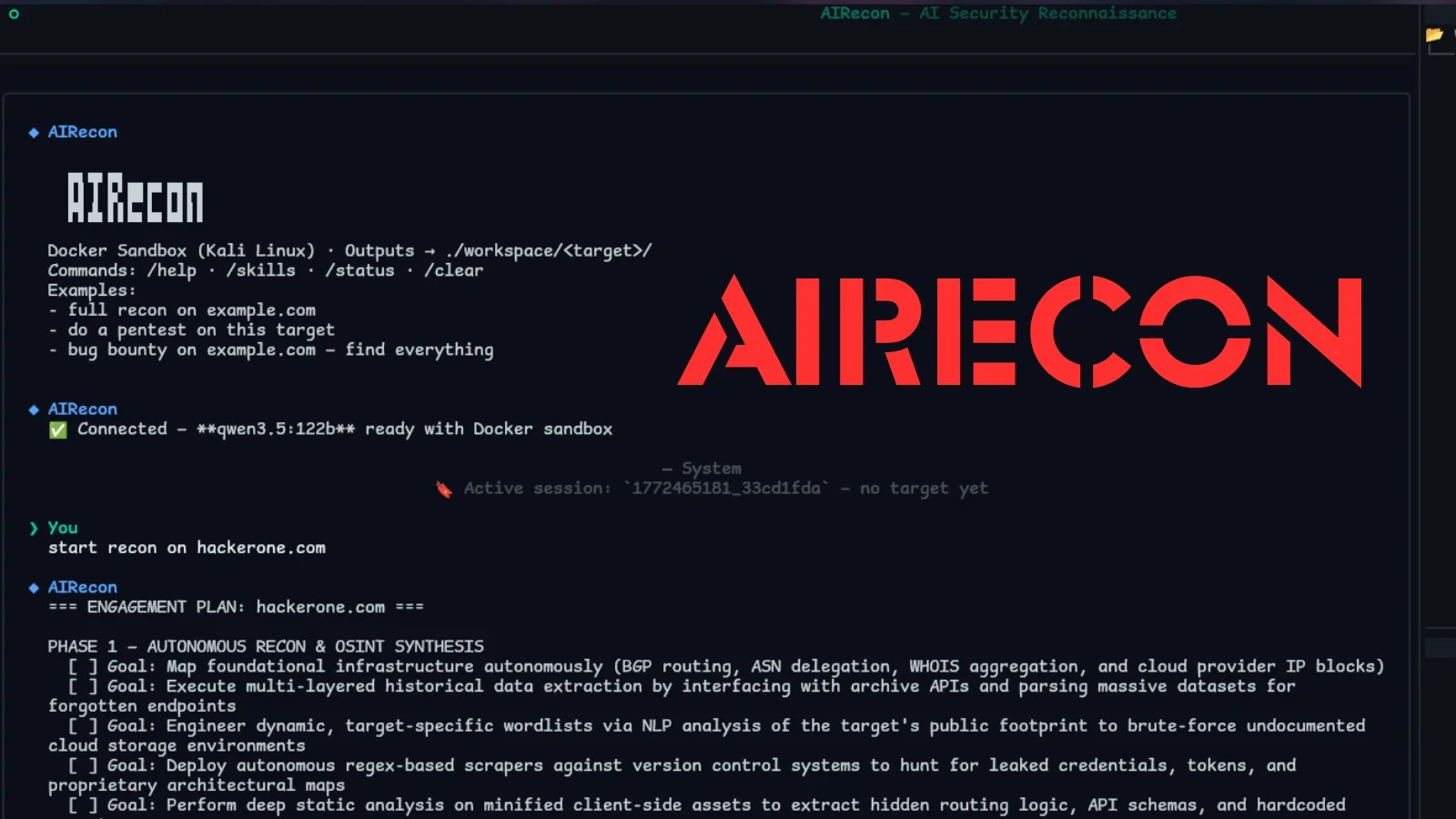
AIRecon has emerged as a groundbreaking tool in the field of cybersecurity, offering offline, AI-powered penetration testing capabilities. This tool integrates a self-hosted Ollama LLM with a Kali Linux Docker sandbox, facilitating comprehensive security evaluations without compromising data privacy by keeping all data on local systems.
Key Features of AIRecon
AIRecon, developed by researcher pikpikcu, addresses the high costs associated with API-based commercial models like GPT-4. By operating entirely offline, it eliminates the need for expensive API calls, offering a cost-effective solution for recursive reconnaissance processes. Unlike other commercial tools that require data to be sent to external servers, AIRecon ensures all information remains on the operator’s machine, maintaining strict data confidentiality.
This tool integrates seamlessly with the Caido proxy and includes five built-in functionalities: list, replay, automate, findings, and scope management. These features are particularly valuable for bug bounty hunters and red team professionals who must adhere to strict data-handling protocols.
Automated Phases and Integration
AIRecon structures its operations into four automated phases, each with specific objectives and suggested tools. The agent transitions through these phases smoothly, ensuring continuous progress without interruptions. Checkpoints occur at regular intervals to evaluate its performance and context, ensuring optimal efficiency.
The full operational stack consists of the Kali sandbox, browser automation, custom fuzzers, Schemathesis API fuzzing, and Semgrep SAST for static source analysis. This comprehensive setup allows for thorough and effective security assessments.
Advanced Features and Requirements
One of the standout features of AIRecon is its optional airecon-dataset, which indexes over 1.09 million security records into local databases, including CVEs and other valuable resources. This allows the LLM to ground its actions in real-world data, enhancing its effectiveness and reducing the risk of erroneous assumptions.
For optimal performance, AIRecon requires models with advanced tool-calling capabilities and extended thinking. Models with fewer than 8 billion parameters are discouraged due to potential inaccuracies. Recommended configurations range from Qwen3.5 12B to Qwen3.5 9B, depending on the available VRAM.
The tool comes equipped with a vast repository of skill files and keyword-to-skill mappings, tailored to cover common offensive techniques. Additionally, it supports integration with MCP servers, allowing for dynamic exposure of external tools.
Installation and Accessibility
Installing AIRecon is straightforward, requiring Python 3.12+, Docker 20.10+, and a running Ollama instance. The process can be completed with a single command from GitHub. Moreover, for those lacking sufficient local VRAM, AIRecon offers a Google Colab T4 GPU tunnel setup. This setup leverages a free-tier Colab session to serve the model while the tool’s TUI operates locally, although sessions are limited to 12 hours.
AIRecon represents a significant advancement in penetration testing, offering a robust, offline solution that enhances data security and reduces operational costs. As cybersecurity threats continue to evolve, tools like AIRecon will be essential for organizations striving to protect their digital assets effectively.