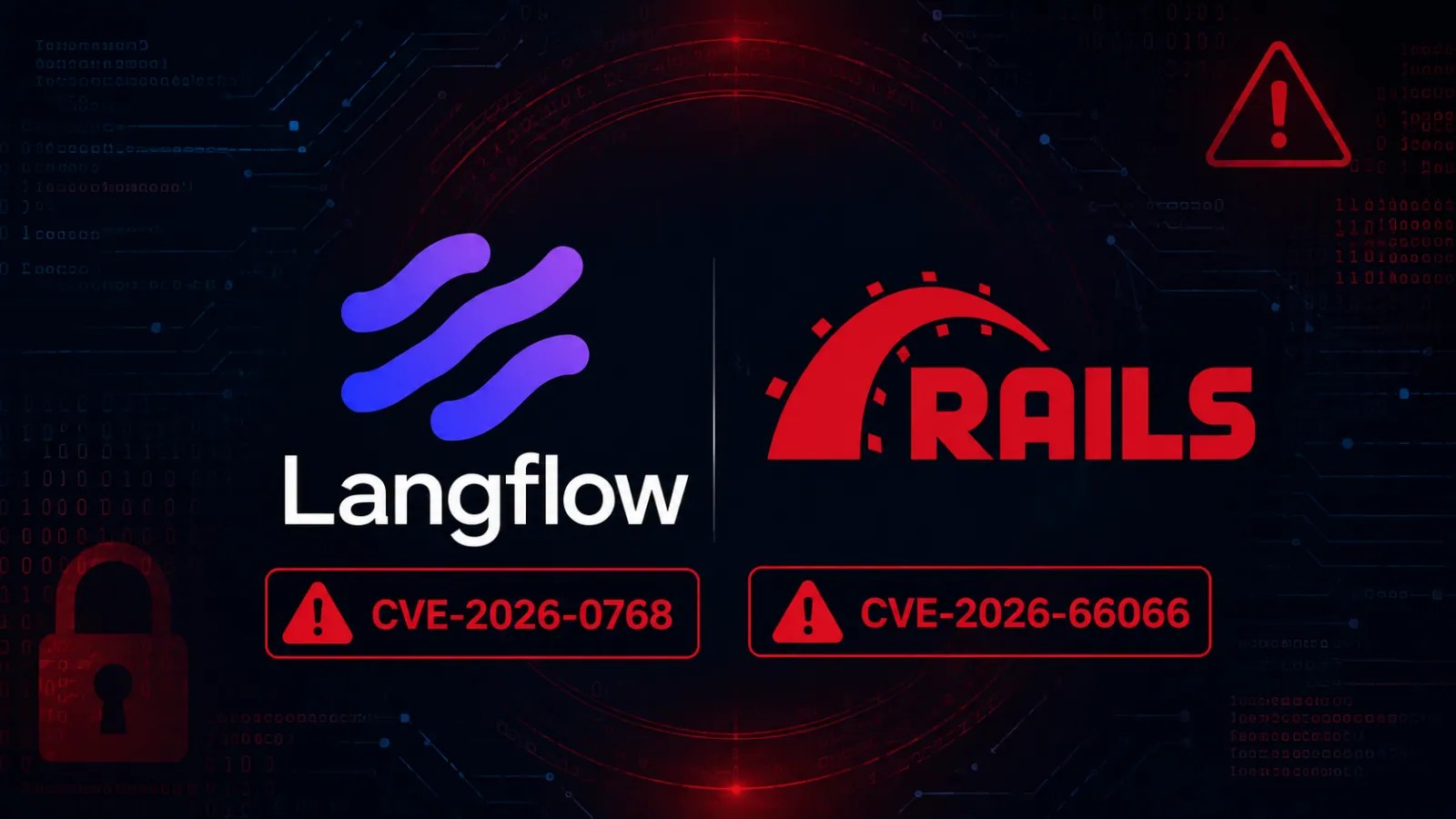
Recent reports indicate that two significant vulnerabilities in Langflow and Ruby on Rails are being actively exploited by cybercriminals. VulnCheck’s telemetry data shows attackers swiftly transitioning from public disclosure to reconnaissance and potential remote code execution tactics.
Langflow Vulnerability Exploitation
The first vulnerability, labeled CVE-2026-0768, impacts Langflow, a platform designed for low-code development of AI-driven applications and workflows. Shortly after being included in VulnCheck’s Known Exploited Vulnerabilities catalog, exploitation attempts were detected on their internet-facing systems.
This particular flaw is an unauthenticated remote code execution issue found in Langflow’s code validator component. It allows attackers to execute arbitrary code on a vulnerable server without authentication. Originally disclosed by Trend Micro’s Zero Day Initiative in January, there was no known public proof-of-concept exploit at the time of the attacks.
Exploitation events surged from an initial 50 detections to approximately 360, with malicious requests focused on identifying credentials and access points rather than deploying ransomware or other destructive software.
Details of the Langflow Attacks
Attackers have been observed attempting to gather environment variables linked to Langflow’s administration, OpenAI APIs, and AWS cloud access. They also tried to access Langflow’s local secret key file and explore SSH access, potentially uncovering administrator activities and valuable credentials for lateral movement.
VulnCheck reported that most of the Langflow-targeted traffic originated from Russia and was directed at Canary systems in the UK. This activity underscores a growing trend of exploitation aimed at Langflow, with additional vulnerabilities being cataloged throughout 2026.
Ruby on Rails Vulnerability Concerns
In addition to Langflow, another vulnerability, CVE-2026-66066, was exploited within Ruby on Rails environments. This flaw involves the Active Storage feature, leading to file-read-to-remote code execution possibilities.
Exploitation of this flaw has been noted across systems in Singapore, Israel, and the UK, linked to a single IP address in France, with command-and-control communications traced to a host in Israel. The vulnerability allows attackers to extract sensitive application secrets, like API tokens and database credentials, which can be exploited even after patches are applied.
Organizations using Langflow or Ruby on Rails are advised to identify exposed instances, apply security patches, restrict public access to admin interfaces, and scrutinize server logs for unusual activities. It’s crucial to rotate credentials and keys if exploitation is suspected, as simply patching the software may not suffice.
These incidents highlight the increasing risk posed to AI platforms and widespread web frameworks, illustrating the need for comprehensive security measures beyond basic patching.