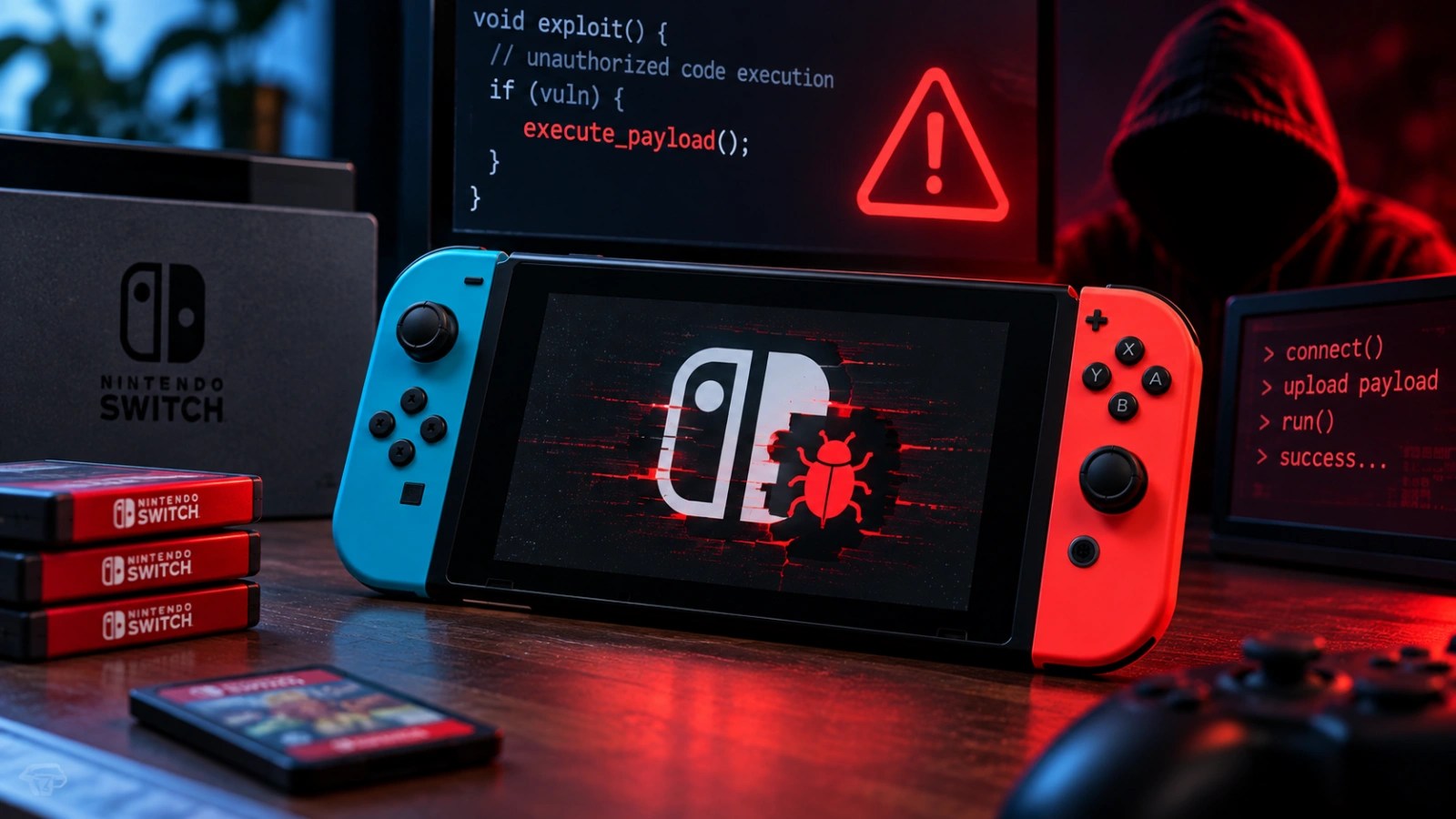
Nintendo has addressed a critical security flaw in its original Switch console, which could enable attackers nearby to execute unauthorized code and potentially access stored information. This vulnerability, identified as CVE-2026-82079, impacts firmware versions prior to 23.0.0 and is rooted in the console’s local wireless networking.
Understanding the Vulnerability
The primary issue is a stack-based buffer overflow, a type of memory corruption that occurs when incoming data exceeds the allocated space on the stack. This flaw can be exploited when an attacker sends specially crafted network traffic, leading to memory corruption and the potential execution of arbitrary operations through return-oriented programming (ROP).
ROP works by chaining together short instruction sequences already present in memory, allowing an adversary to redirect program execution. This vulnerability is limited to certain workflows, requiring the attacker to be within wireless range and interact directly with the console through a QR code displayed on the screen or a connected television.
Exploitation Scenarios
Exploitation requires precise conditions, including interaction with specific features like the Album’s “Send to Smartphone” function or the Mario Kart Live: Home Circuit. Once an attacker is part of the console’s temporary local wireless environment, they can send crafted packets to exploit the networking code vulnerability.
Successful exploitation could compromise the confidentiality, integrity, and availability of the system. However, the requirement for close proximity and QR-code scanning limits opportunistic attacks. Nintendo has assigned the vulnerability a CVSS 4.0 base score of 7.0, indicating a high severity with low complexity for exploitation.
Protection and Mitigation
Nintendo has released an update to address this issue, recommending users install firmware version 23.0.0 immediately. To verify the installed firmware version, users should navigate to System Settings from the HOME Menu, select System, and check the version displayed. System updates are typically downloaded automatically when connected to the internet.
For users unable to update immediately, it’s advised to avoid using affected sharing features, prevent QR code scanning by unfamiliar devices, and limit smartphone interactions to trusted personal devices. Additionally, users should exercise caution with unfamiliar Mario Kart Live karts.
The vulnerability was reported by external security researchers, with Nintendo issuing an advisory on September 10, 2026. This proactive disclosure aims to mitigate risks and ensure user safety.
In summary, Nintendo Switch owners should prioritize updating their devices to protect against this significant vulnerability and follow best practices to minimize potential exposure until the patch is applied.