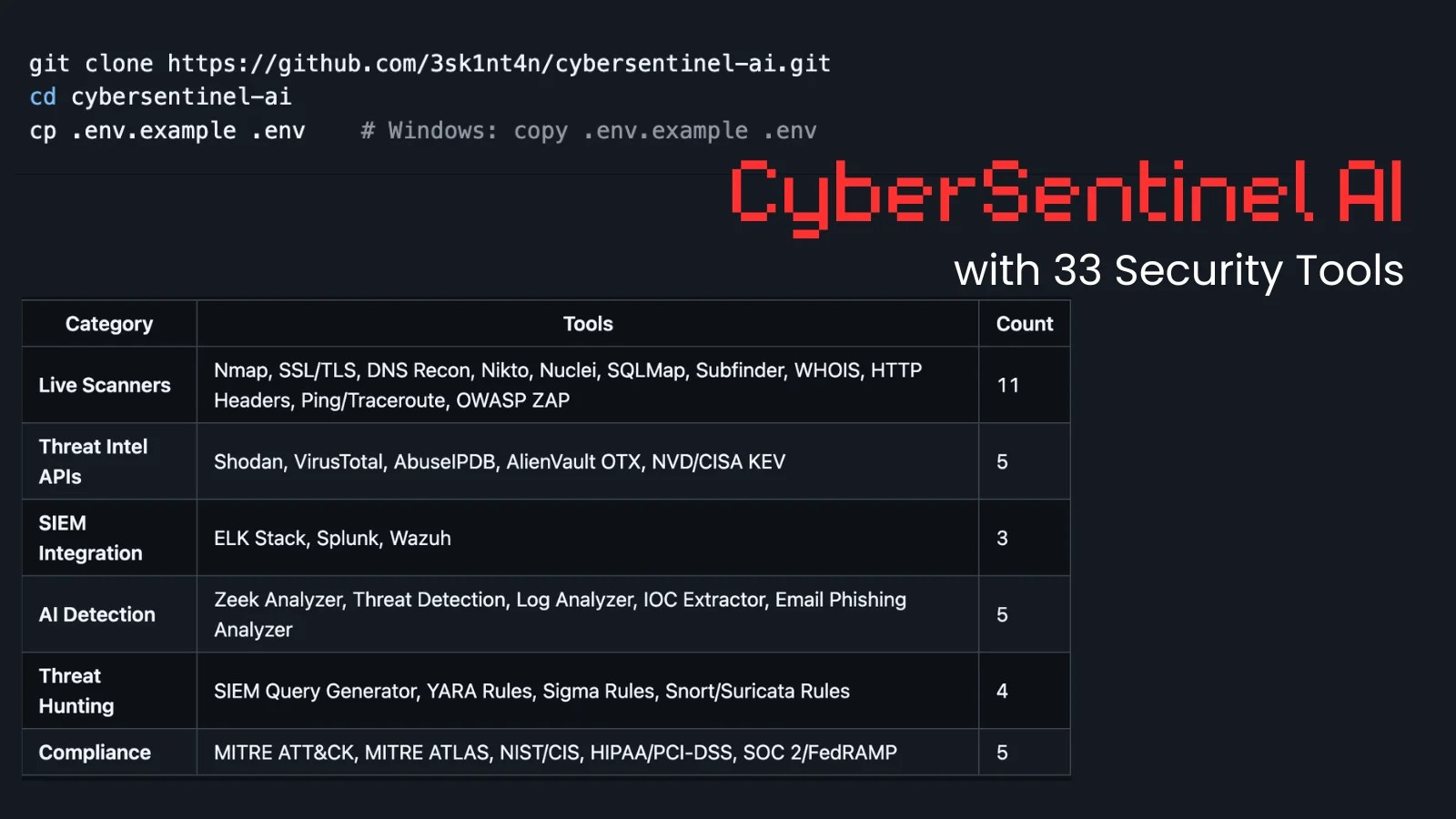
CyberSentinel AI v3.0 has emerged as a groundbreaking open-source platform in the field of cybersecurity, merging 33 practical penetration testing and threat intelligence tools with a versatile AI engine. This engine is compatible with Claude, GPT-4o, OpenRouter, and operates offline through Ollama, providing a comprehensive security solution.
Advanced Security Tool Integration
CyberSentinel AI distinguishes itself from traditional AI security assistants by actively executing tools such as Nmap, SQLMap, and OWASP ZAP within an isolated Kali Linux Docker environment. This not only enhances security operations but also allows real-time AI analysis of results, making it an invaluable asset for security professionals.
Hosted on GitHub under 3sk1nt4n/cybersentinel-ai, the platform is designed to function entirely on local infrastructure, eliminating the need for cloud dependencies and enhancing security by keeping operations contained within a local environment.
Comprehensive Platform Architecture
The deployment of CyberSentinel AI is achieved through Docker Compose, featuring seven containerized services. A Next.js frontend provides a seamless chat interface, while a FastAPI backend manages AI routing and tool orchestration. Security scans are executed within a sandboxed Kali container, ensuring that potentially harmful activities are isolated from the host system.
Supporting the AI capabilities are three data infrastructure components: Neo4j for mapping attack surfaces, ChromaDB for Retrieval-Augmented Generation aligned with MITRE and NIST standards, and the ELK Stack for log analysis with pre-configured security events.
AI-Driven Security Automation
The agentic execution model of CyberSentinel AI enables it to autonomously classify user intent, select appropriate tools, and execute up to five tools concurrently. This capability represents significant progress towards practical and autonomous security automation.
CyberSentinel AI categorizes its toolset into six functional areas, including live scanners, threat intelligence APIs, SIEM integration, AI detection, threat hunting, and compliance frameworks. This organization ensures comprehensive coverage of various security needs.
Unique to CyberSentinel AI is its mid-conversation AI provider switching, allowing users to seamlessly switch between AI providers such as Anthropic Claude and OpenAI GPT-4o without losing context. The platform can fully operate offline using Ollama, with API keys being optional.
Operational Safeguards and Requirements
CyberSentinel AI incorporates numerous safeguards, including input/output restrictions to prevent prompt injection and SSRF attacks. All scanning activities are confined within an isolated container, and users are cautioned against unauthorized scanning, which is illegal under the Computer Fraud and Abuse Act.
The system demands include Docker Desktop and a minimum of 8 GB RAM, with initial setup requiring the download of 4–5GB of data. Subsequent startups are swift, completing in about 30 seconds.
In conclusion, CyberSentinel AI v3.0 represents a significant step in integrating agentic AI with robust security tools, offering researchers and security teams a self-contained platform that operates independently of cloud services.