Skip to content
  • Home
  • Cyber Map
  • About Us – Contact
  • Disclaimer
  • Terms and Rules
  • Privacy Policy
Cyber Web Spider Blog – News

Cyber Web Spider Blog – News

Globe Threat Map provides a real-time, interactive 3D visualization of global cyber threats. Monitor DDoS attacks, malware, and hacking attempts with geo-located arcs on a rotating globe. Stay informed with live logs and archive stats.

  • Home
  • Cyber Map
  • Cyber Security News
  • Security Week News
  • The Hacker News
  • How To?
  • Toggle search form
EtherRAT Malware Propagation via Remote Tasks on Windows

EtherRAT Malware Propagation via Remote Tasks on Windows

Posted on August 5, 2026 By CWS

In a recent cyber intrusion incident, EtherRAT has emerged as a threat within a Windows domain, attributed to an affiliate of the Gentlemen ransomware group. This situation demonstrates how attackers can exploit a single access point to compromise an entire network when they obtain elevated privileges.

Remote Tasks as a Vector for EtherRAT

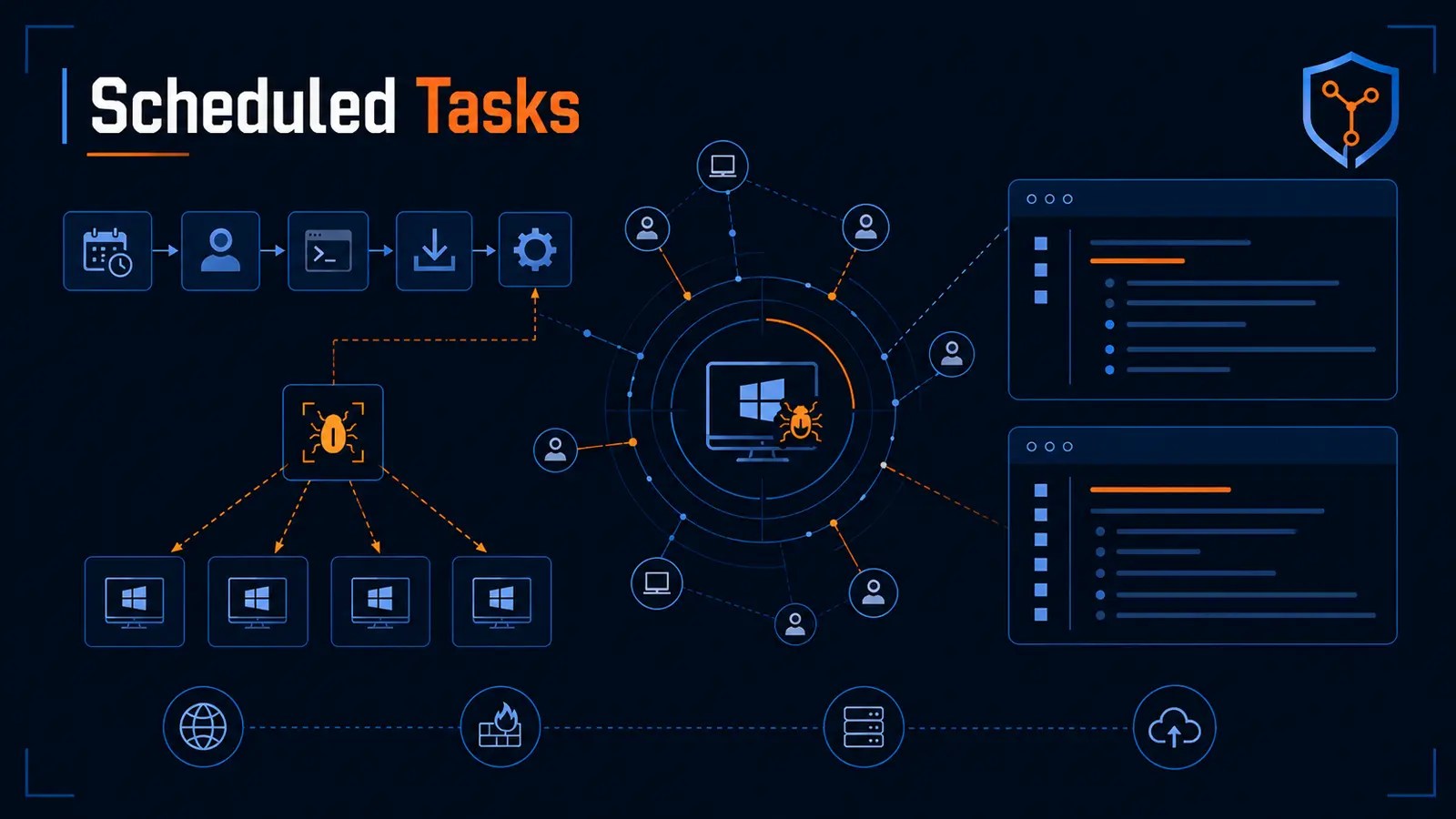
The attackers utilized remote scheduled tasks to disseminate harmful installer packages across various systems. These packages installed EtherRAT, a remote access tool based on Node.js, capable of executing commands, exfiltrating data, and maintaining persistence post-compromise.

Hunt.io analysts uncovered these activities by discovering an exposed directory on a server involved in the attack. The directory contained scripts, task configurations, and other tools, providing a rare insight into the tactics and tools of active threat actors.

Detailed Analysis of the Attack Strategy

Hunt.io’s report, shared with Cyber Security News, indicates a strategic approach to infiltrate victim environments while gathering credentials and Active Directory data. The use of administrative shares, Windows Management Instrumentation, and remote task registration allowed the attackers to reach internal hosts efficiently.

Scripts were employed to transfer payloads to remote machines, creating tasks with innocuous names like WinSvcUpdate2 to disguise malicious activities. This highlights how the abuse of Windows task scheduler can serve both as a persistence mechanism and a means for lateral network movement.

Decoding EtherRAT’s Malware Infrastructure

Post-installation, EtherRAT decrypts a JavaScript backdoor and sets up a Run-key entry for automatic execution upon user login. If Node.js is not present, a runtime is downloaded first. The malware then masks its web requests with random paths, complicating detection efforts.

Uniquely, EtherRAT queries an Ethereum smart contract to determine its command server, allowing for dynamic changes without altering the malware itself. This method complicates tracking but provides investigators a trail via contract history.

Security teams are urged to review remotely created scheduled tasks, especially those running as SYSTEM or invoking PowerShell, certutil, msiexec, or operating outside normal paths. Identifying and isolating affected systems, resetting compromised credentials, and checking for persistent Run-key entries are critical steps to mitigate further spread.

For detailed indicators of compromise and further technical analysis, refer to the full report and resources provided by Hunt.io and Cyber Security News.

Cyber Security News Tags:blockchain C2, Cybersecurity, EtherRAT, Gentlemen operation, Malware, network intrusion, Node.js, Ransomware, remote tasks, Windows security

Post navigation

Previous Post: SAFE Guidelines Aim to Standardize AI Incident Reporting

Related Posts

Russia’s Use of Cellebrite to Access Activist’s iPhone Russia’s Use of Cellebrite to Access Activist’s iPhone Cyber Security News
Notepad++ DLL Hijacking Vulnerability Let Attackers Execute Malicious Code Notepad++ DLL Hijacking Vulnerability Let Attackers Execute Malicious Code Cyber Security News
EvilTokens: A New Phishing Threat Targeting Microsoft Accounts EvilTokens: A New Phishing Threat Targeting Microsoft Accounts Cyber Security News
Microsoft’s April 2026 Update Boosts RDP Security Microsoft’s April 2026 Update Boosts RDP Security Cyber Security News
SmarterTools SmarterMail Vulnerability Enables Remote Code Execution Attack SmarterTools SmarterMail Vulnerability Enables Remote Code Execution Attack Cyber Security News
Critical Windows Vulnerability Allows Admin Access Critical Windows Vulnerability Allows Admin Access Cyber Security News

Categories

  • Cyber Security News
  • How To?
  • Security Week News
  • The Hacker News

Recent Posts

  • EtherRAT Malware Propagation via Remote Tasks on Windows
  • SAFE Guidelines Aim to Standardize AI Incident Reporting
  • CISA Reports Active Exploitation of Key Software Flaws
  • Rapid Response: Microsoft Defender Thwarts Ransomware in Seconds
  • CISA Alerts on Langflow, N-central, and Tomcat Risks

Pages

  • About Us – Contact
  • Disclaimer
  • Privacy Policy
  • Terms and Rules

Archives

  • August 2026
  • July 2026
  • June 2026
  • May 2026
  • April 2026
  • March 2026
  • February 2026
  • January 2026
  • December 2025
  • November 2025
  • October 2025
  • September 2025
  • August 2025
  • July 2025
  • June 2025
  • May 2025

Recent Posts

  • EtherRAT Malware Propagation via Remote Tasks on Windows
  • SAFE Guidelines Aim to Standardize AI Incident Reporting
  • CISA Reports Active Exploitation of Key Software Flaws
  • Rapid Response: Microsoft Defender Thwarts Ransomware in Seconds
  • CISA Alerts on Langflow, N-central, and Tomcat Risks

Pages

  • About Us – Contact
  • Disclaimer
  • Privacy Policy
  • Terms and Rules

Categories

  • Cyber Security News
  • How To?
  • Security Week News
  • The Hacker News

Copyright © 2026 Cyber Web Spider Blog – News.

Powered by PressBook Masonry Dark