Skip to content
  • Home
  • Cyber Map
  • About Us – Contact
  • Disclaimer
  • Terms and Rules
  • Privacy Policy
Cyber Web Spider Blog – News

Cyber Web Spider Blog – News

Globe Threat Map provides a real-time, interactive 3D visualization of global cyber threats. Monitor DDoS attacks, malware, and hacking attempts with geo-located arcs on a rotating globe. Stay informed with live logs and archive stats.

  • Home
  • Cyber Map
  • Cyber Security News
  • Security Week News
  • The Hacker News
  • How To?
  • Toggle search form
Exploit Code Published for Microsoft SCCM Vulnerability

Exploit Code Published for Microsoft SCCM Vulnerability

Posted on August 18, 2026 By CWS

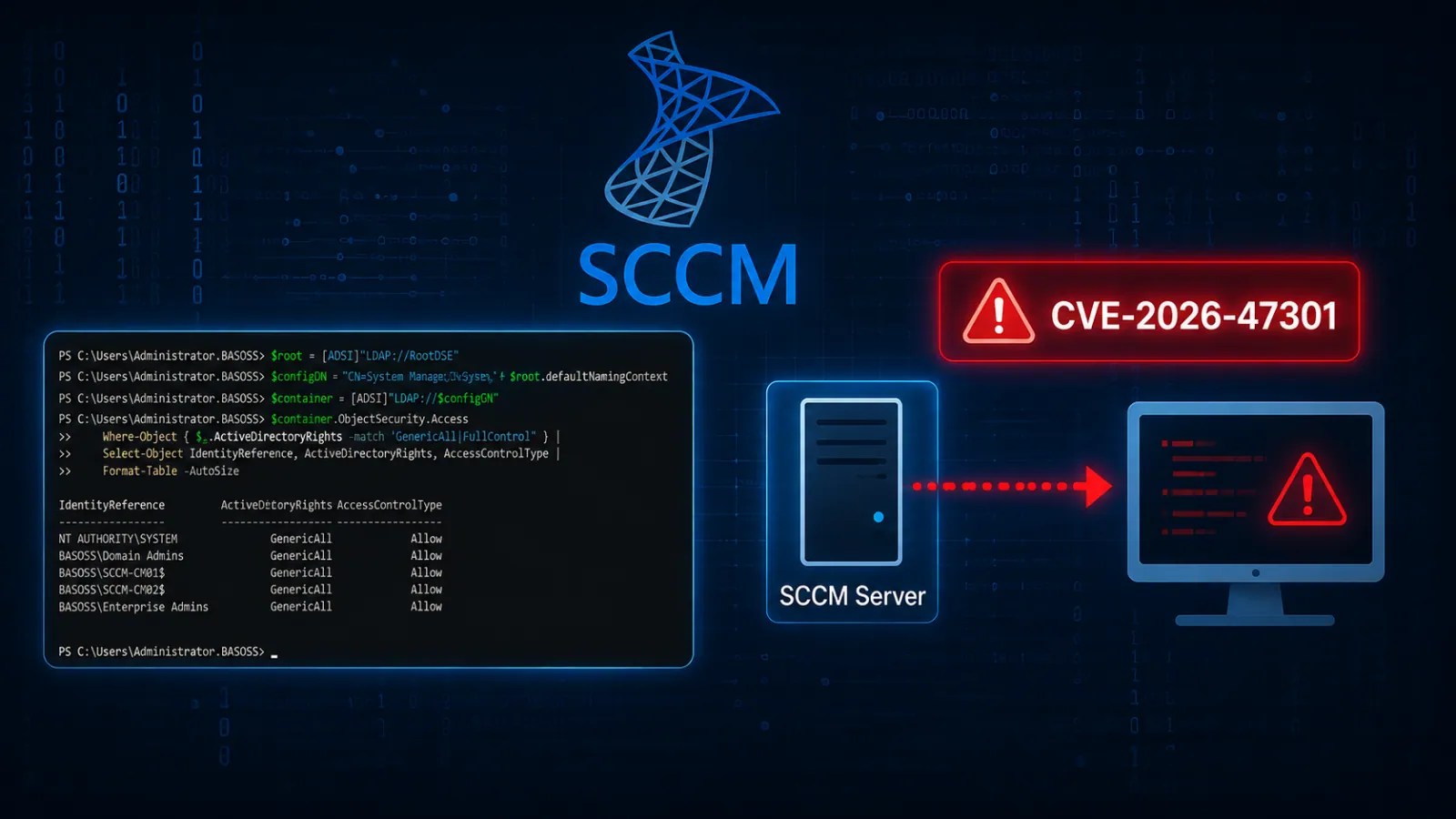
The release of a public exploit code for CVE-2026-47301, a critical vulnerability in Microsoft Configuration Manager (SCCM), has raised significant concerns among IT security professionals. This remote code execution flaw could potentially allow attackers to execute code at a SYSTEM level on a Configuration Manager Primary Site Server, posing a significant threat to enterprise systems.

Understanding the Exploit Code

Security researcher Omri Baso has made the proof-of-concept code available, which outlines a complex exploit chain rather than a single vulnerability. The repository includes source code, project files, a specially crafted CAB archive, and a compiled release. The vulnerability exploits broken access control, path traversal during CAB extraction, arbitrary file write, certificate-verification bypass, and DLL hijacking.

These weaknesses collectively enable attackers to implant files into the SCCM installation directory, allowing a privileged service to load them. This method targets the SMS_EXECUTIVE service, a crucial SCCM component that operates with elevated privileges, using a DLL proxying technique involving specific DLL files.

Potential Impact on Enterprises

The exploit’s ability to achieve SYSTEM-level execution on a Primary Site Server makes it a potent tool for attackers aiming for lateral movement, deployment of malware, credential theft, or even launching ransomware attacks. SCCM servers are particularly attractive targets as they oversee software deployment and administrative tasks in enterprise environments.

For exploitation to be successful, identifying the SCCM Primary Site Server is crucial. Although this information may not be openly available in Active Directory, it can be deduced by examining permissions within the System Management container. Malicious actors can exploit domain computer accounts that have Full Control or GenericAll permissions over this container.

Mitigation and Response Strategies

Organizations using SCCM are advised to immediately consult Microsoft’s advisory on CVE-2026-47301, identify any exposed or unpatched Primary Site Servers, and apply necessary security updates. Additionally, restricting access to SCCM management interfaces, auditing Active Directory permissions, and monitoring the SMS_EXECUTIVE service for unusual DLL-loading activity are crucial steps.

The public availability of the exploit code transforms this vulnerability from a standard patch management issue into an urgent detection and response challenge. Signs such as unexpected changes to built-in accounts, unusual DLLs in the installation directory, and suspicious CAB file activities should be prioritized for investigation.

In conclusion, the swift application of patches and heightened monitoring are imperative to safeguard enterprise environments from potential exploits and ensure robust cybersecurity defenses.


Cyber Security News Tags:CVE-2026-47301, Cybersecurity, enterprise risk, exploit code, IT management, Microsoft SCCM, network security, remote code execution, system security, Vulnerability

Post navigation

Previous Post: Apple Releases Security Updates Fixing WebKit Flaws

Related Posts

Lazarus Hackers Actively Attacking European Drone Manufacturing Companies Lazarus Hackers Actively Attacking European Drone Manufacturing Companies Cyber Security News
Citrix Netscaler 0-day RCE Vulnerability Patched Citrix Netscaler 0-day RCE Vulnerability Patched Cyber Security News
Securing Multi-Cloud Infrastructures in 2025 Enterprise Deployments Securing Multi-Cloud Infrastructures in 2025 Enterprise Deployments Cyber Security News
WhatsApp Scam: How GhostPairing Endangers Accounts WhatsApp Scam: How GhostPairing Endangers Accounts Cyber Security News
Critical Vulnerability in Ubuntu Allows Root Access Critical Vulnerability in Ubuntu Allows Root Access Cyber Security News
Hackers Compromised Official Gaming Mouse Software to Deliver Windows-based Xred Malware Hackers Compromised Official Gaming Mouse Software to Deliver Windows-based Xred Malware Cyber Security News

Categories

  • Cyber Security News
  • How To?
  • Security Week News
  • The Hacker News

Recent Posts

  • Exploit Code Published for Microsoft SCCM Vulnerability
  • Apple Releases Security Updates Fixing WebKit Flaws
  • CISA Urges Action on Severe Ray Vulnerability
  • AI-Driven Ransomware Attack Exploits VPNs and Databases
  • GeoServer Zero-Day Exploitation: Critical RCE Threat

Pages

  • About Us – Contact
  • Disclaimer
  • Privacy Policy
  • Terms and Rules

Archives

  • August 2026
  • July 2026
  • June 2026
  • May 2026
  • April 2026
  • March 2026
  • February 2026
  • January 2026
  • December 2025
  • November 2025
  • October 2025
  • September 2025
  • August 2025
  • July 2025
  • June 2025
  • May 2025

Recent Posts

  • Exploit Code Published for Microsoft SCCM Vulnerability
  • Apple Releases Security Updates Fixing WebKit Flaws
  • CISA Urges Action on Severe Ray Vulnerability
  • AI-Driven Ransomware Attack Exploits VPNs and Databases
  • GeoServer Zero-Day Exploitation: Critical RCE Threat

Pages

  • About Us – Contact
  • Disclaimer
  • Privacy Policy
  • Terms and Rules

Categories

  • Cyber Security News
  • How To?
  • Security Week News
  • The Hacker News

Copyright © 2026 Cyber Web Spider Blog – News.

Powered by PressBook Masonry Dark