Skip to content
  • Home
  • Cyber Map
  • About Us – Contact
  • Disclaimer
  • Terms and Rules
  • Privacy Policy
Cyber Web Spider Blog – News

Cyber Web Spider Blog – News

Globe Threat Map provides a real-time, interactive 3D visualization of global cyber threats. Monitor DDoS attacks, malware, and hacking attempts with geo-located arcs on a rotating globe. Stay informed with live logs and archive stats.

  • Home
  • Cyber Map
  • Cyber Security News
  • Security Week News
  • The Hacker News
  • How To?
  • Toggle search form
Critical FFmpeg Vulnerabilities Demand Urgent Updates

Critical FFmpeg Vulnerabilities Demand Urgent Updates

Posted on July 28, 2026 By CWS

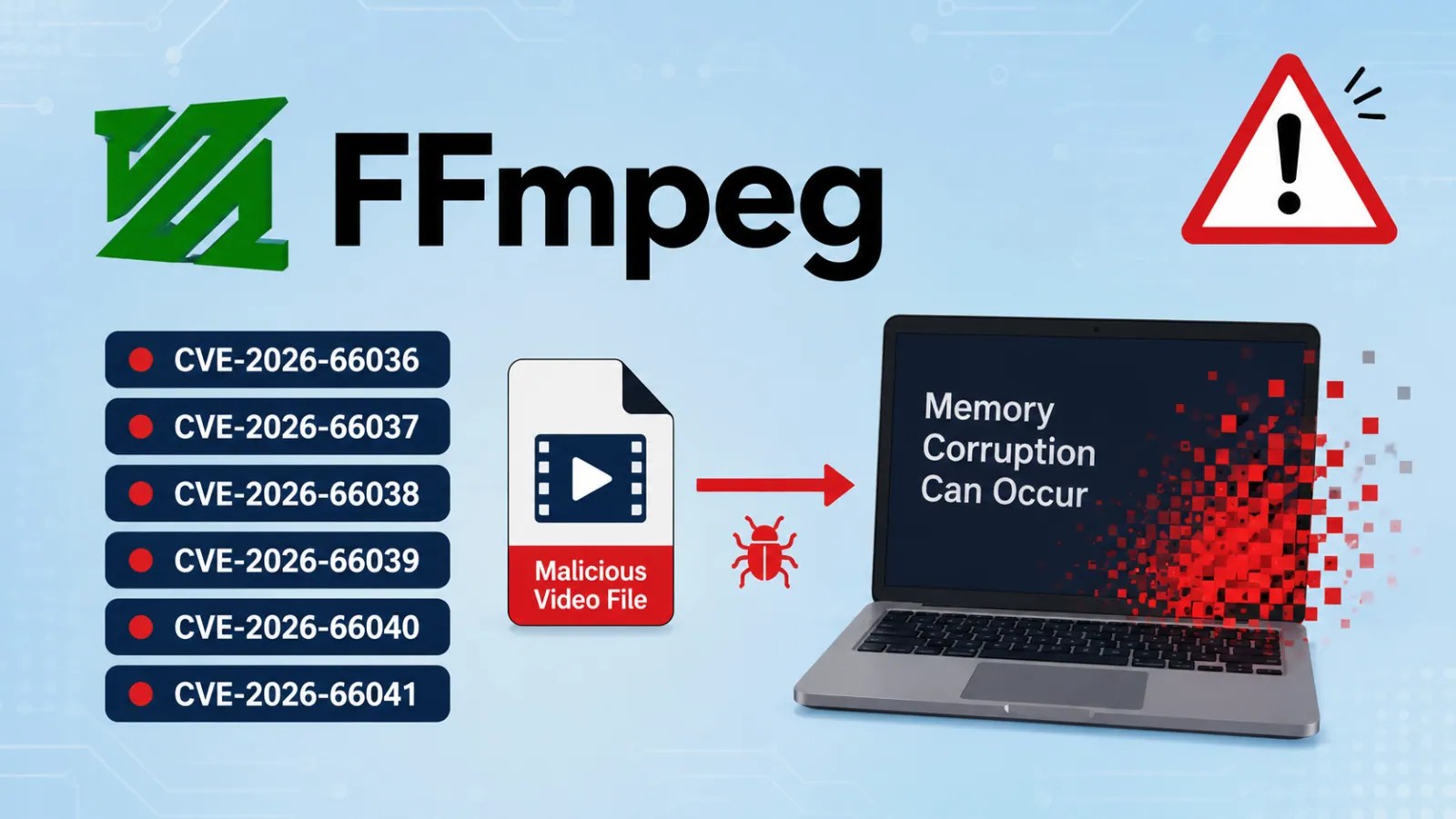
Recent analysis has uncovered multiple critical vulnerabilities in FFmpeg, a leading open-source multimedia framework. These weaknesses primarily affect the framework’s media parsing, decoding, filtering, and encoding functions. When applications process malicious files, these vulnerabilities can be exploited, potentially leading to severe consequences.

Understanding the Impact of FFmpeg Vulnerabilities

The identified issues can result in heap memory corruption, potentially causing applications to crash or, in certain cases, allowing attackers to execute arbitrary code. Additional vulnerabilities may lead to denial-of-service attacks or expose uninitialized heap memory, posing further risks to system security.

To mitigate these threats, FFmpeg’s latest updates have addressed the vulnerabilities. Organizations are strongly encouraged to upgrade to the patched versions or rebuild the framework using the recommended patches.

Details of Specific Vulnerabilities

One of the critical issues, CVE-2026-66036, has a CVSS score of 7.7 and impacts the vf_hqdn3d video denoising filter. Exploitation occurs when a video file increases frame resolution unexpectedly, leading to memory buffer overruns. Another vulnerability, CVE-2026-66041, also rated 7.7, targets the vf_quirc filter, potentially causing buffer overflow through crafted subtitle files.

Further vulnerabilities include CVE-2026-66039, an integer overflow issue in the MACE6 audio decoder, and CVE-2026-66040, affecting PNG and APNG encoders. Both vulnerabilities pose significant risks of heap buffer overflow and code execution. Additionally, CVE-2026-66037 and CVE-2026-66038, with scores of 7.1, can lead to uncontrolled resource consumption and potential data disclosure.

Steps for Mitigation and Future Outlook

Immediate updates to FFmpeg are crucial to protect systems from these vulnerabilities. Key fixes are available in several upstream commits, including 5d7112c, 8670835, and others. If immediate patching is not possible, organizations should restrict untrusted media processing, enforce memory limits, and avoid risky configurations.

Adopting these security measures will help safeguard systems against potential exploits. As cyber threats evolve, maintaining updated software and employing robust security practices remain essential for organizational protection.
Cyber Security News Tags:code execution, CVE, Cybersecurity, denial of service, FFmpeg, heap corruption, media framework, memory allocation, multimedia, patch management, Security, security updates, Software Security, software update, Vulnerabilities

Post navigation

Previous Post: Google Introduces New Naming System for Threat Actors
Next Post: Critical TeamCity Vulnerability Demands Immediate Update

Related Posts

Vulnerable Codes in Legacy Python Packages Enables Attacks on Python Package Index Via Domain Compromise Vulnerable Codes in Legacy Python Packages Enables Attacks on Python Package Index Via Domain Compromise Cyber Security News
Google Dismantles Chinese Cyber Espionage Network Google Dismantles Chinese Cyber Espionage Network Cyber Security News
Hackers Accessed Email Account Contains Valid Credentials Hackers Accessed Email Account Contains Valid Credentials Cyber Security News
Jenkins Security Flaws Pose Major XSS Threats Jenkins Security Flaws Pose Major XSS Threats Cyber Security News
Hackers Can Access Microsoft Teams Chat and Emails by Retrieving Access Tokens Hackers Can Access Microsoft Teams Chat and Emails by Retrieving Access Tokens Cyber Security News
CISA Urges Action on Fortinet SQL Injection Flaw CISA Urges Action on Fortinet SQL Injection Flaw Cyber Security News

Categories

  • Cyber Security News
  • How To?
  • Security Week News
  • The Hacker News

Recent Posts

  • Microsoft Teams Vishing Attack Exploits Quick Assist
  • Critical TeamCity Vulnerability Demands Immediate Update
  • Critical FFmpeg Vulnerabilities Demand Urgent Updates
  • Google Introduces New Naming System for Threat Actors
  • Critical Vulnerabilities in LoadMaster Demand Immediate Updates

Pages

  • About Us – Contact
  • Disclaimer
  • Privacy Policy
  • Terms and Rules

Archives

  • July 2026
  • June 2026
  • May 2026
  • April 2026
  • March 2026
  • February 2026
  • January 2026
  • December 2025
  • November 2025
  • October 2025
  • September 2025
  • August 2025
  • July 2025
  • June 2025
  • May 2025

Recent Posts

  • Microsoft Teams Vishing Attack Exploits Quick Assist
  • Critical TeamCity Vulnerability Demands Immediate Update
  • Critical FFmpeg Vulnerabilities Demand Urgent Updates
  • Google Introduces New Naming System for Threat Actors
  • Critical Vulnerabilities in LoadMaster Demand Immediate Updates

Pages

  • About Us – Contact
  • Disclaimer
  • Privacy Policy
  • Terms and Rules

Categories

  • Cyber Security News
  • How To?
  • Security Week News
  • The Hacker News

Copyright © 2026 Cyber Web Spider Blog – News.

Powered by PressBook Masonry Dark