Skip to content
  • Home
  • Cyber Map
  • About Us – Contact
  • Disclaimer
  • Terms and Rules
  • Privacy Policy
Cyber Web Spider Blog – News

Cyber Web Spider Blog – News

Globe Threat Map provides a real-time, interactive 3D visualization of global cyber threats. Monitor DDoS attacks, malware, and hacking attempts with geo-located arcs on a rotating globe. Stay informed with live logs and archive stats.

  • Home
  • Cyber Map
  • Cyber Security News
  • Security Week News
  • The Hacker News
  • How To?
  • Toggle search form
GhostLock Vulnerability in Linux Kernel Exposes Security Risks

GhostLock Vulnerability in Linux Kernel Exposes Security Risks

Posted on July 8, 2026 By CWS

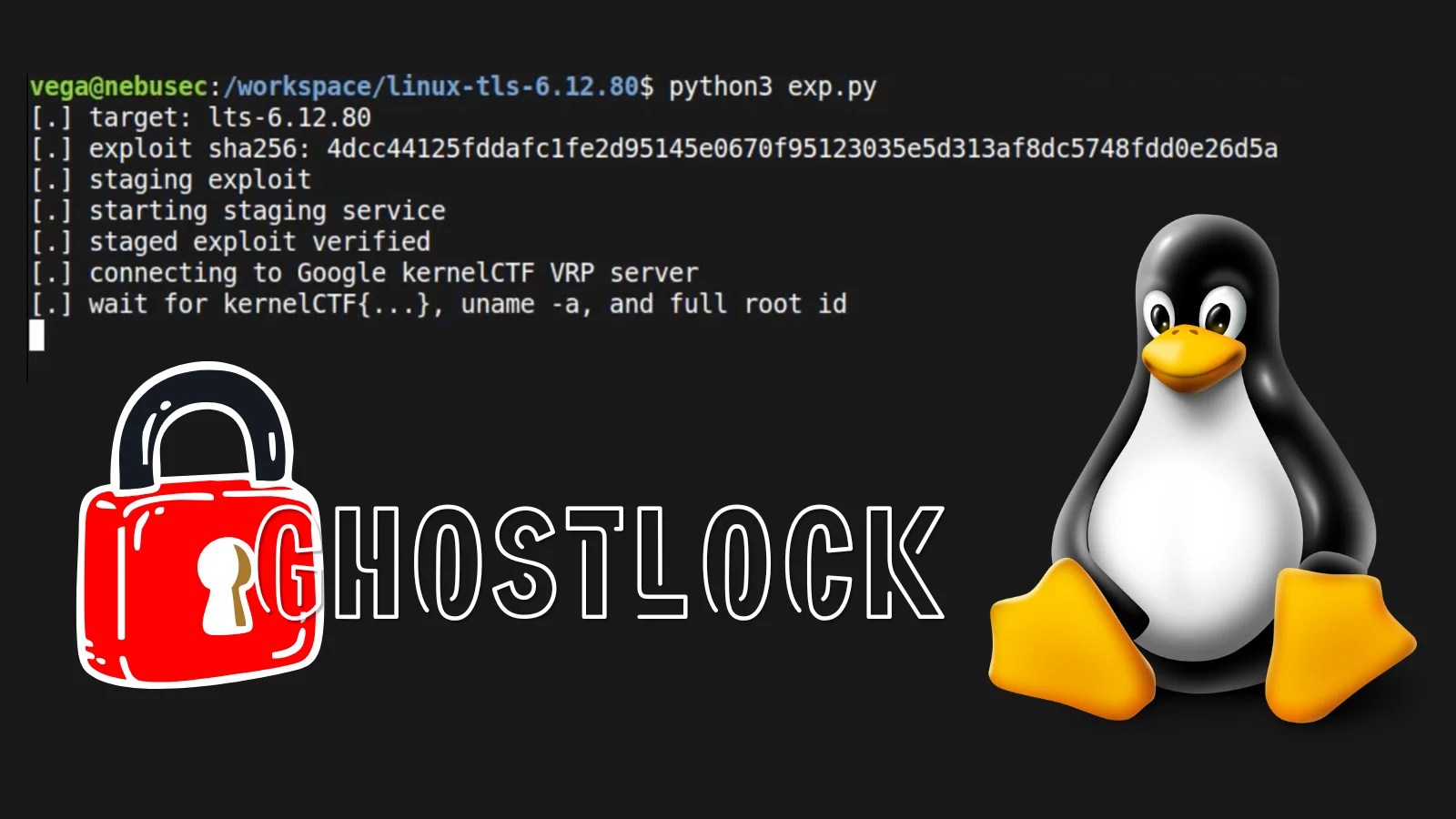
A newly disclosed vulnerability in the Linux kernel, identified as CVE-2026-43499 and called “GhostLock,” poses a significant security threat by enabling privilege escalation. Researchers from VEGA have revealed this flaw, which has quietly impacted major Linux distributions for over 15 years.

Origins of GhostLock Vulnerability

The GhostLock vulnerability stems from a logic error in the kernel’s real-time mutex (rtmutex) subsystem, first introduced in version 2.6.39 back in 2011. This flaw went unnoticed until its patching in April 2026, affecting all Linux kernels up to version 7.1.

Nebula Security researchers have demonstrated an exploit with an impressive 97% success rate, earning them a $92,337 reward via Google’s kernelCTF program. This vulnerability allows local attackers, without elevated privileges, to manipulate kernel memory and gain root access.

Technical Details and Exploitation

The vulnerability arises due to an error in the remove_waiter() function, which incorrectly manages pointers related to task execution during futex operations. This oversight results in a dangling pointer, referencing freed kernel stack memory, which attackers can exploit through a race condition involving priority-inheritance futexes.

By coordinating multiple threads and futex variables, attackers can induce a deadlock, prompting the kernel to rollback and leave a stale pointer. This exploit allows attackers to reclaim and manipulate the freed memory, enabling them to alter kernel structures and perform arbitrary writes, albeit constrained, to kernel memory.

Implications and Mitigations

Researchers successfully exploited the inet6_protos table, redirecting function pointers to attacker-controlled memory and hijacking control flow with crafted network packets. The attack circumvents kernel address space layout randomization (KASLR) and leverages predictable memory regions to construct a return-oriented programming chain.

A subsequent attack phase, known as DirtyMode, modifies sysctl settings via a single kernel memory write, allowing arbitrary code execution as root. This poses significant risks in multi-user systems and containerized environments, facilitating potential container escapes.

To address this, Linux kernel maintainers have corrected the remove_waiter() function to reference the proper task structure. However, the initial patch introduced a null pointer exception, necessitating further updates. Users are urged to upgrade to patched kernel versions or the latest long-term support releases to mitigate the risk of exploitation.

Given the high reliability of this attack, swift patching is crucial to safeguard systems from potential breaches.


Cyber Security News Tags:CVE-2026-43499, Cybersecurity, GhostLock, kernel exploit, Linux kernel, Nebula Security, Patching, privilege escalation, Security, Vega, Vulnerability

Post navigation

Previous Post: CISA Demands Urgent Patch for Critical Software Vulnerabilities
Next Post: GitHub Vulnerability Exposes Private Data to Attacks

Related Posts

Jewelbug Exploits Browsers to Infiltrate Government Systems Jewelbug Exploits Browsers to Infiltrate Government Systems Cyber Security News
New Analysis Uncovers LockBit 5.0 Key Capabilities and Two-Stage Execution Model New Analysis Uncovers LockBit 5.0 Key Capabilities and Two-Stage Execution Model Cyber Security News
Angular Platform Vulnerability Allows Malicious Code Execution Via Weaponized SVG Animation Files Angular Platform Vulnerability Allows Malicious Code Execution Via Weaponized SVG Animation Files Cyber Security News
Critical Next.js Flaws Allow Remote Code Execution Critical Next.js Flaws Allow Remote Code Execution Cyber Security News
Fancy Bear Exploits Routers and Cloud for Covert Cyberattacks Fancy Bear Exploits Routers and Cloud for Covert Cyberattacks Cyber Security News
Critical Cisco Vulnerability Exposes SD-WAN to Attacks Critical Cisco Vulnerability Exposes SD-WAN to Attacks Cyber Security News

Categories

  • Cyber Security News
  • How To?
  • Security Week News
  • The Hacker News

Recent Posts

  • Iranian Hackers Exploit Fake Coding Test to Infiltrate Iraqi Systems
  • Aembit Enhances Security for AI Agents in Enterprises
  • ASOS Investigates Unauthorized Notifications Breach
  • Linux Backdoors Mimic Email Tools to Evade Detection
  • Enhancing Threat Monitoring with Intelligence-Led Approaches

Pages

  • About Us – Contact
  • Disclaimer
  • Privacy Policy
  • Terms and Rules

Archives

  • October 2026
  • September 2026
  • August 2026
  • July 2026
  • June 2026
  • May 2026
  • April 2026
  • March 2026
  • February 2026
  • January 2026
  • December 2025
  • November 2025
  • October 2025
  • September 2025
  • August 2025
  • July 2025
  • June 2025
  • May 2025

Recent Posts

  • Iranian Hackers Exploit Fake Coding Test to Infiltrate Iraqi Systems
  • Aembit Enhances Security for AI Agents in Enterprises
  • ASOS Investigates Unauthorized Notifications Breach
  • Linux Backdoors Mimic Email Tools to Evade Detection
  • Enhancing Threat Monitoring with Intelligence-Led Approaches

Pages

  • About Us – Contact
  • Disclaimer
  • Privacy Policy
  • Terms and Rules

Categories

  • Cyber Security News
  • How To?
  • Security Week News
  • The Hacker News

Copyright © 2026 Cyber Web Spider Blog – News.

Powered by PressBook Masonry Dark