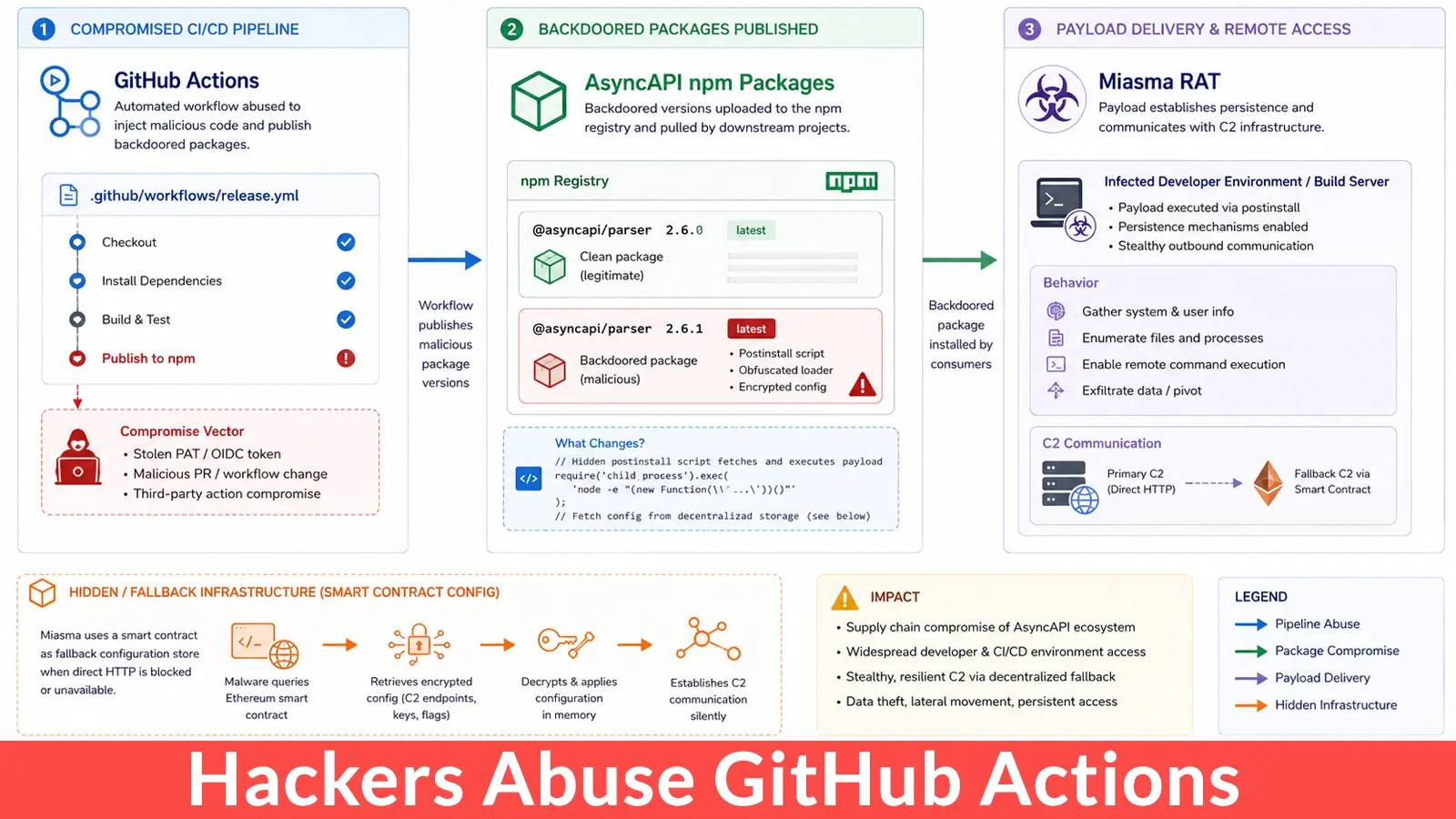
A recent supply chain attack has leveraged GitHub Actions to introduce the Miasma malware into widely used AsyncAPI npm packages. This breach poses significant risks to developer environments and automated systems. By exploiting a compromised release process, attackers have managed to distribute malicious code via the project’s legitimate npm namespace, impacting approximately 2.9 million weekly downloads.
Exploiting Trusted Channels
The attackers successfully infiltrated the release process, utilizing trusted software pathways to propagate a Node.js payload associated with Miasma. As reported by Cato Networks to Cyber Security News, this campaign highlights the inadequacy of relying solely on valid package names and official workflows for security. The incident underscores the potential for adversaries to target automation processes to access sensitive data and downstream projects.
The breach began with a misconfigured GitHub Actions setup that allowed unverified pull request content to manipulate a privileged workflow context. This vulnerability provided attackers a means to alter AsyncAPI repository content, masquerading the malicious changes as typical development activities.
Malicious Code Distribution
Once embedded in a branch linked to the project’s release process, the malicious changes were published by AsyncAPI’s automation, lending them a veneer of legitimacy. This tactic differentiates the incident from traditional typosquatting, where attackers publish deceptively similar packages under unfamiliar accounts. It also resonates with previous vulnerabilities identified in GitHub Actions workflows, which can expose critical tokens and cloud credentials.
The affected npm packages, including versions like @asyncapi/generator 3.3.1 and @asyncapi/specs 6.11.2-alpha.1, were automatically incorporated into environments restoring dependencies during the breach period.
Stealthy Malware Execution
Unlike typical npm lifecycle scripts, the embedded JavaScript executed upon module import, remaining dormant post-installation. This stealthy execution model allows the malware to activate during various tasks, such as application runs or CI/CD jobs, evading standard detection measures.
The initial code executed a detached Node.js process, fetching an encrypted payload from IPFS. This payload enabled persistent access, remote command execution, and interaction with attacker-controlled infrastructure, using an Ethereum contract for fallback command-and-control configurations.
Recommendations for Security Measures
Organizations should scrutinize their manifests, lockfiles, and build artifacts for compromised versions to assess potential exposure. Security teams are advised to inspect outbound connections, review repository logs, and rotate credentials. Additionally, enhancing privileged workflow security, particularly those involving pull_request_target, is crucial.
Indicators of compromise have been detailed, including specific npm package versions and network signatures. These indicators should be incorporated into monitoring strategies to detect and mitigate similar threats effectively.
The attack serves as a stark reminder of the vulnerabilities inherent in automation processes and the necessity of robust security measures to safeguard against sophisticated threats in software ecosystems.