Skip to content
  • Home
  • Cyber Map
  • About Us – Contact
  • Disclaimer
  • Terms and Rules
  • Privacy Policy
Cyber Web Spider Blog – News

Cyber Web Spider Blog – News

Globe Threat Map provides a real-time, interactive 3D visualization of global cyber threats. Monitor DDoS attacks, malware, and hacking attempts with geo-located arcs on a rotating globe. Stay informed with live logs and archive stats.

  • Home
  • Cyber Map
  • Cyber Security News
  • Security Week News
  • The Hacker News
  • How To?
  • Toggle search form
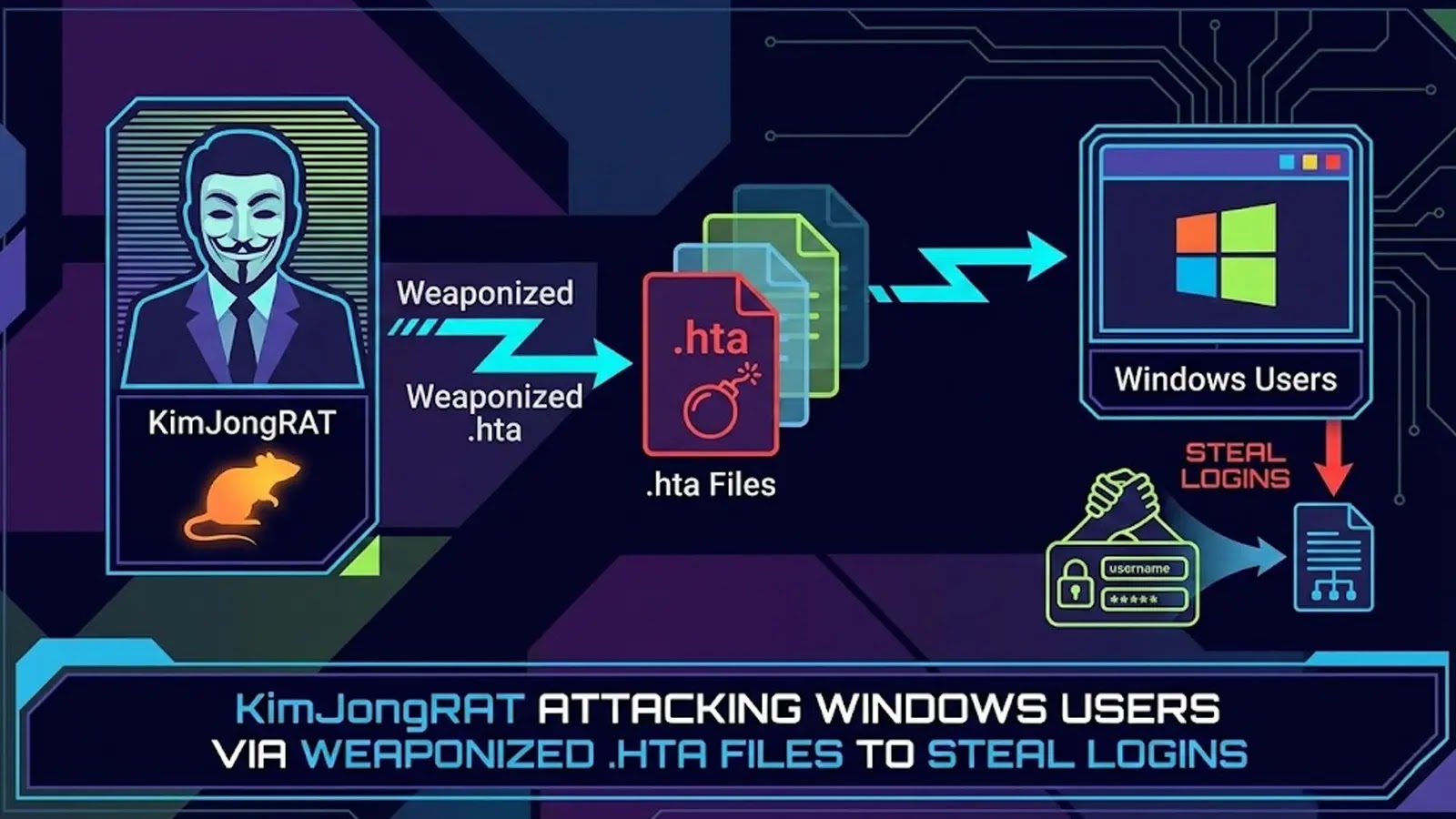
KimJongRAT Attacking Windows Users via Weaponized .hta Files to Steal Logins

KimJongRAT Attacking Windows Users via Weaponized .hta Files to Steal Logins

Posted on December 1, 2025December 1, 2025 By CWS

A brand new distant entry trojan dubbed KimJongRAT has surfaced, posing a extreme menace to Home windows customers.

This refined malware is believed to be orchestrated by the Kimsuky group, a menace actor with alleged state backing.

The marketing campaign usually begins with a phishing e-mail containing a misleading archive named Nationwide Tax Discover, which lures unsuspecting victims into initiating the an infection chain.

Upon opening the malicious archive, customers are introduced with a shortcut file disguised as a professional PDF doc.

Tax discover.pdf (Supply – Alyac)

When executed, this shortcut file triggers a hidden command that decodes a Base64 URL and abuses the professional Microsoft HTML Utility utility to contact a distant server.

This course of stealthily downloads a further payload often known as tax.hta, successfully bypassing normal safety checks.

Alyac safety analysts recognized that this loader script is applied in VBScript and employs intelligent evasion methods.

The malware makes an attempt to evade detection by using professional providers like Google Drive to host its malicious parts.

As soon as lively, the loader retrieves each decoy paperwork to trick the person and the precise malicious binaries required for the subsequent stage of the assault.

Exfiltration of delicate information

The first goal of this marketing campaign is the exfiltration of delicate private and monetary information.

The malware targets a wide selection of knowledge, together with system particulars, browser storage information, and encryption keys.

It particularly hunts for cryptocurrency pockets data and credentials for communication platforms like Telegram and Discord, making it a extremely harmful device for identification theft and monetary fraud.

Probably the most notable facet of KimJongRAT is its means to adapt its habits based mostly on the goal setting’s safety posture.

The malware executes a selected VBScript command to verify the standing of Home windows Defender earlier than continuing.

It makes use of the code snippet Set exec = oShell.Exec(ss) adopted by If InStr(output, “STOPPED”) > 0 Then to find out if the safety service is lively.

If Home windows Defender is disabled, the malware downloads a file named v3.log, which executes the first payload.

Conversely, if safety is lively, it retrieves another file referred to as pipe.log to avoid detection.

Whatever the path taken, the malware establishes persistence by registering itself within the system registry, guaranteeing it runs routinely to transmit stolen information periodically.

Record of cryptocurrency wallets hijacked by malware (Supply – Alyac)

Whereas the Record of cryptocurrency wallets hijacked by malware highlights the breadth of focused functions, it additionally highlights the precise monetary intent behind this tailor-made menace.

Observe us on Google Information, LinkedIn, and X to Get Extra Immediate Updates, Set CSN as a Most well-liked Supply in Google.
Cyber Security News Tags:Attacking, Files, HTA, KimJongRAT, Logins, Steal, Users, Weaponized, Windows

Post navigation

Previous Post: Operation Hanoi Thief Attacking IT Professionals with Pseudo-Polyglot Payload to Hide Malware
Next Post: Chinese Front Companies Providing Advanced Steganography Solutions for APT Operations

Related Posts

LANSCOPE Endpoint Manager Vulnerability Let Attackers Execute Remote Code LANSCOPE Endpoint Manager Vulnerability Let Attackers Execute Remote Code Cyber Security News
RONINGLOADER Weaponized Weaponizes Signed Drivers to Disable Defender and Evade EDR Tools RONINGLOADER Weaponized Weaponizes Signed Drivers to Disable Defender and Evade EDR Tools Cyber Security News
Threat Actors Weaponizing RMM Tools to Take Control of The Machine and Steal Data Threat Actors Weaponizing RMM Tools to Take Control of The Machine and Steal Data Cyber Security News
Hackers Infiltrate VS Code Marketplace with 19 Malicious Extensions Posing as PNG File Hackers Infiltrate VS Code Marketplace with 19 Malicious Extensions Posing as PNG File Cyber Security News
Top 10 Best Dynamic Application Security Testing (DAST) Platforms in 2025 Top 10 Best Dynamic Application Security Testing (DAST) Platforms in 2025 Cyber Security News
Millions of Dell Laptops Vulnerable to Device Takeover and Persistent Malware Attacks Millions of Dell Laptops Vulnerable to Device Takeover and Persistent Malware Attacks Cyber Security News

Categories

  • Cyber Security News
  • How To?
  • Security Week News
  • The Hacker News

Recent Posts

  • Muddled Libra Exploits VMware vSphere in Cyber Attack
  • Feiniu NAS Devices Targeted in Major Botnet Attack
  • Rapid SSH Worm Exploits Linux Systems with Credential Stuffing
  • Odido Telecom Hacked: 6.2 Million Accounts Compromised
  • Lazarus Group Targets npm and PyPI with Malicious Packages

Pages

  • About Us – Contact
  • Disclaimer
  • Privacy Policy
  • Terms and Rules

Archives

  • February 2026
  • January 2026
  • December 2025
  • November 2025
  • October 2025
  • September 2025
  • August 2025
  • July 2025
  • June 2025
  • May 2025

Recent Posts

  • Muddled Libra Exploits VMware vSphere in Cyber Attack
  • Feiniu NAS Devices Targeted in Major Botnet Attack
  • Rapid SSH Worm Exploits Linux Systems with Credential Stuffing
  • Odido Telecom Hacked: 6.2 Million Accounts Compromised
  • Lazarus Group Targets npm and PyPI with Malicious Packages

Pages

  • About Us – Contact
  • Disclaimer
  • Privacy Policy
  • Terms and Rules

Categories

  • Cyber Security News
  • How To?
  • Security Week News
  • The Hacker News