In a significant development in cybersecurity, researchers have publicly demonstrated the first macOS kernel exploit targeting Apple’s M5 silicon chip. Despite Apple’s robust hardware-level memory protection, this breakthrough highlights potential vulnerabilities in the system.
Exploitation of Apple’s M5 Chip
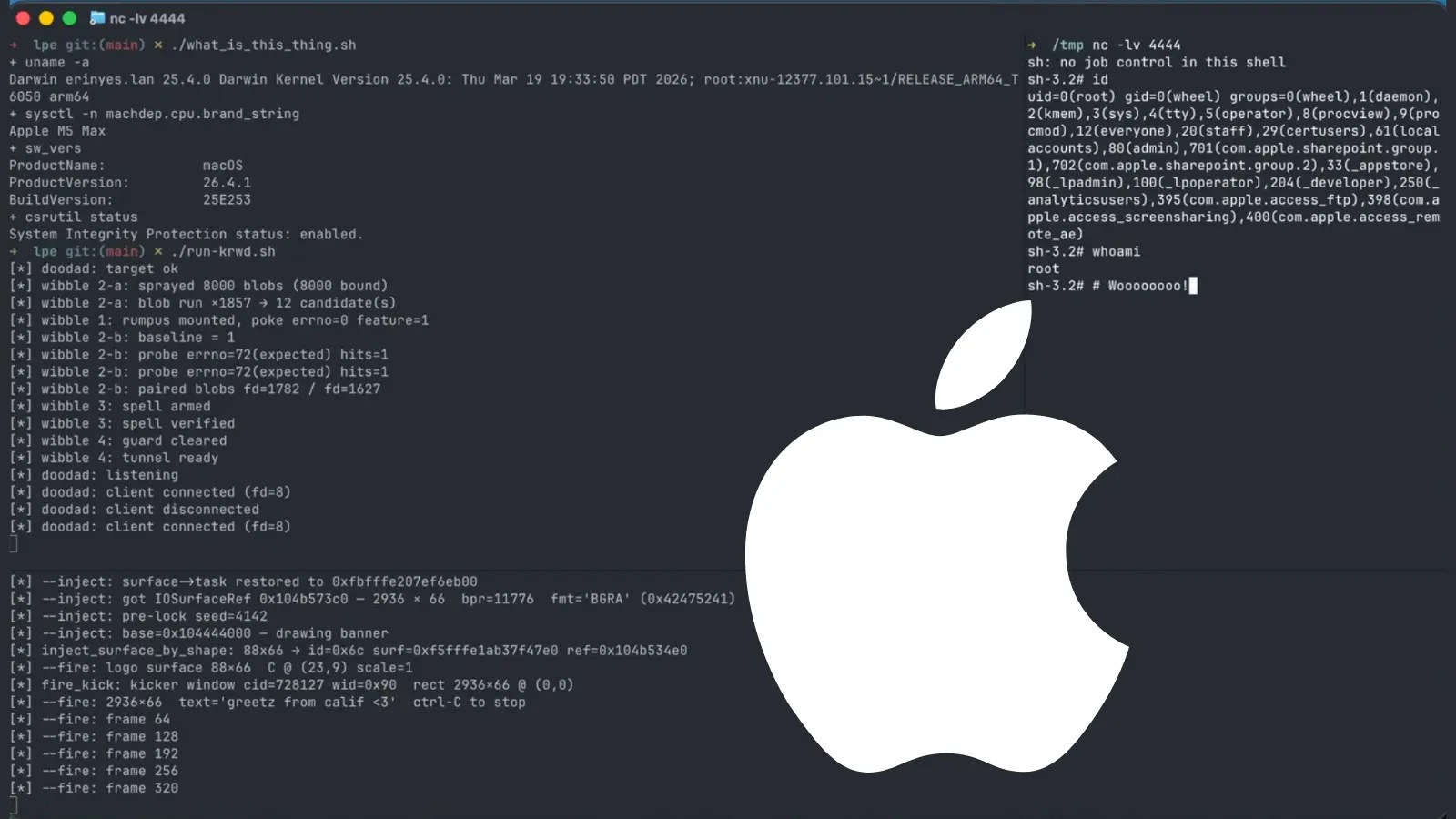
A team of researchers comprising Bruce Dang, Dion Blazakis, and Josh Maine from Calif has successfully developed a kernel local privilege escalation (LPE) exploit. This exploit targets macOS version 26.4.1 (25E253) running on the M5 hardware, achieving a full root shell from an unprivileged local user account.
The exploit chain operates using only standard system calls, effectively bypassing Apple’s Memory Integrity Enforcement (MIE) protection. The researchers identified two vulnerabilities on April 25, collaborated shortly after, and presented a working exploit by May 1.
Unique Approach to Disclosure
In a strategic move, the researchers bypassed traditional bug bounty channels by delivering a comprehensive 55-page report directly to Apple Park in Cupertino. This approach was intended to avoid the congestion typically experienced during large-scale events like Pwn2Own. Details of the exploit will remain confidential until Apple releases a corresponding patch.
Memory Integrity Enforcement is a key security feature built on ARM’s Memory Tagging Extension (MTE) architecture. Apple’s substantial investment in MIE aims to mitigate kernel memory corruption exploits, which makes this development particularly noteworthy.
The Role of AI in Security Research
The exploit’s success was partly attributed to Anthropic’s Mythos Preview, an advanced AI model that played a crucial role in identifying the vulnerabilities and assisting in the exploit’s development. This AI tool is noted for its ability to generalize attack patterns across broad vulnerability classes.
While the bugs were identified swiftly due to their known classification, the autonomous bypassing of MIE required significant human expertise. This collaboration between AI and human researchers demonstrates the evolving landscape of security research.
Memory corruption continues to be a widespread vulnerability across modern platforms. While security mechanisms like MIE aim to increase the difficulty of exploitation, they do not make it impossible. The rapid development of this exploit underscores the growing capabilities of AI in identifying and exploiting system vulnerabilities.
The discovery of this macOS kernel exploit signals a potential shift in the hardware security paradigm, emphasizing the need for continuous advancements in security measures. Apple is currently working on a patch to address this vulnerability, but until then, systems running macOS 26.4.1 on M5 hardware remain susceptible to this form of attack.