Skip to content
  • Home
  • Cyber Map
  • About Us – Contact
  • Disclaimer
  • Terms and Rules
  • Privacy Policy
Cyber Web Spider Blog – News

Cyber Web Spider Blog – News

Globe Threat Map provides a real-time, interactive 3D visualization of global cyber threats. Monitor DDoS attacks, malware, and hacking attempts with geo-located arcs on a rotating globe. Stay informed with live logs and archive stats.

  • Home
  • Cyber Map
  • Cyber Security News
  • Security Week News
  • The Hacker News
  • How To?
  • Toggle search form
Record-breaking 11.5 Tbps UDP Flood DDoS Attack Originated from Google Cloud Platform

Record-breaking 11.5 Tbps UDP Flood DDoS Attack Originated from Google Cloud Platform

Posted on September 2, 2025September 2, 2025 By CWS

Cloudflare, an organization that gives internet safety and infrastructure, lately reported that it stopped an enormous cyber assault.

This assault reached a file excessive of 11.5 terabits per second (Tbps). It was a kind of assault known as a Distributed Denial-of-Service (DDoS) assault, particularly a UDP flood. A lot of the assault got here from compromised assets on the Google Cloud Platform.

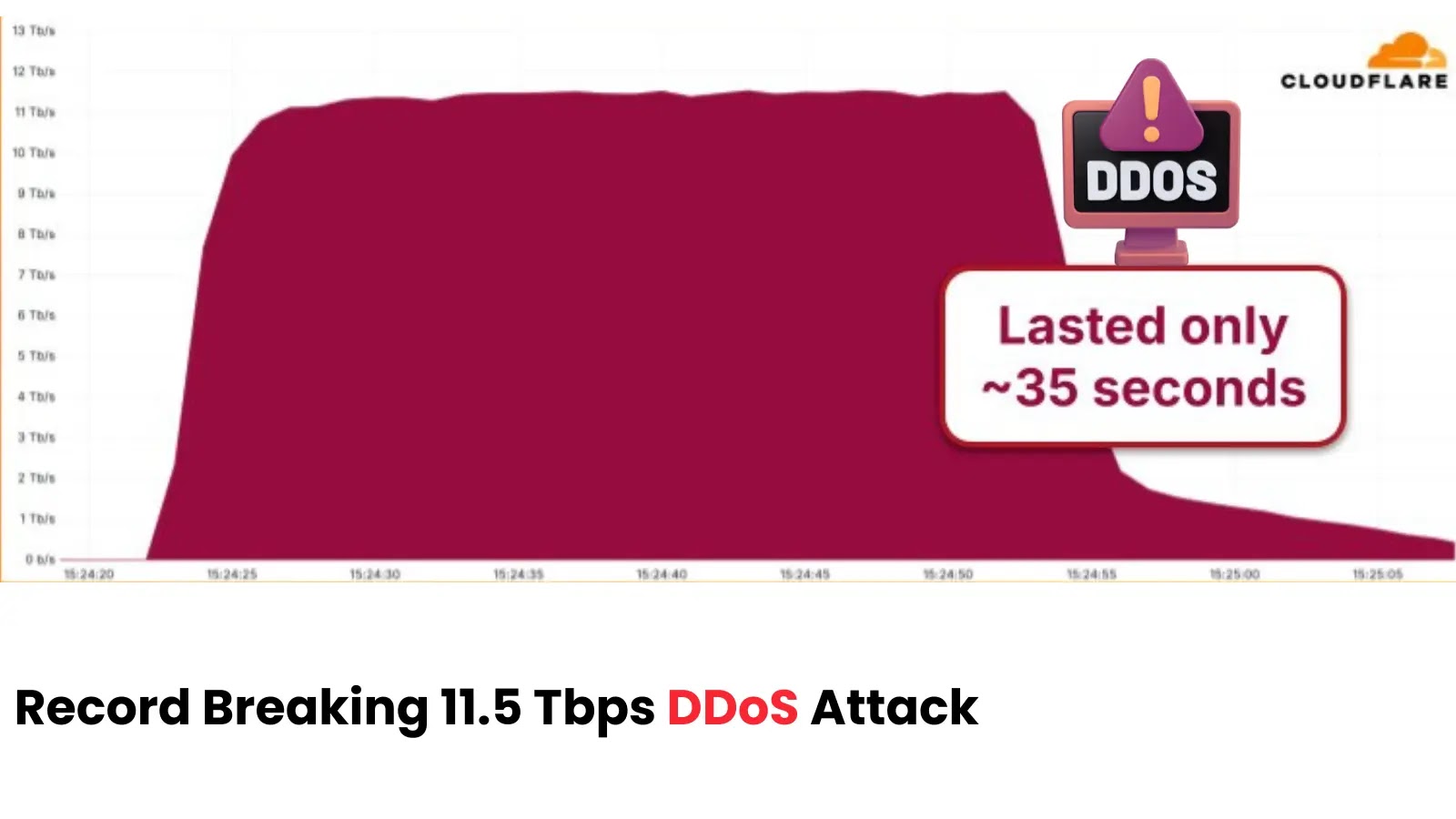
The corporate’s automated protection programs detected and neutralized the hyper-volumetric assault, which, regardless of its immense measurement, lasted for less than about 35 seconds.

A picture shared by Cloudflare detailed the assault’s temporary however highly effective lifecycle, exhibiting a fast spike to 11.5 Tbps earlier than being introduced beneath management.

Cloudflare confirmed its programs “autonomously detected and mitigated” the menace, highlighting the essential position of automated defenses in combating fashionable cyberattacks that may materialize and vanish in minutes.

DDoS Assault Graph (Supply: Cloudflare)

This record-shattering occasion shouldn’t be an remoted incident. In line with Cloudflare, its safety infrastructure has been beneath intense stress over the previous few weeks, having blocked “a whole bunch of hyper-volumetric DDoS assaults.”

Amongst these was one other vital assault that registered 5.1 billion packets per second (Bpps), demonstrating the various and chronic nature of the threats concentrating on on-line providers.

A UDP (Consumer Datagram Protocol) flood is a kind of DDoS assault the place the attacker overwhelms a goal server with an enormous variety of UDP packets.

As a result of UDP is a “connectionless” protocol, the server will be shortly exhausted because it makes an attempt to course of and reply to every incoming packet, ultimately rendering it unable to deal with professional site visitors.

The origination of such a large-scale assault from a serious public cloud supplier like Google Cloud highlights a persistent problem within the cybersecurity panorama.

Malicious actors usually exploit the huge assets and scalability of cloud platforms to construct highly effective botnets, able to launching assaults with a magnitude that may be tough to realize with conventional {hardware}.

Cloudflare has indicated {that a} extra detailed technical evaluation of the assault can be supplied in an upcoming report.

Discover this Story Attention-grabbing! Observe us on Google Information, LinkedIn, and X to Get Extra Instantaneous Updates.

Cyber Security News Tags:Attack, Cloud, DDoS, Flood, Google, Originated, Platform, RecordBreaking, Tbps, UDP

Post navigation

Previous Post: Ukrainian Network FDN3 Launches Massive Brute-Force Attacks on SSL VPN and RDP Devices
Next Post: Microsoft to Kill Popular Editor Browser Extensions on Edge and Chrome

Related Posts

Curly COMrades Hacker Group Using New Tools to Create Hidden Remote Access on Compromised Windows 10 Curly COMrades Hacker Group Using New Tools to Create Hidden Remote Access on Compromised Windows 10 Cyber Security News
70,000+ MongoDB Servers Vulnerable to MongoBleed Exploit 70,000+ MongoDB Servers Vulnerable to MongoBleed Exploit Cyber Security News
Hackers use Weaponized Microsoft Teams Installer to Compromise Systems With Oyster Malware Hackers use Weaponized Microsoft Teams Installer to Compromise Systems With Oyster Malware Cyber Security News
ZeroDayRAT: New Spyware Targeting Android and iOS ZeroDayRAT: New Spyware Targeting Android and iOS Cyber Security News
SEO Campaign Disguises Apps to Spread AsyncRAT SEO Campaign Disguises Apps to Spread AsyncRAT Cyber Security News
Free Converter Apps that Convert your Clean System to Infected in Seconds Free Converter Apps that Convert your Clean System to Infected in Seconds Cyber Security News

Categories

  • Cyber Security News
  • How To?
  • Security Week News
  • The Hacker News

Recent Posts

  • Top Log Monitoring Tools to Watch in 2026
  • Top Spam Filter Tools for 2026: A Comprehensive Guide
  • Top Fraud Detection Tools for 2026
  • Microsoft Urges Action on Critical Windows Updates
  • Citrix NetScaler Threat: Immediate Action Required

Pages

  • About Us – Contact
  • Disclaimer
  • Privacy Policy
  • Terms and Rules

Archives

  • March 2026
  • February 2026
  • January 2026
  • December 2025
  • November 2025
  • October 2025
  • September 2025
  • August 2025
  • July 2025
  • June 2025
  • May 2025

Recent Posts

  • Top Log Monitoring Tools to Watch in 2026
  • Top Spam Filter Tools for 2026: A Comprehensive Guide
  • Top Fraud Detection Tools for 2026
  • Microsoft Urges Action on Critical Windows Updates
  • Citrix NetScaler Threat: Immediate Action Required

Pages

  • About Us – Contact
  • Disclaimer
  • Privacy Policy
  • Terms and Rules

Categories

  • Cyber Security News
  • How To?
  • Security Week News
  • The Hacker News

Copyright © 2026 Cyber Web Spider Blog – News.

Powered by PressBook Masonry Dark