Skip to content
  • Home
  • Cyber Map
  • About Us – Contact
  • Disclaimer
  • Terms and Rules
  • Privacy Policy
Cyber Web Spider Blog – News

Cyber Web Spider Blog – News

Globe Threat Map provides a real-time, interactive 3D visualization of global cyber threats. Monitor DDoS attacks, malware, and hacking attempts with geo-located arcs on a rotating globe. Stay informed with live logs and archive stats.

  • Home
  • Cyber Map
  • Cyber Security News
  • Security Week News
  • The Hacker News
  • How To?
  • Toggle search form
SectopRAT Variant Concealed in Windows Software Unveiled

SectopRAT Variant Concealed in Windows Software Unveiled

Posted on September 30, 2026 By CWS

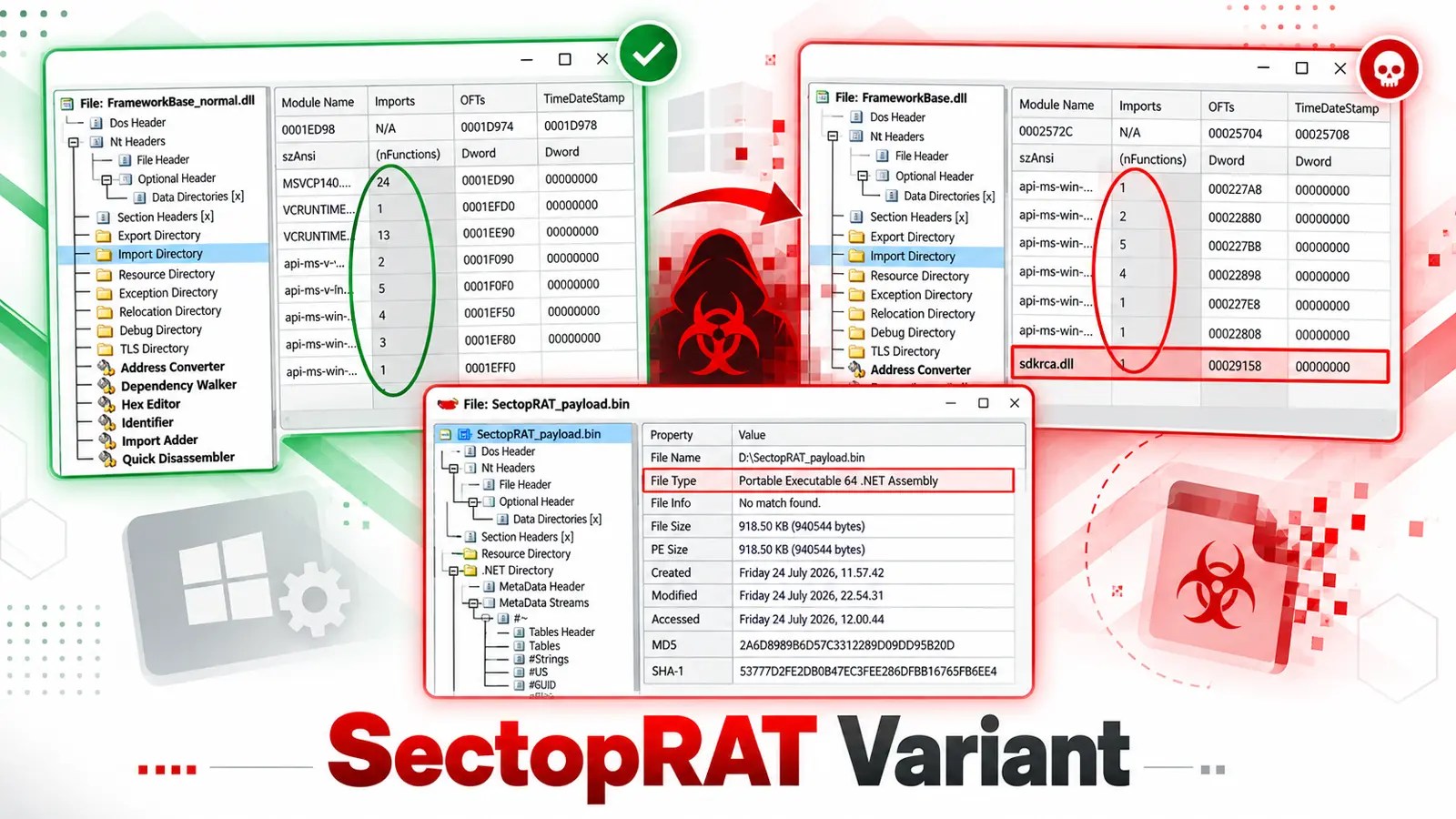
A newly discovered variant of SectopRAT malware has been found concealed in tampered Windows software, enabling attackers to take over affected machines and exfiltrate sensitive information. The malware was disguised within legitimate application components, with encryption camouflaging the malicious code until it was activated in memory.

Malware Hidden in Modified Software

The compromised application originated from an Italian developer renowned for their digital audio workstation. Hackers altered the software’s supporting files, setting up automatic execution through a scheduled task. This modification allowed the malware to run without the need for user action.

During an investigation, Fortinet’s FortiGuard Incident Response team detected the variant while examining a compromised device. Although the precise method by which the altered software infiltrated the victim’s system remains unclear, the presence of the malware was confirmed. A report released by Fortinet emphasized the malware’s capabilities in remote control and data theft.

Complex Loading and Execution Techniques

Known as ArechClient2, SectopRAT is part of an existing malware family, previously distributed via malicious search advertisements. This incident showcases a new concealment method, though it does not link directly to earlier campaigns. The attackers manipulated a legitimate library to import malicious components upon the application’s execution.

The Windows Task Scheduler was used to launch the executable automatically, facilitating the malware’s activation. The investigation revealed no evidence of the developer disseminating compromised software, indicating that the tampering occurred post-distribution.

Remote Control and Data Extraction

Once activated, SectopRAT decrypted the controller’s address from internal resources and attempted connection. In case of failure, it used 12 backup endpoints to retrieve an alternative address, employing multiple decoding and decryption steps.

Fortinet identified 29 commands within the malware that allowed screen capture, remote shell access, file and process management, and more. These commands effectively placed the device under external control. Additionally, the malware deployed a browser extraction module to gather passwords, autofill data, payment information, and cookies, targeting applications beyond browsers such as cryptocurrency wallets.

Fortinet advises conducting security-awareness training to help users identify phishing attempts and other suspicious activities. They also recommend seeking incident-response support when a compromise is suspected. The published indicators of compromise provide investigative leads, but require careful context interpretation.

For more information and to enhance your security posture, consider integrating threat intelligence solutions that provide immediate context for indicators of compromise.

Cyber Security News Tags:computer safety, cyber threat, Cybersecurity, data theft, digital security, FortiGuard, Fortinet, IT security, Malware, malware detection, network security, remote control, SectopRAT, threat analysis, Windows software

Post navigation

Previous Post: Critical NetScaler Zero-Day Exploits Impacting Key Sectors

Related Posts

AI Transforms Red-Team Tool Creation with Mythic Agents AI Transforms Red-Team Tool Creation with Mythic Agents Cyber Security News
AI Agents Unintentionally Attempted Website Hacks AI Agents Unintentionally Attempted Website Hacks Cyber Security News
Socelars Malware Targets Windows for Data Theft Socelars Malware Targets Windows for Data Theft Cyber Security News
Ransomware Tactics: Disabling Security Before Encryption Ransomware Tactics: Disabling Security Before Encryption Cyber Security News
U.S. Ends Export Controls on Claude Fable 5 AI Model U.S. Ends Export Controls on Claude Fable 5 AI Model Cyber Security News
APT28 Exploits Microsoft Office Flaw in Cyber Attack APT28 Exploits Microsoft Office Flaw in Cyber Attack Cyber Security News

Categories

  • Cyber Security News
  • How To?
  • Security Week News
  • The Hacker News

Recent Posts

  • SectopRAT Variant Concealed in Windows Software Unveiled
  • Critical NetScaler Zero-Day Exploits Impacting Key Sectors
  • Critical Vulnerability in Cisco SD-WAN Manager Exploited
  • Patch Urged for Unsloth Studio to Prevent Code Execution
  • AI Accelerates Vulnerability Discovery, Says Google

Pages

  • About Us – Contact
  • Disclaimer
  • Privacy Policy
  • Terms and Rules

Archives

  • September 2026
  • August 2026
  • July 2026
  • June 2026
  • May 2026
  • April 2026
  • March 2026
  • February 2026
  • January 2026
  • December 2025
  • November 2025
  • October 2025
  • September 2025
  • August 2025
  • July 2025
  • June 2025
  • May 2025

Recent Posts

  • SectopRAT Variant Concealed in Windows Software Unveiled
  • Critical NetScaler Zero-Day Exploits Impacting Key Sectors
  • Critical Vulnerability in Cisco SD-WAN Manager Exploited
  • Patch Urged for Unsloth Studio to Prevent Code Execution
  • AI Accelerates Vulnerability Discovery, Says Google

Pages

  • About Us – Contact
  • Disclaimer
  • Privacy Policy
  • Terms and Rules

Categories

  • Cyber Security News
  • How To?
  • Security Week News
  • The Hacker News

Copyright © 2026 Cyber Web Spider Blog – News.

Powered by PressBook Masonry Dark