Skip to content
  • Home
  • Cyber Map
  • About Us – Contact
  • Disclaimer
  • Terms and Rules
  • Privacy Policy
Cyber Web Spider Blog – News

Cyber Web Spider Blog – News

Globe Threat Map provides a real-time, interactive 3D visualization of global cyber threats. Monitor DDoS attacks, malware, and hacking attempts with geo-located arcs on a rotating globe. Stay informed with live logs and archive stats.

  • Home
  • Cyber Map
  • Cyber Security News
  • Security Week News
  • The Hacker News
  • How To?
  • Toggle search form
Supply Chain Attack Compromises Popular Python Package

Supply Chain Attack Compromises Popular Python Package

Posted on April 30, 2026 By CWS

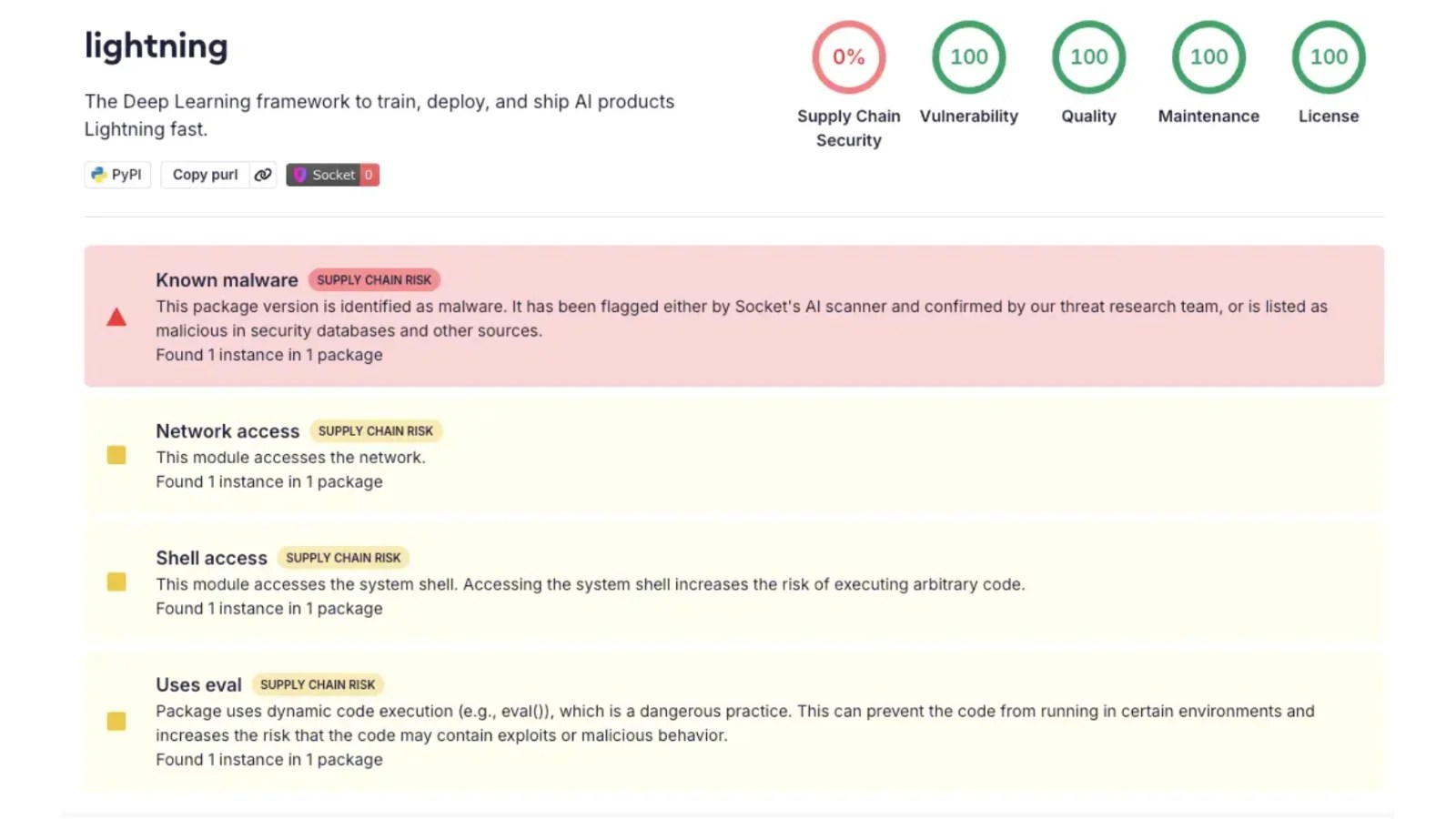
An alarming supply chain attack has targeted the widely-utilized Python package, lightning, a crucial tool in the realm of AI and machine learning development. The breach has not only executed credential-stealing malware but also compromised GitHub maintainer accounts, raising significant security concerns.

Identified by Socket’s Research Team, the malicious versions 2.6.2 and 2.6.3 of the lightning package were flagged a mere 18 minutes post-publication on April 30, 2026. In contrast, version 2.6.1, released earlier in January, remains unaffected and is deemed safe for use, serving as the last secure benchmark.

Implications of the Compromised Package

This breach targets developer workstations, continuous integration/continuous deployment (CI/CD) pipelines, and cloud build environments. Systems that have installed and imported the compromised package versions are vulnerable to the attack.

Socket’s research uncovered a covert _runtime directory within the compromised packages, housing a multi-stage execution chain that activates without user intervention upon module import. This includes components like start.py, which downloads and runs Bun, a JavaScript runtime, and router_runtime.js, a heavily obfuscated payload.

Technical Details of the Malware

The router_runtime.js payload, measuring 11 MB, is extensively obfuscated, with numerous references to system processes and authentication materials, making detection challenging. The malware silently exfiltrates credentials, targeting GitHub tokens, NPM tokens, and cloud account details.

Further analysis reveals parallels with the Shai-Hulud attack campaign, sharing similar credential targeting patterns and obfuscation techniques. This incident is part of an ongoing open-source supply chain campaign by Team PCP, which has previously compromised other platforms.

Response and Future Actions

Reports from the community and subsequent actions taken on GitHub indicate a possible compromise of the project’s GitHub account. Security teams are advised to treat environments using lightning versions 2.6.2 and 2.6.3 as compromised.

Immediate actions include removing the affected versions, reverting to version 2.6.1, and rotating all credentials. A thorough audit of GitHub repositories and system logs is also recommended to identify unauthorized activities. Socket continues to investigate and will provide further insights as the situation evolves.

Stay informed with the latest updates on this security breach by following us on Google News, LinkedIn, and X. For more insights, contact us with your cybersecurity stories.


Cyber Security News Tags:AI, cloud credentials, Cybersecurity, developer tools, GitHub compromise, GitHub tokens, LAPSUS, machine learning, Malware, npm tokens, Python, PyTorch Lightning, security breach, Socket analysis, supply chain attack, Team PCP

Post navigation

Previous Post: AI Propels Cybercrime with Rapid Attack Deployment
Next Post: Security Flaw in WordPress Plugin Uncovered After Years

Related Posts

Microsoft Introduces Efficiency Mode in Teams for Low-End Devices Microsoft Introduces Efficiency Mode in Teams for Low-End Devices Cyber Security News
Microsoft Office Flaw Allows Dangerous Code Execution Microsoft Office Flaw Allows Dangerous Code Execution Cyber Security News
Oracle WebLogic Vulnerability Exploited: CISA Issues Alert Oracle WebLogic Vulnerability Exploited: CISA Issues Alert Cyber Security News
UEFI Shell Vulnerabilities Could Allow Hackers to Bypass Secure Boot on 200,000+ Laptops UEFI Shell Vulnerabilities Could Allow Hackers to Bypass Secure Boot on 200,000+ Laptops Cyber Security News
Attackers Hijacking Official GitHub Desktop Repository to Distribute Malware as Official Installer Attackers Hijacking Official GitHub Desktop Repository to Distribute Malware as Official Installer Cyber Security News
AWS Addresses Major Security Flaws in RES Platform AWS Addresses Major Security Flaws in RES Platform Cyber Security News

Categories

  • Cyber Security News
  • How To?
  • Security Week News
  • The Hacker News

Recent Posts

  • AI SPERA Presents AITEM at Infosecurity Europe 2026
  • Chrome Extensions Exploit User Data for Ad Revenue
  • Maine Suspends Data Breach Portal Due to Fraudulent Reports
  • Critical Vulnerabilities in Protobuf.js Threaten Node.js Security
  • Microsoft Defender Zero-Day Vulnerability Exposes System Access

Pages

  • About Us – Contact
  • Disclaimer
  • Privacy Policy
  • Terms and Rules

Archives

  • June 2026
  • May 2026
  • April 2026
  • March 2026
  • February 2026
  • January 2026
  • December 2025
  • November 2025
  • October 2025
  • September 2025
  • August 2025
  • July 2025
  • June 2025
  • May 2025

Recent Posts

  • AI SPERA Presents AITEM at Infosecurity Europe 2026
  • Chrome Extensions Exploit User Data for Ad Revenue
  • Maine Suspends Data Breach Portal Due to Fraudulent Reports
  • Critical Vulnerabilities in Protobuf.js Threaten Node.js Security
  • Microsoft Defender Zero-Day Vulnerability Exposes System Access

Pages

  • About Us – Contact
  • Disclaimer
  • Privacy Policy
  • Terms and Rules

Categories

  • Cyber Security News
  • How To?
  • Security Week News
  • The Hacker News

Copyright © 2026 Cyber Web Spider Blog – News.

Powered by PressBook Masonry Dark