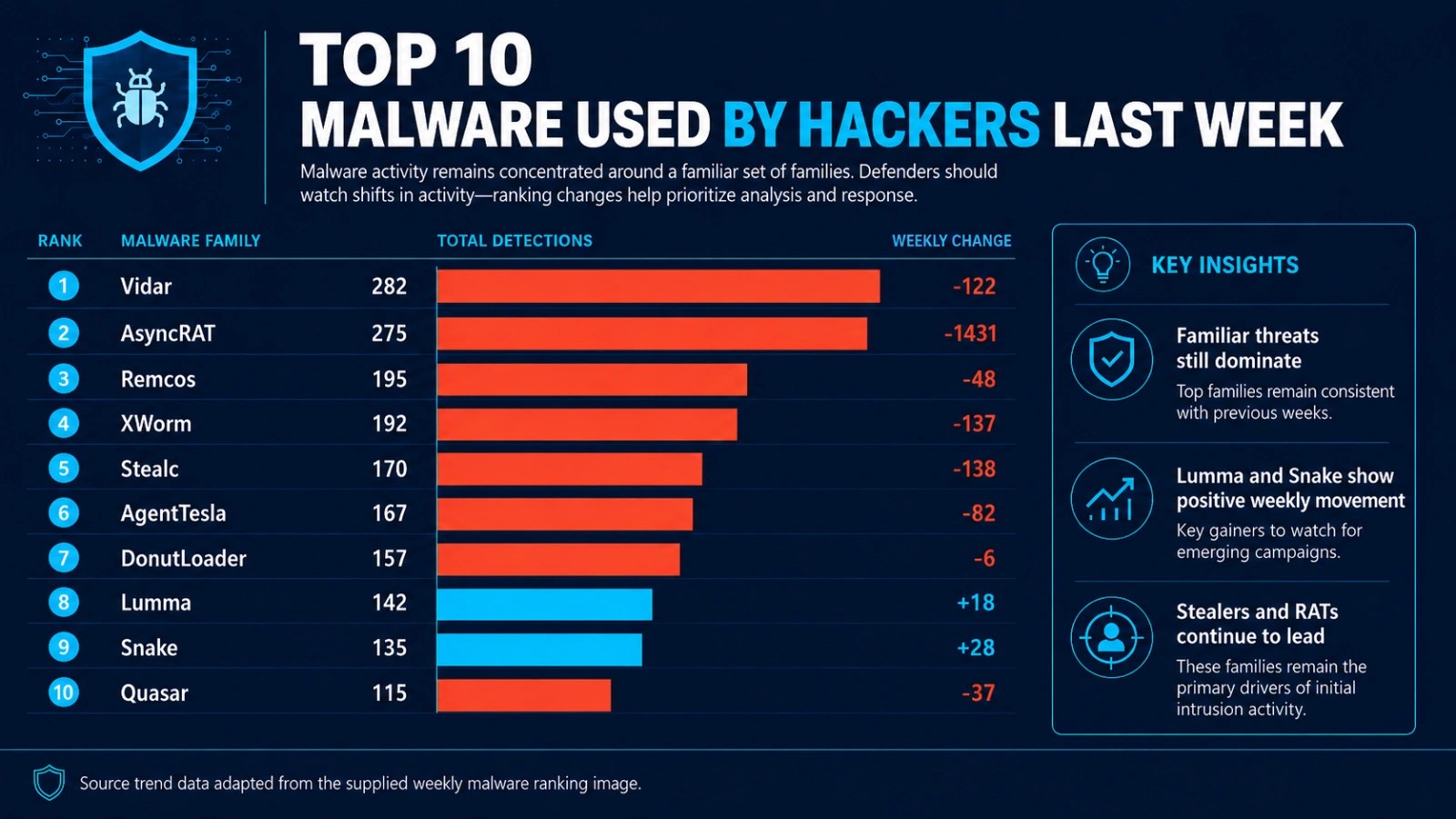
Last week, the cybersecurity world continued to witness the prevalence of known malware families, with infostealers and remote access trojans (RATs) dominating the threat landscape. These malicious tools remain primary choices for cybercriminals aiming for unauthorized system access, credential theft, and prolonged control over compromised systems.
Top Malware Families and Their Impact
Vidar emerged as the most detected malware, with 282 instances, closely followed by AsyncRAT with 275 detections. Despite its decline, AsyncRAT maintained a significant presence. Additionally, Remcos and XWorm were also prominent, highlighting the continued preference for RATs capable of various espionage and theft activities.
According to telemetry from ANY.RUN’s sandbox, malware activity largely revolved around ten recurring families. Among these, Vidar and AsyncRAT were at the forefront, with Remcos, Xworm, StealC, and AgentTesla trailing behind. Notably, most malware families experienced a decline in activity, except for Lumma and Snake Keylogger, which saw modest increases.
Detailed Analysis of Leading Malware
Vidar, an infostealer known for targeting U.S. and EU enterprises, remains a significant threat. It relies on techniques like malvertising and multi-stage loaders to deliver its payload. Meanwhile, AsyncRAT, a highly forked open-source RAT, primarily targets industries such as financial services and education through phishing campaigns.
Remcos RAT, although marketed for legitimate use, is widely exploited for espionage. It utilizes phishing emails with malicious attachments to infiltrate systems. Xworm, another RAT, employs sophisticated delivery methods, including exploiting known vulnerabilities and hiding payloads within seemingly benign files.
Industry-Specific Targeting and Defense Strategies
Industries such as finance, healthcare, and government continue to be primary targets for these malware families. The tactics employed often involve exploiting software vulnerabilities or leveraging social engineering to deceive victims into executing malicious files.
To combat these threats, organizations should prioritize behavioral detection and monitor for suspicious registry and scheduled-task modifications. Additionally, focusing on DNS and command-and-control pattern analysis can enhance defenses against these evolving threats.
In conclusion, the persistence of known malware families underscores the need for robust security measures. By monitoring changes in malware rankings, security teams can better allocate resources and develop targeted threat detection strategies, ultimately mitigating the risk of cyberattacks.