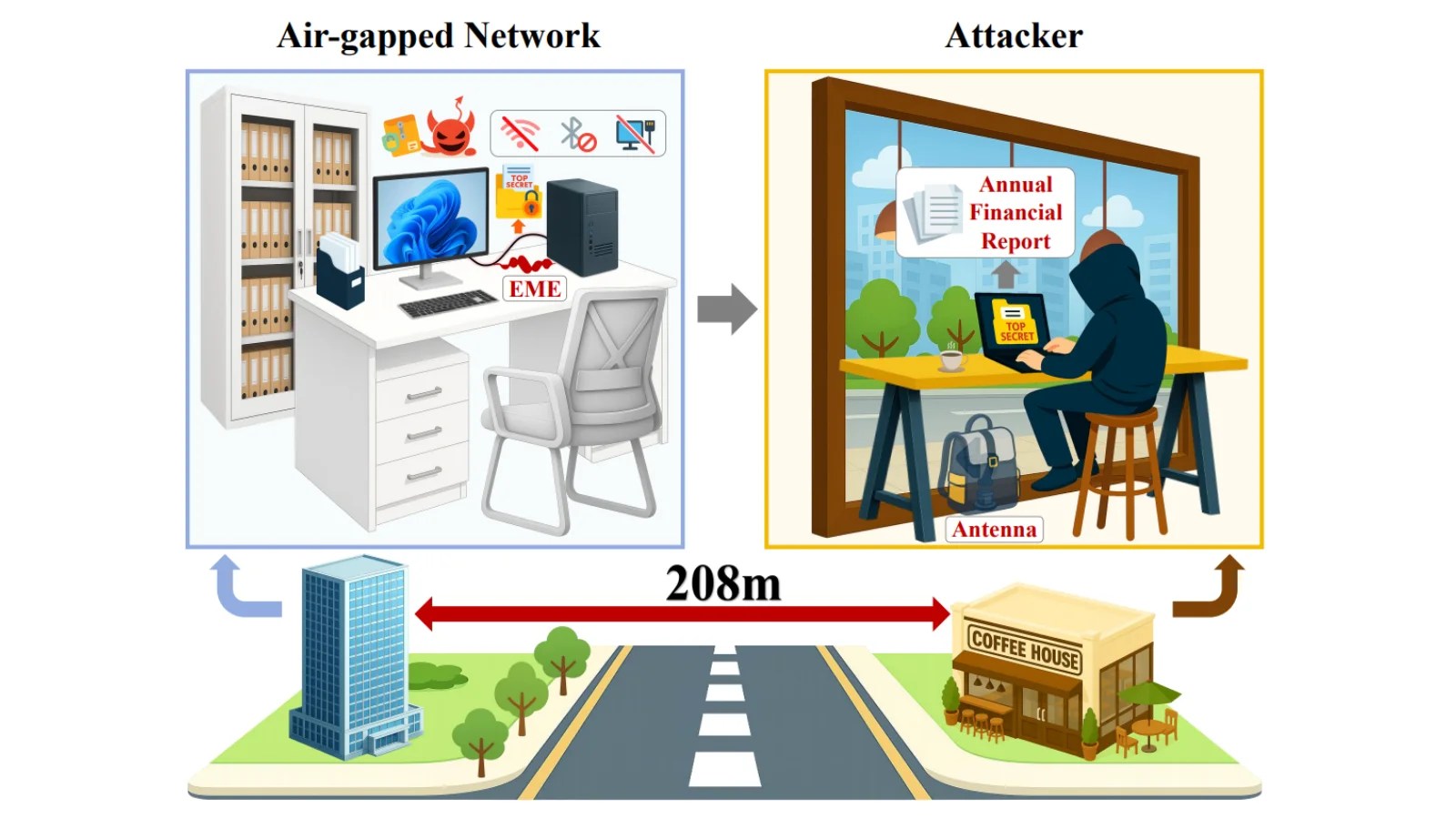
A groundbreaking electromagnetic (EM) covert-channel technique, known as TrojPix, poses a new risk to air-gapped computers by extracting sensitive information from distances as far as 208 meters. Developed by researchers from Shandong University and Quan Cheng Laboratory, the method will be showcased at the 35th USENIX Security Symposium.
Innovative Data Theft Method
TrojPix represents a substantial advancement in the realm of EM covert channels, achieving a transmission rate of 8.1 Mbps, significantly surpassing previous methods. Notably, this approach remains completely undetectable to human observers.
Air-gapped systems, isolated from external networks, are employed in sectors demanding high confidentiality, such as military and governmental operations. TrojPix circumvents this isolation by transforming digital video cables into unintentional radio transmitters.
Technical Mechanisms and Impact
The attack leverages Transition-Minimized Differential Signaling (TMDS), the encoding method for HDMI interfaces. By subtly altering pixel values, malware can modulate EM emissions from the video cable, allowing remote data capture via standard radio equipment.
Crucially, TrojPix operates without requiring administrative access or hardware modifications, functioning in user mode. The malware scans for sensitive files and uses a camouflaged ‘attack video’ to establish the covert channel, making it a method for data exfiltration rather than initial compromise.
While TrojPix requires prior malware presence, its ability to retrieve data from a compromised setup over 200 meters illustrates its potential threat.
Security Implications and Countermeasures
The TrojPix researchers exemplified two attack modes: Fake Screen-Off Mode, which continues data transfer with the screen appearing off, and Foreground Embedding Mode, which integrates data into visible content. These methods remain imperceptible under various conditions and setups.
Despite EM shielding attempts, success rates remain high, indicating the limitations of current defenses. Implementing EM-leakage-free video connections and software-level countermeasures are among the suggested mitigations. The researchers are engaging with manufacturers for responsible disclosure, withholding specifics to prevent exploitation.
The emergence of TrojPix underscores the need for enhanced security measures in air-gapped environments, highlighting vulnerabilities and pushing for advancements in protective technologies.