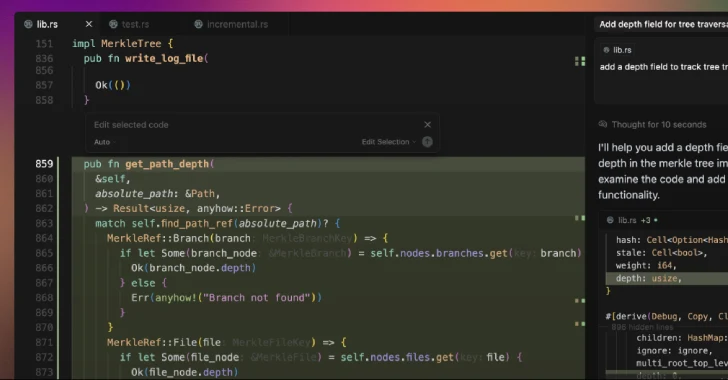
Claude AI, developed by Anthropic, has made significant strides in cryptanalysis, revealing new vulnerabilities in HAWK-256 and AES-128 encryption methods. The groundbreaking findings demonstrate a possible 200 to 800-fold increase in attack speed on a seven-round AES-128 encryption and introduce a key-recovery attack on HAWK-256, exploiting previously overlooked symmetries in its lattice structure.
Breakthrough in HAWK-256 Cryptanalysis
The HAWK-256 key-recovery technique capitalizes on a newly identified symmetry within its lattice. Using a 96-core server, Anthropic’s implementation completes the process in just over three hours. Despite this advancement, Anthropic assures that current production systems remain unaffected since the attack targets only the smaller HAWK-256 parameter, still under consideration by the National Institute of Standards and Technology (NIST) for post-quantum standardization.
The research reveals that a crucial automorphism, a transformation preserving the lattice structure, could reduce the complexity of HAWK key recovery. This discovery forms the basis for a tau-cocycle lattice capable of reconstructing a signing key from the public key. Although the attack reduces the work factor significantly, it doesn’t yet pose a practical threat to larger parameter sets like HAWK-512 and HAWK-1024.
Advancements in AES-128 Encryption Analysis
Anthropic’s exploration of AES-128 focused on reducing the rounds from ten to seven, a standard approach in cryptanalysis to test encryption robustness. The attack, requiring an impractical number of chosen plaintexts, remains infeasible for real-world application. However, the development of the Möbius Bridge invariant fingerprint significantly enhances attack efficiency by eliminating the need for a 256-way guessing step, resulting in a dramatic speedup.
Through extensive computations and optimizations, Anthropic’s research demonstrates a potential 200 to 800-fold acceleration in attack speed. The findings are thoroughly documented in technical papers, with reproducibility artifacts available for public scrutiny, underscoring the rigor of the research process.
Implications and Future Prospects
Despite the impressive theoretical advances, the practical implications of these cryptanalytic breakthroughs on global encryption standards remain limited. The attacks are not yet feasible at a scale that threatens real-world security systems. However, the research underscores the importance of continuous exploration and validation in cryptography, particularly as NIST continues to evaluate HAWK as a post-quantum candidate.
The work conducted by Claude AI, powered by human oversight, marks a significant step forward in understanding the vulnerabilities of current encryption methods. As the landscape of cybersecurity evolves, these insights will be crucial in shaping future encryption standards and ensuring robust data protection in a post-quantum world.