Jun 08, 2025Ravie LakshmananMalware / Browser Safety
Cybersecurity researchers have make clear a brand new marketing campaign focusing on Brazilian customers for the reason that begin of 2025 to contaminate customers with a malicious extension for Chromium-based net browsers and siphon consumer authentication knowledge.
“A number of the phishing emails had been despatched from the servers of compromised firms, growing the possibilities of a profitable assault,” Optimistic Applied sciences safety researcher Klimentiy Galkin stated in a report. “The attackers used a malicious extension for Google Chrome, Microsoft Edge, and Courageous browsers, in addition to Mesh Agent and PDQ Join Agent.”
The Russian cybersecurity firm, which is monitoring the exercise beneath the identify Operation Phantom Enigma, stated the malicious extension was downloaded 722 instances from throughout Brazil, Colombia, the Czech Republic, Mexico, Russia, and Vietnam, amongst others. As many as 70 distinctive sufferer firms have been recognized. Some points of the marketing campaign had been disclosed in early April by a researcher who goes by the alias @johnk3r on X.
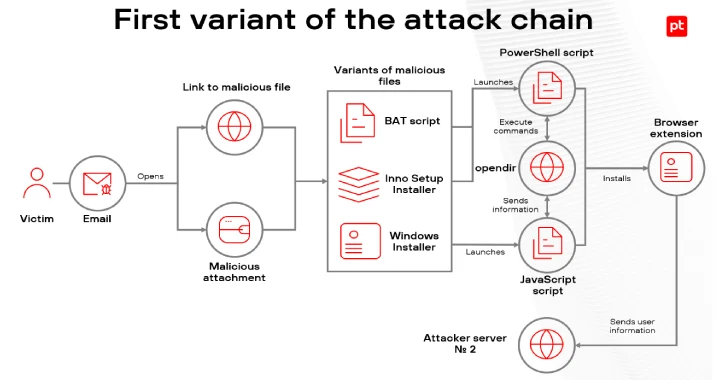
The assault begins with phishing emails disguised as invoices that set off a multi-stage course of to deploy the browser extension. The messages encourage recipients to obtain a file from an embedded hyperlink or open a malicious attachment contained inside an archive.
Current throughout the information is a batch script that is accountable for downloading and launching a PowerShell script, which, in flip, performs a sequence of checks to find out if it is working in a virtualized setting and the presence of a software program named Diebold Warsaw.
Developed by GAS Tecnologia, Warsaw is a safety plugin that is used to safe banking and e-commerce transactions by means of the Web and cell units in Brazil. It is price noting that Latin American banking trojans like Casbaneiro have integrated related options, as disclosed by ESET in October 2019.
The PowerShell script can also be engineered to disable Consumer Account Management (UAC), arrange persistence by configuring the aforementioned batch script to be launched routinely upon system reboot, and set up a reference to a distant server to await additional instructions.
The record of supported instructions is as follows –
PING – Ship a heartbeat message to the server by sending “PONG” in response
DISCONNECT – Cease the present script course of on the sufferer’s system
REMOVEKL – Uninstall the script
CHECAEXT – Examine the Home windows Registry for the presence of a malicious browser extension, sending OKEXT if it exists, or NOEXT, if the extension is just not discovered
START_SCREEN – Set up the extension within the browser by modifying the ExtensionInstallForcelist coverage, which specifies an inventory of apps and extensions that may be put in with out consumer interplay
The detected extensions (identifiers nplfchpahihleeejpjmodggckakhglee, ckkjdiimhlanonhceggkfjlmjnenpmfm, and lkpiodmpjdhhhkdhdbnncigggodgdfli) have already been faraway from the Chrome Net Retailer.
Different assault chains swap the preliminary batch script for Home windows Installer and Inno Setup installer information which might be utilized to ship the extensions. The add-on, per Optimistic Applied sciences, is supplied to execute malicious JavaScript code when the energetic browser tab corresponds to an online web page related to Banco do Brasil.
Particularly, it sends the consumer’s authentication token and a request to the attackers’ server to obtain instructions to doubtless show a loading display screen to the sufferer (WARTEN or SCHLIEBEN_WARTEN) or serve a malicious QR code on the financial institution’s net web page (CODE_ZUM_LESEN). The presence of German phrases for the instructions might both allude to the attacker’s location or that the supply code was repurposed from elsewhere.
In what seems to be an effort to maximise the variety of potential victims, the unknown operators have discovered to leverage invoice-related lures to distribute installer information and deploy distant entry software program akin to MeshCentral Agent or PDQ Join Agent as a substitute of a malicious browser extension.
Optimistic Applied sciences stated it additionally recognized an open listing belonging to the attacker’s auxiliary scripts containing hyperlinks with parameters that included the EnigmaCyberSecurity identifier (“<victim-domain>/about.php?key=EnigmaCyberSecurity”).
“The research highlights the usage of moderately distinctive methods in Latin America, together with a malicious browser extension and distribution through Home windows Installer and Inno Setup installers,” Galkin stated.
“Recordsdata within the attackers’ open listing point out that infecting firms was mandatory for discreetly distributing emails on their behalf. Nevertheless, the principle focus of the assaults remained on common Brazilian customers. The attackers’ objective is to steal authentication knowledge from the victims’ financial institution accounts.”
Discovered this text fascinating? Comply with us on Twitter and LinkedIn to learn extra unique content material we publish.