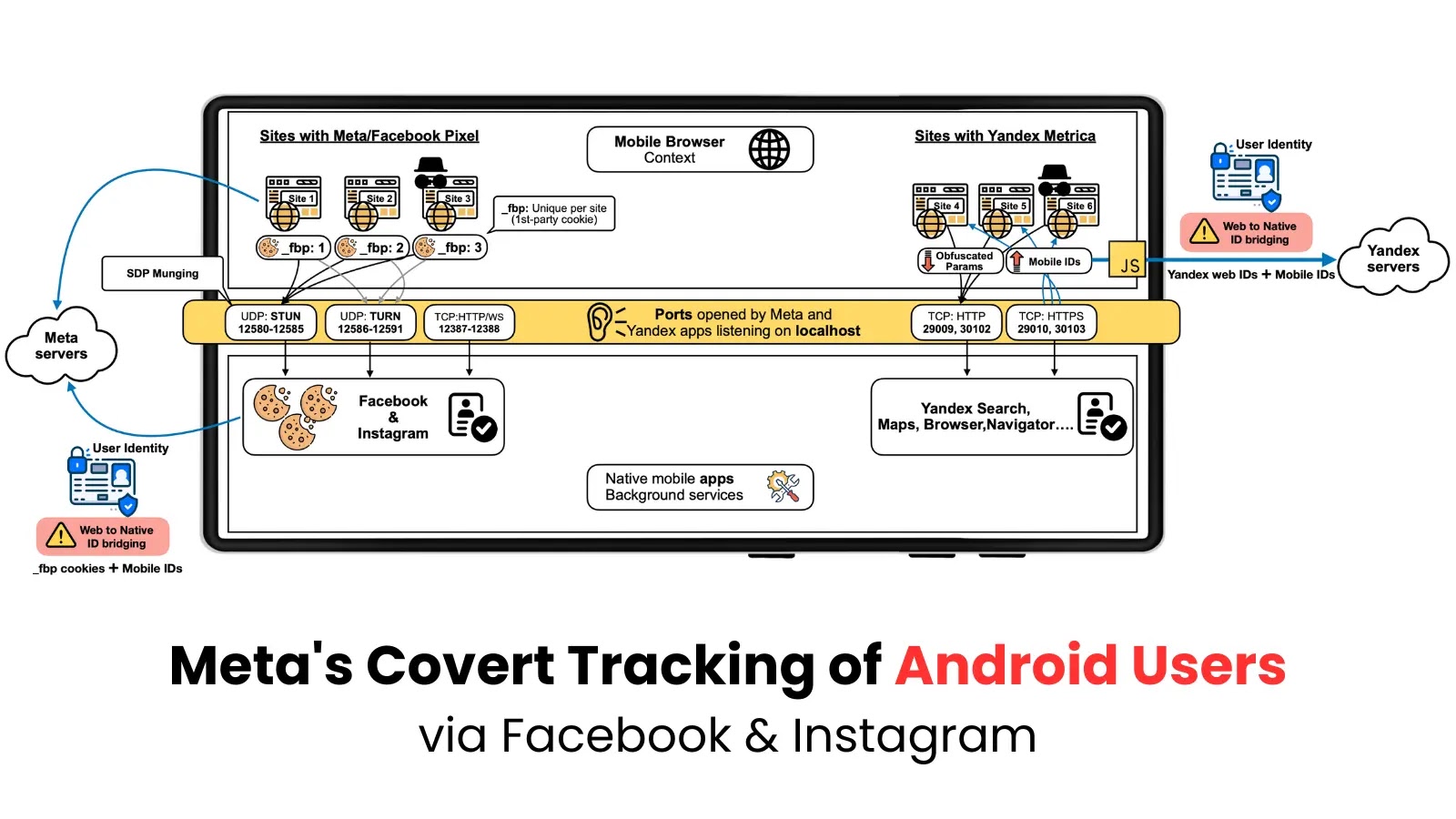
A complicated monitoring technique employed by Meta (Fb) and Yandex that probably affected billions of Android customers via covert web-to-app communications by way of localhost sockets.
The method allowed native Android apps, together with Fb and Instagram, to silently obtain browser metadata, cookies, and instructions from Meta Pixel scripts embedded on 1000’s of internet sites, successfully linking cellular looking classes to consumer identities and bypassing commonplace privateness protections.
Implementation Through WebRTC and Port Manipulation
GitHub stories that the monitoring mechanism exploited Android’s unrestricted entry to localhost sockets, with Meta’s method evolving via a number of technical iterations.
Initially utilizing HTTP requests in September 2024, Meta’s system progressed to WebSocket communications earlier than selecting WebRTC STUN with SDP Munging by November 2024.
The Meta Pixel JavaScript transmitted the first-party _fbp cookie utilizing WebRTC to UDP ports 12580–12585, the place Fb and Instagram apps maintained persistent listeners.
The technical implementation concerned SDP Munging, the place Meta inserted the _fbp cookie contents into the SDP “ice-ufrag” area, producing Binding Request STUN messages despatched to the loopback deal with 127.0.0.1.
This information circulate remained invisible to straightforward browser debugging instruments like Chrome’s DevTools, making detection difficult for customers and safety researchers.
By Might 2025, Meta launched WebRTC TURN communications to ports 12586-12591, avoiding SDP Munging after Chrome builders introduced plans to disable the method.
The monitoring technique demonstrated unprecedented scope, with Meta Pixel embedded on over 5.8 million web sites based on BuiltWith, making the _fbp cookie the third most typical first-party cookie throughout the net.
Analysis crawls of the highest 100,000 web sites revealed Meta Pixel trying localhost communications on 17,223 websites within the US and 15,677 websites within the EU, with roughly 75-78% of those websites triggering the habits with out express consumer consent.
The system successfully circumvented established privateness protections, together with cookie clearing, Incognito Mode, and Android’s permission controls.
Even customers not logged into Fb or Instagram on their cellular browsers remained susceptible to monitoring via the Android Promoting ID (AAID) bridging mechanism.
The tactic labored by linking ephemeral net identifiers to persistent cellular app IDs, permitting Meta to affiliate completely different _fbp cookies throughout web sites with the identical consumer account.
Mitigation Efforts
Following accountable disclosure to main browser distributors, a number of countermeasures entered growth and deployment.
Chrome model 137, launched Might 26, 2025, carried out protections blocking abused ports and disabling the precise SDP munging methods utilized by Meta Pixel.
Firefox model 139 included related port-blocking countermeasures, whereas DuckDuckGo and Courageous browsers already maintained blocklist-based protections in opposition to localhost communications.
Considerably, Meta discontinued the follow round June 3, 2025, with the Fb Pixel script not sending packets to localhost and the accountable code being virtually fully eliminated. Yandex equally ceased its localhost-based monitoring operations following the disclosure.
The revelation prompted broader discussions about platform sandboxing limitations and the necessity for enhanced Android interprocess communication safety, notably concerning localhost connections that allow cross-application information sharing with out consumer consciousness or consent.
Searching for AI-Powered Nex-Gen malware safety? – Obtain Malware Safety Plus for Free