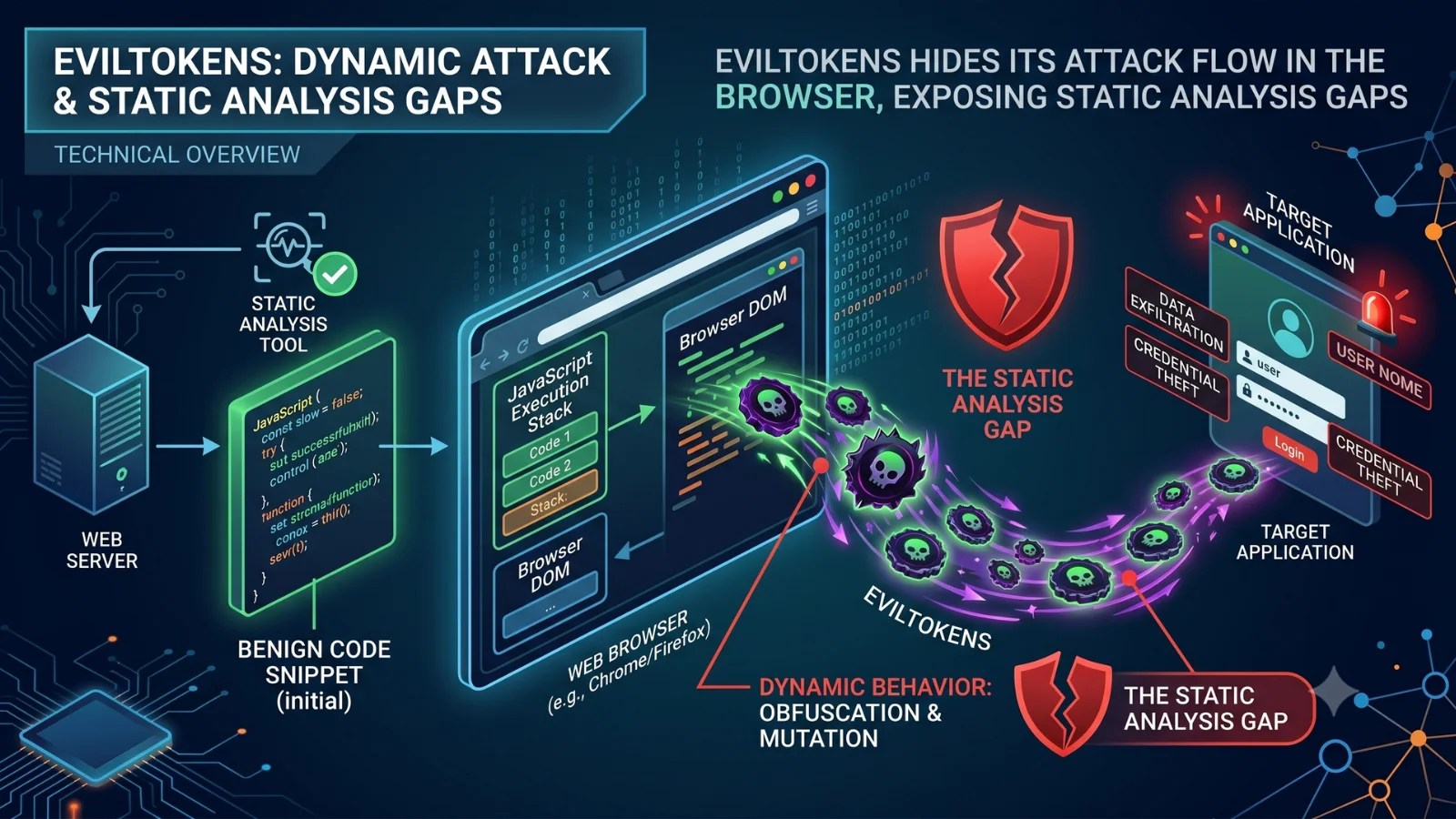
EvilTokens is at the forefront of phishing investigations, exploiting Microsoft Device Code authentication to mask key components of its attack strategy from static URL analysis. This sophisticated tactic underscores the need for enhanced browser-level visibility to effectively detect and respond to dynamic phishing behavior.
Understanding EvilTokens’ Concealment Techniques
Device-code phishing campaigns orchestrated by EvilTokens have been linked to security breaches in numerous organizations. The primary concern isn’t just the phishing toolkit itself but the investigative blind spots it creates. When analysts examine a suspicious URL, they may see minimal evidence of malicious activity, despite the phishing workflow being actively concealed.
This obfuscation arises because the phishing page remains hidden in the server’s initial response. EvilTokens delivers an encrypted payload, decrypted only when browser-side JavaScript is executed. As a result, the phishing content, including a Microsoft-branded authentication page, materializes in the DOM, misleading unsuspecting victims.
The Importance of Browser-Level Visibility
The reliance on dynamic browser actions by phishing kits like EvilTokens presents a significant challenge for analysts. Static URL analysis typically reveals page source and network requests but misses the content that emerges post-execution. This visibility gap can lead to slower phishing triage, delayed confirmation of risks, more manual intervention, and missed indicators of compromise (IOCs).
Utilizing ANY.RUN’s sandbox environment offers a comprehensive view of the EvilTokens attack process. Analysts can access a unified investigation interface, examining page alterations, infrastructure data, and browser-generated requests. This consolidation enables more efficient triage and response decisions, as all necessary evidence is readily available.
Enhancing Threat Detection Through Comprehensive Analysis
Beyond identifying the phishing flow, analysts can leverage ANY.RUN Threat Intelligence to determine if the activity is part of a larger campaign. In this specific case, EvilTokens activity is predominantly linked to the U.S. and Europe, identified through triggered Microsoft OAuth device-code phishing signatures.
The Indicators tab aids in discerning which artifacts are valuable for detection. While broad infrastructure indicators like CloudflareNet IPs might be too generic, specific domains, URIs, or hashes offer stronger candidates for hunting and rule creation. This ensures more accurate threat detection and response strategies.
As phishing strategies increasingly rely on browser-side executions, it is crucial for analysts to swiftly uncover hidden content, validate malicious activities, and gather evidence for prompt responses. EvilTokens exemplifies how critical artifacts can remain unseen until browser execution, causing delays in triage and investigation.
By integrating browser activity, infrastructure details, HTTP requests, and indicators into a streamlined workflow, ANY.RUN aids analysts in reconstructing attacks more efficiently, enabling quicker, more confident decision-making. Organizations utilizing ANY.RUN report mean time to detect (MTTD) as low as 15 seconds, with a corresponding mean time to respond (MTTR) reduced by up to 21 minutes per case, significantly enhancing their overall response time.