The Rust programming ecosystem recently faced a significant security breach as two widely used packages, arrayref and append-only-vec, were compromised to deliver malware. This incident, affecting over 244 million downloads, marks one of the largest Rust crate compromises by volume.
Discovery of the Breach
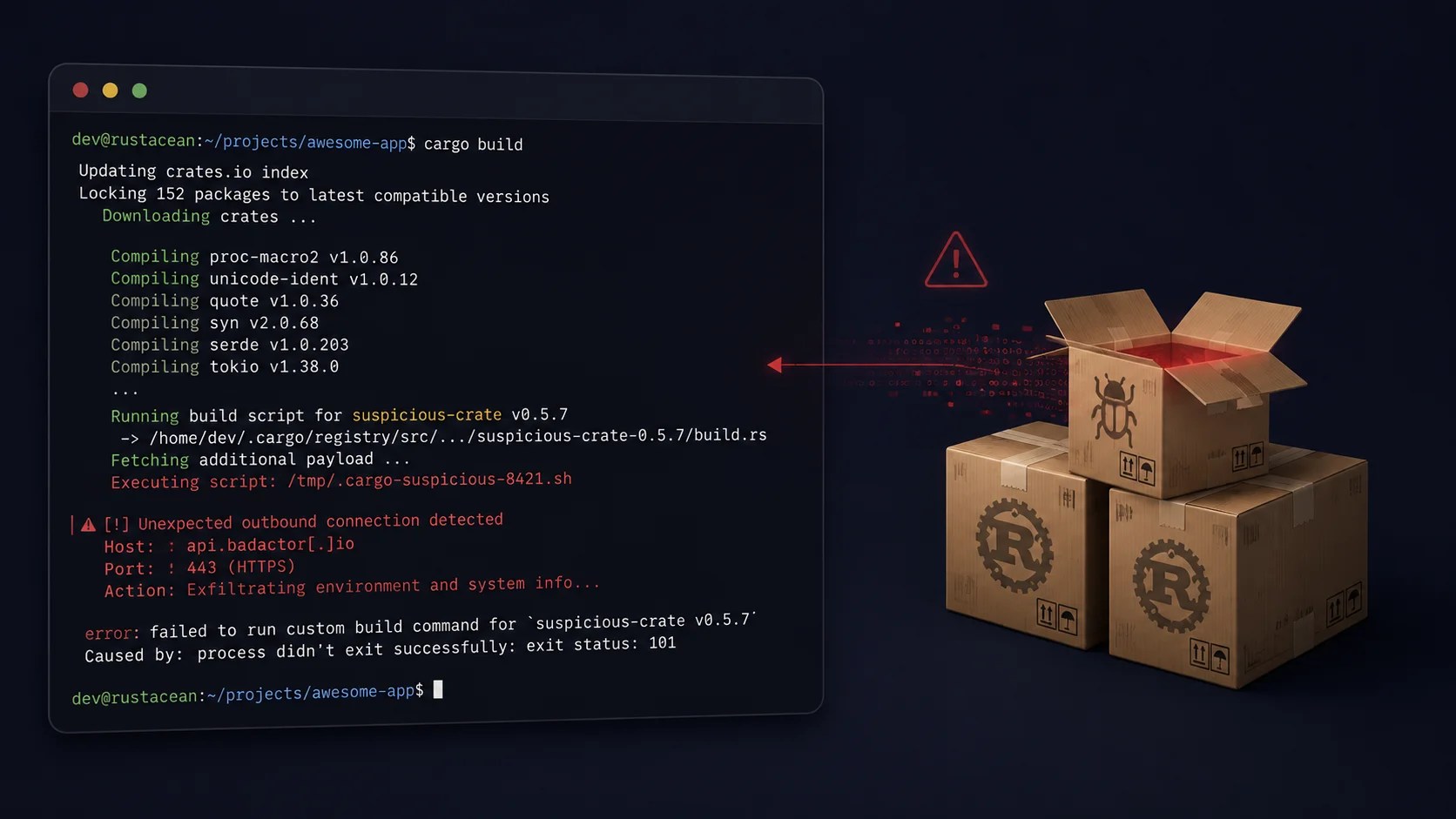
Security experts at Aikido Security first noticed a new suspicious package, proc-macro1, which was secretly downloading and executing a remote file during its build process. This package was a typosquat of the legitimate proc-macro2, designed to deceive developers by mimicking its documentation and description.
Within an hour of its appearance, arrayref and append-only-vec added proc-macro1 as a dependency. This shift turned an isolated incident into a widespread supply chain attack.
Technical Details of the Attack
The compromise was subtly embedded within the manifest files of the affected crates, pointing to proc-macro1 version 1.0.107. Notably, the primary source code for arrayref and append-only-vec remained unchanged, allowing the malware to go unnoticed during manual code reviews.
The malicious activity was hidden within the build.rs script of proc-macro1, automatically compiled by Cargo during builds. This tactic meant developers did not need to directly use the compromised crates for their systems to be infected.
Once triggered, the build script downloaded a system-specific binary for Linux, Windows, or macOS from a remote server. On Unix and macOS, the malware executed as a background process, continuing to run post-build, as reported by Aikido Security.
Impact and Response
Analysis of the malware revealed its capability to steal credentials from Chromium-based browsers and extract data from cryptocurrency wallet extensions. Additionally, it maintained persistence on macOS systems through a LaunchAgent for continuous operation.
The Rust Security Response Team, alerted by Nextron Systems, confirmed the malicious script and swiftly removed proc-macro1 and related packages. They also locked the compromised maintainer’s account, Andrew Gallant, a victim of credential theft.
The attack, spanning just two hours on August 20, 2026, prompted teams using Rust during this period to scrutinize their CI pipelines and build caches for potential compromise.
Preventive Measures and Future Outlook
To safeguard against similar incidents, developers should pin arrayref below version 0.3.10, audit build logs, and enable two-factor authentication on crates.io. Rigorous patch management can help secure automated pipelines from rogue dependencies.
This incident highlights the inherent vulnerability within package ecosystems, where build-time scripts can execute arbitrary code with full privileges. Ensuring dependency trust is as crucial as thorough source code reviews to prevent such security breaches in the future.