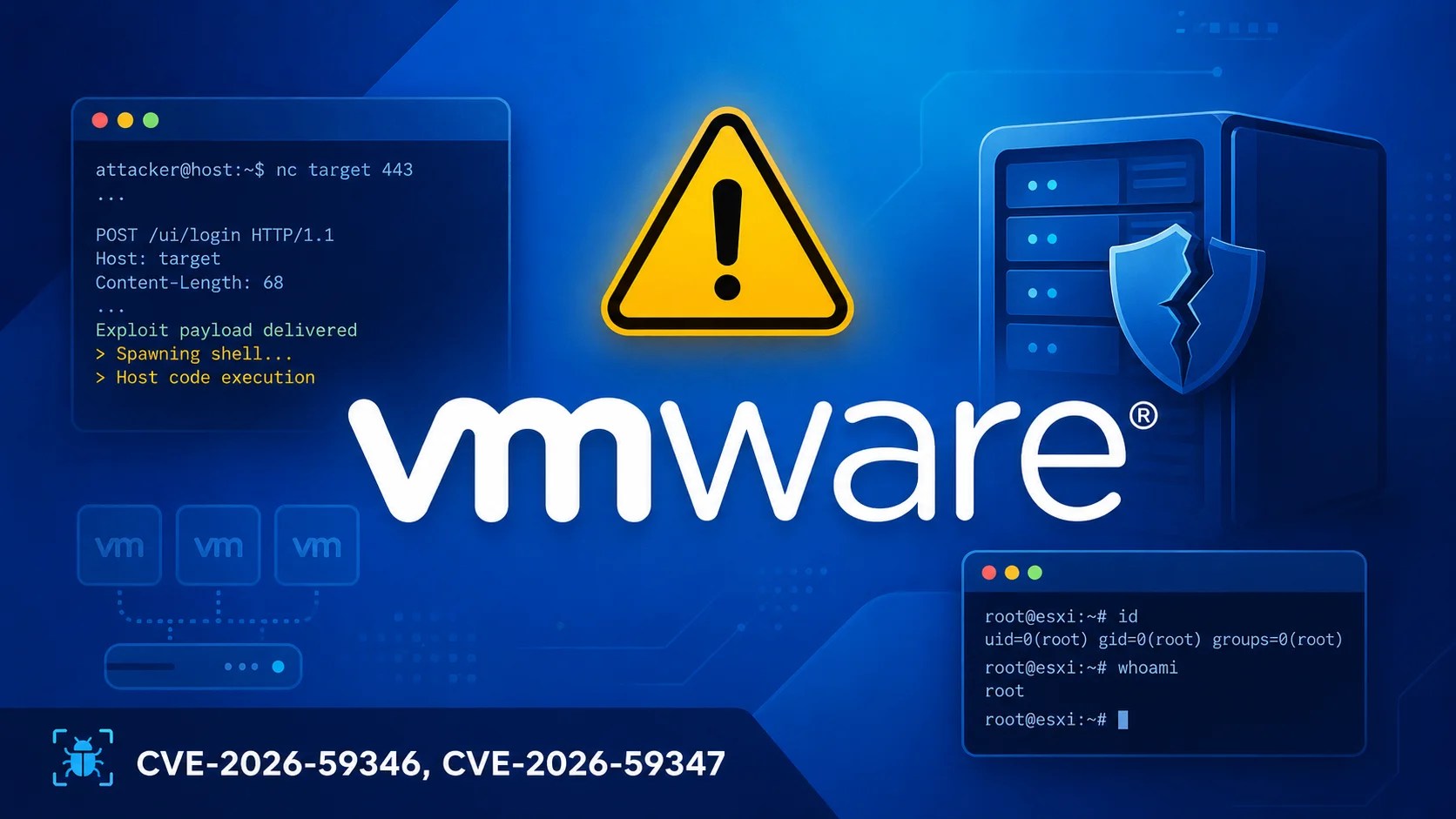
Broadcom has issued a crucial security advisory concerning two recently identified vulnerabilities in VMware Workstation and Fusion. These flaws pose a significant risk as they enable attackers to escape from a virtual machine (VM) and execute malicious code on the underlying host system. This development challenges the fundamental security assurances provided by virtualization technology.
Details of the Security Flaws
The advisory, labeled VMSA-2026-0007 and released on September 3, 2026, highlights two vulnerabilities affecting VMware’s desktop virtualization solutions. The more critical of the two, CVE-2026-59346, involves an integer-overflow issue in the VMXNET3 network adapter. This flaw has been assigned a CVSSv3 score of 9.3, indicating its critical severity.
As outlined in the advisory, an attacker with local administrative rights on a VM that uses a VMXNET3 adapter can exploit this flaw to run code on the host machine. This allows the attacker to breach the VM’s sandboxed environment.
Understanding the Second Vulnerability
The second vulnerability, CVE-2026-59347, is a stack-based buffer overflow in the Host-Guest File System (HGFS), which manages shared folders between a VM and the host. This flaw has a CVSSv3 score of 8.1 and is considered important rather than critical. Exploiting it enables an attacker with administrative access within a guest VM to execute code as the VMX process on the host, thus gaining unauthorized access to host-level operations.
These vulnerabilities were reported to Broadcom by independent research teams, rather than being identified through public exploitation. CVE-2026-59346 was reported by h4urek of secsys lab and researchers Y² and Stan S through Trend Micro’s Zero Day Initiative. CVE-2026-59347 was reported by Yeonghyeon Choi and Tianchu Chen from Tencent’s Xuanwu Lab.
Impact and Mitigation Measures
The vulnerabilities impact VMware Workstation versions 25H2 and 26H1 on any host OS, and VMware Fusion versions 25H2 and 26H1 on macOS. Broadcom has released version 26H1u1 to address these flaws. Notably, no workarounds are available, making the patch essential for protection.
Given that these vulnerabilities only necessitate local administrative rights within a guest VM to compromise the host, it is imperative for security teams using VMware Workstation or Fusion in testing or malware-analysis environments to prioritize this update.
Virtualization platforms are integral for isolating untrusted code, and a breach of this nature could allow attackers to move from a contained environment into production systems. Administrators should immediately upgrade to version 26H1u1 and review which VMs utilize VMXNET3 adapters or shared folder functionalities.
In conclusion, ensuring timely updates is critical to mitigate risks associated with these vulnerabilities and maintain the integrity of virtualization infrastructure.