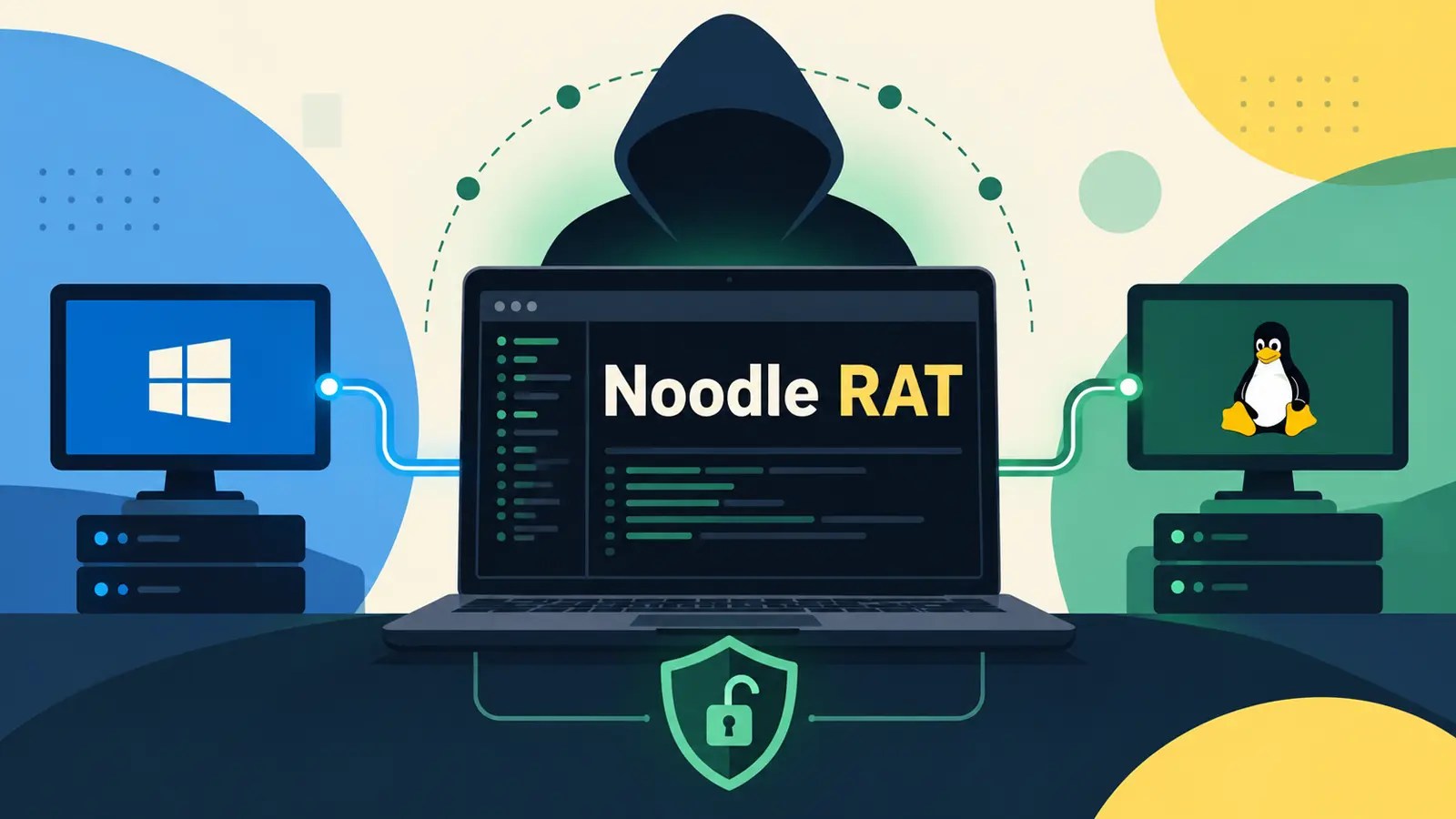
The emergence of Noodle RAT as a significant cyber threat is causing concern among cybersecurity experts. This remote-access trojan (RAT) grants attackers control over compromised systems, targeting both Windows and Linux environments. Its ability to operate cross-platform has increased its reach across corporate networks, making it a formidable tool for cybercriminals.
Impact Across Asia-Pacific
Noodle RAT has been observed in attacks on organizations throughout the Asia-Pacific region, including countries such as Thailand, India, Japan, Malaysia, and Taiwan. Hackers use this malware to steal files, execute commands, and reroute traffic through victim systems, transforming initial breaches into larger network threats.
According to Check Point analysts, Noodle RAT is a distinct malware family and not merely a variant of Gh0st RAT or Rekoobe. Known as ANGRYREBEL and Nood RAT, it has been associated with Chinese-speaking threat actors since mid-2016. This association suggests its deployment by both state-aligned groups and financially motivated criminals.
Technical Functionality and Encryption
Noodle RAT utilizes different techniques across operating systems but maintains a unified command-and-control structure. On Windows, it functions as a modular backdoor, executing in memory via shellcode, with loaders like MULTIDROP and MICROLOAD facilitating its stealth. Capable of uploading and downloading files, it acts as a TCP proxy, and can self-delete to avoid detection.
Conversely, on Linux, Noodle RAT emphasizes server-side access, enabling attackers to open reverse shells, manage files, and create SOCKS tunnels. These actions often follow exploitation or web-shell deployment on exposed servers. Both variants employ sophisticated encryption methods—RC4, XOR, and custom encryption on Windows, and HMAC-SHA1 and AES-128-CBC on Linux—making detection more challenging.
Defensive Strategies and Recommendations
The widespread deployment of Noodle RAT by groups like Iron Tiger and Calypso APT highlights its appeal as a versatile tool in cyber attacks. Organizations are encouraged to patch exposed services promptly, enforce multifactor authentication, and monitor for unusual outbound connections to mitigate risks.
Security teams must also focus on correlating suspicious activities, such as abnormal proxy behavior or task scheduling, to identify potential Noodle RAT infections. Maintaining robust backups and segregating critical servers from user networks are essential steps in minimizing the impact of a compromise.
Ultimately, the Noodle RAT threat underlines the importance of consistent visibility across mixed operating systems. By analyzing endpoint and server telemetry alongside indicators of compromise, organizations can enhance their defensive measures and respond more swiftly to threats.